AC Gas Refill Cost in India 2026: R32, R410A & R22 Price List (Plus the Anti-Scam Guide)
Every summer across India, millions of homeowners hear the exact same sentence from visiting technicians: "Bhaiyya, gas khatam ho gaya hai, refill karna padega." Before you hand over ₹3,000 to ₹6,000, here is the unfiltered reality: your air conditioner never "consumes" gas like a car burns petrol. If your gas is low, your AC has an active physical leak.
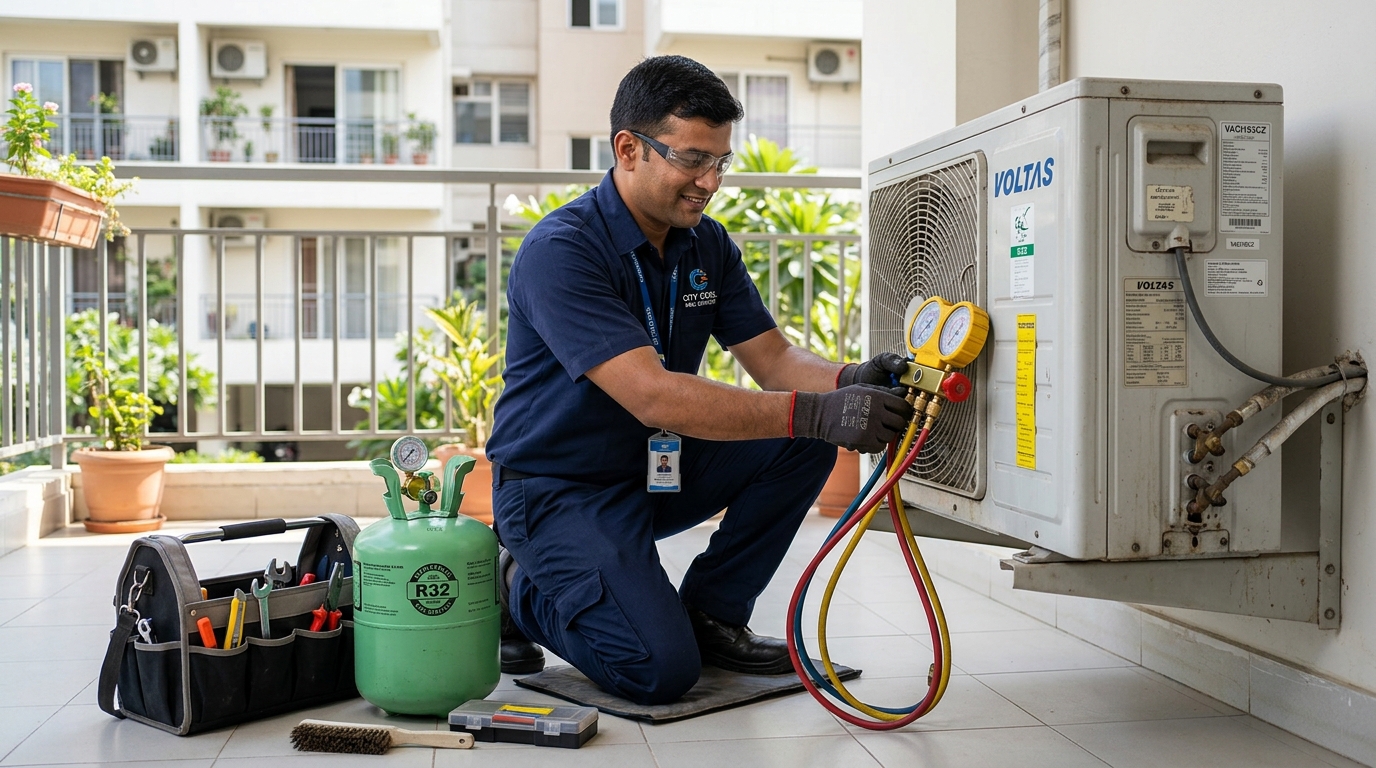
Whether you own an inverter split AC from Voltas, Daikin, LG, Blue Star, or Hitachi, dealing with an unexpected cooling failure when outside temperatures soar past 44°C is stressful. Unethical service personnel prey directly on that desperation. They spray a bit of water, glance at an unconnected gauge, declare zero gas, and charge arbitrary fees.
In this definitive guide, we break down true market prices for every common refrigerant in India for 2026, itemize every step of a legitimate gas charging procedure, reveal the top 5 scams technicians pull in Indian households, and provide a clear financial framework to decide whether to repair an old leaky unit or upgrade to a brand-new high-efficiency model.
The Closed Loop Reality: Why AC Gas Doesn't "Run Out"
To understand why you might be getting cheated, you first need to understand the basic thermodynamics of your air conditioner. Inside your split or window AC, the chemical refrigerant (commonly called "gas") cycles continuously through a closed hermetic circuit:
- The Compressor pumps low-pressure gas, compressing it into high-pressure, superheated vapor.
- The Condenser Coil (in the outdoor unit) rejects heat outside, condensing the hot vapor into high-pressure liquid.
- The Expansion Valve / Capillary Tube drops the liquid's pressure suddenly, causing its temperature to plummet.
- The Evaporator Coil (in your indoor unit) absorbs heat from your room air, causing the cold liquid refrigerant to boil back into a gas, cooling your room in the process.
- The low-pressure gas returns to the compressor, and the exact same cycle repeats thousands of times per season.
Notice anything missing? There is no exhaust pipe. There is no combustion chamber. Unlike the petrol in a scooter or the LPG in your cooking cylinder, refrigerant is not a consumable fuel. It undergoes only physical phase changes from liquid to gas and back again inside factory-brazed copper pipes.
Think of your kitchen refrigerator. It uses the exact same refrigeration cycle with R600a or R134a refrigerant. Have you ever called a technician to "refill gas" in your refrigerator after two years? Almost certainly not. Many Indian refrigerators run quietly for 15 to 20 years on their original factory charge.
The Golden Rule: If your air conditioner has low gas, it has a physical hole or loose joint. Simply pumping in new gas without finding and brazing that leak is like pouring water into a cracked bucket. That fresh ₹3,000 gas will quietly vent into the atmosphere within 2 to 6 weeks, leaving you right back where you started.
AC Gas Refill Cost in India (2026 Price List)
The total cost to recharge an air conditioner depends on three primary variables: the refrigerant type, the tonnage of your machine, and the scope of work required (simple joint tightening versus coil braze repair and nitrogen pressure testing).
Here is what you should expect to pay across India in 2026 for authentic refrigerant recharges:
| Refrigerant Type | AC Capacity | Typical Gas Weight | Gas Only Cost | Full Job (Leak Test + Vacuum + Gas) |
|---|---|---|---|---|
| R32 (Eco Inverter) | 1.0 Ton | 450g – 650g | ₹1,200 – ₹1,800 | ₹2,200 – ₹3,200 |
| R32 (Eco Inverter) | 1.5 Ton | 750g – 1,050g | ₹1,600 – ₹2,400 | ₹2,500 – ₹4,000 |
| R32 (Eco Inverter) | 2.0 Ton | 1,100g – 1,450g | ₹2,000 – ₹3,000 | ₹3,200 – ₹4,800 |
| R410A (Twin Blend) | 1.0 Ton | 600g – 850g | ₹1,500 – ₹2,200 | ₹2,600 – ₹3,800 |
| R410A (Twin Blend) | 1.5 Ton | 950g – 1,350g | ₹2,000 – ₹3,000 | ₹3,000 – ₹5,000 |
| R410A (Twin Blend) | 2.0 Ton | 1,400g – 1,850g | ₹2,800 – ₹4,000 | ₹4,000 – ₹6,000 |
| R22 (Legacy Gas) | 1.0 Ton | 700g – 950g | ₹2,500 – ₹3,500 | ₹3,500 – ₹5,000 |
| R22 (Legacy Gas) | 1.5 Ton | 1,000g – 1,400g | ₹3,200 – ₹4,800 | ₹4,000 – ₹7,000 |
| R22 (Legacy Gas) | 2.0 Ton | 1,500g – 2,100g | ₹4,200 – ₹6,000 | ₹5,500 – ₹8,500 |
Itemized Cost Breakdown: What You Are Actually Paying For
When a reputable technician issues an invoice for ₹3,500 to recharge your 1.5 Ton R32 split AC, that bill includes multiple physical materials and specialized labor. You should always insist on an itemized estimate. Here is how reasonable costs break down in Indian metro areas:
- Technician Visiting & Diagnostic Charge: ₹350 – ₹600 (waived or adjusted if you proceed with the major repair).
- Nitrogen Pressure Leak Testing: ₹500 – ₹900. The technician pressurizes the disconnected copper lines with Oxygen-Free Dry Nitrogen (OFDN) up to 300 PSI to pinpoint microscopic leaks using soap solution or an ultrasonic sniffer.
- Copper Brazing / Soldering: ₹400 – ₹800 per joint. Uses silver-copper brazing rods and an oxy-acetylene or portable MAPP gas torch to permanently seal the pinhole crack.
- Deep Vacuuming & Evacuation: ₹300 – ₹500. Using a motorized two-stage vacuum pump to drop internal pressure below 500 microns, boiling away any atmospheric moisture trapped inside.
- Refrigerant Charge by Weight: ₹1,200 – ₹1,800 for 800g to 1kg of genuine R32 gas from sealed disposable or refillable cylinders (brands like Floron, SRF, Honeywell, or Chemours).
- Flare Nut Replacement / Copper Flaring: ₹200 – ₹400 if brass flare nuts cracked from overtightening.
Who Should You Call? Authorized Service vs Aggregators vs Local Mechanics
Where you source your repair dramatically impacts both the price and the longevity of the fix:
| Service Provider Type | Typical 1.5T R32 Package | Warranty on Gas / Leak | Pros & Cons |
|---|---|---|---|
| Brand Authorized (LG, Daikin, Voltas) | ₹3,500 – ₹5,000 | 30 – 90 Days official written warranty | Highest price, but guaranteed genuine virgin refrigerant, factory-spec nitrogen pressure testing, and accountability. |
| Platform Aggregators (Urban Company) | ₹2,800 – ₹3,800 | 30 – 60 Days app-backed warranty | Standardized upfront pricing on app, background-checked technicians, easy dispute escalation if gas leaks within 30 days. |
| Local Independent Mechanics | ₹1,800 – ₹2,800 | Verbal promise (0 – 7 days practically) | Cheapest upfront option, but high risk of adulterated/reclaimed gas, skipped vacuuming, and refusal to return if gas leaks again. |
City-Wise AC Gas Refill Costs Across India (2026)
AC repair costs vary noticeably across Indian geographic zones. Coastal metros with humid, salt-heavy ocean air experience severe corrosion rates, leading to rampant condenser leaks. In contrast, inland northern cities experience scorching peak summer heatwaves reaching 46°C to 48°C, which triggers severe supply bottlenecks and surge pricing among technicians in May and June.
| City / Region | 1.5T R32 Average | 1.5T R410A Average | Old R22 Average | Primary Local Failure Mode |
|---|---|---|---|---|
| Delhi NCR (Noida, Gurgaon) | ₹2,800 – ₹4,200 | ₹3,400 – ₹5,200 | ₹4,500 – ₹7,500 | Peak summer heat (46°C+) causes extreme head pressure; flare nut stress fractures. High demand surge in May-June. |
| Mumbai & MMR (Thane, Navi Mumbai) | ₹2,600 – ₹3,800 | ₹3,200 – ₹4,800 | ₹4,200 – ₹6,800 | Salt aerosol corrosion from Arabian Sea attacks outdoor U-bends. Formicary corrosion near open drains. |
| Bengaluru | ₹2,700 – ₹3,900 | ₹3,200 – ₹4,600 | ₹4,000 – ₹6,500 | Moderate climate, but high labor charges and tech platform rates. Leaks mainly due to poor initial installation. |
| Chennai | ₹2,500 – ₹3,700 | ₹3,000 – ₹4,500 | ₹4,000 – ₹6,200 | Corrosive coastal humidity; frequent evaporator coil pitting. Requires anti-corrosive epoxy coat post-braze. |
| Hyderabad | ₹2,600 – ₹3,800 | ₹3,100 – ₹4,700 | ₹4,200 – ₹6,800 | Dry intense summer heat waves. Compressor overheating combined with partial gas starvation. |
| Kolkata | ₹2,400 – ₹3,500 | ₹2,900 – ₹4,400 | ₹3,800 – ₹6,000 | High ambient humidity and industrial pollutants accelerate coil fin degradation and microscopic leaks. |
| Pune | ₹2,500 – ₹3,600 | ₹3,000 – ₹4,500 | ₹4,000 – ₹6,400 | High adoption of inverter ACs. Moderate service costs; seasonal demand surges in April-May. |
| Ahmedabad & Surat | ₹2,700 – ₹4,000 | ₹3,300 – ₹4,900 | ₹4,400 – ₹7,200 | Prolonged 45°C+ summer weather pushes head pressure; high rate of compressor thermal overload trips. |
Understanding AC Refrigerants: R32 vs R410A vs R22
The chemical stamped on your outdoor unit's metal data plate dictates not just the price of your refill, but also whether a simple top-up is even physically possible. Let's look at the three gases found in Indian homes:
1. R32 (Difluoromethane, CH₂F₂) — The Modern Standard
R32 is the dominant refrigerant in virtually all modern 3-star and 5-star inverter ACs sold in India since 2020 by Daikin, LG, Voltas, Panasonic, and Blue Star.
- Eco-Friendly: Zero Ozone Depletion Potential (ODP = 0) and a Global Warming Potential (GWP) of 675, which is roughly one-third of R410A.
- Thermodynamic Superiority: R32 has a higher latent heat of vaporization. It transfers heat approximately 10% more efficiently than R410A and requires about 20% to 30% less physical charge by weight for the exact same cooling capacity.
- Single Component: Because it is a 100% pure chemical compound, it does not separate or fractionate when leaking.
- Safety Rating: Classified as A2L (mildly flammable). It poses zero risk in daily home use, but service technicians must use spark-free tools and pass nitrogen purge before brazing.
2. R410A (Puron) — The High-Pressure Blend
Popular between 2013 and 2021, R410A was the initial ozone-friendly replacement for old R22 models. It is still common in older non-inverter and early-generation inverter splits.
- Dual Compound Blend: R410A is a near-azeotropic mixture composed of 50% R32 and 50% R125 (Pentafluoroethane).
- The Fractional Leak Problem: Because it is a blend, when a leak occurs, R32 leaks out at a slightly different vapor rate than R125. This ruins the precise 50:50 chemical balance. You cannot simply top up a half-leaked R410A AC. The remaining gas must be safely recovered, the leak fixed, the system deep-vacuumed, and a fresh charge loaded as a liquid (cylinder inverted).
- High Operating Pressures: Operates at 1.6 times the pressure of R22 (suction pressure 120–140 PSI, discharge pressure exceeding 400 PSI).
- High GWP: Global Warming Potential is 2,088, leading Indian manufacturers to phase it out in favor of R32.
3. R22 (Chlorodifluoromethane, CHClF₂) — The Obsolete Fossil
If your AC was purchased before 2016–2018, it likely runs on R22.
- Ozone Destroyer: Contains chlorine molecules that deplete the stratospheric ozone layer. Under the Montreal Protocol and India's Ministry of Environment, Forest and Climate Change (MoEFCC) regulations, production and import of R22-based equipment were banned.
- Severe Price Escalation: With domestic production quotas dropping steeply year after year, virgin R22 is scarce. Refills now cost a staggering ₹4,000 to ₹7,000 for a 1.5 Ton unit.
- Moderate Pressure: Runs at lower suction pressures of 60 to 70 PSI using traditional mineral oil lubricant.
| Specification | R32 | R410A | R22 (Legacy) |
|---|---|---|---|
| Chemical Makeup | Pure Difluoromethane (100%) | 50% R32 + 50% R125 Blend | Pure Chlorodifluoromethane |
| Ozone Depletion (ODP) | 0.00 (Zero) | 0.00 (Zero) | 0.055 (Harmful) |
| Global Warming Potential (GWP) | 675 (Low) | 2,088 (Very High) | 1,810 (High) |
| ASHRAE Safety Class | A2L (Mildly Flammable) | A1 (Non-Flammable) | A1 (Non-Flammable) |
| Suction Pressure (Running) | 115 – 135 PSI | 120 – 140 PSI | 60 – 70 PSI |
| Top-up Allowed? | Yes (if leak fixed) | No (must full recharge) | Technically yes |
| Lubricant Oil Required | Synthetic POE Oil | Synthetic POE Oil | Mineral Oil |
| 2026 Refill Package (1.5T) | ₹2,500 – ₹4,000 | ₹3,000 – ₹5,000 | ₹4,000 – ₹7,000 |
6 Clear Signs Your AC Actually Has a Gas Leak
Before scheduling an expensive technician visit, make sure your cooling issue is genuinely refrigerant-related. An AC not cooling is frequently caused by filthy air filters, a choked blower wheel, or a dead ₹300 starting capacitor.
Here are the 6 unmistakable symptoms that confirm a loss of refrigerant:
1. The Delta-T Test Fails (Lukewarm Air from Louvers)
The simplest scientific test you can perform at home takes two minutes with an instant digital thermometer:
- Set your AC to 18°C in "Cool" mode with maximum fan speed.
- Let the compressor run continuously for 15 minutes.
- Measure the temperature of the air entering the top intake grille of the indoor unit (Room Return Air, e.g., 28°C).
- Measure the temperature of the cold air blowing directly out of the bottom swing louvers (Supply Air).
- Calculate the difference: Delta T = Return Temp − Supply Temp.
A healthy AC running on full gas produces a Delta T of 8°C to 12°C (e.g., 28°C intake yields 16°C–18°C vent output). If your Delta T is barely 2°C to 4°C despite clean filters and a buzzing outdoor compressor, you have a severe refrigerant deficit.
2. Frost or Solid Ice on Evaporator Coils or Thin Copper Pipe
This seems counterintuitive: why would an AC with less gas produce ice?
Under normal gas pressure, liquid refrigerant evaporates at approximately 2°C to 5°C inside the coils—cold enough to chill the air, but above freezing point. When gas leaks out, the internal suction pressure drops drastically. Under lower pressure, the boiling point of the remaining refrigerant drops below 0°C.
As room moisture contacts these sub-zero coils, it instantly freezes into frost. Eventually, a thick blanket of solid white ice encases the indoor coil and the thin outdoor copper pipe (the liquid line).
3. Outdoor Unit Fan Blows Cool or Lukewarm Air
Walk outside to your condenser unit while the AC is running. Put your hand in front of the large outdoor exhaust fan.
Your AC does not "create" cold; it extracts heat from your bedroom and dumps it outside. A properly functioning AC will blast noticeably hot air from the outdoor fan—usually 10°C to 15°C hotter than the ambient outdoor temperature (around 48°C to 52°C during an Indian summer afternoon). If that outdoor fan air feels room-temperature or cool, the refrigerant loop is devoid of gas and cannot carry heat outward.
4. The Compressor Runs Non-Stop Without Cutting Off
In a conventional non-inverter split AC, the thermostat should shut the compressor off once the room reaches the setpoint (say, 24°C). In an inverter AC, the Variable Speed Compressor will ramp down from 100% to 30% power once cruising temperature is established.
When gas is leaking, the room never hits the target temperature. The compressor remains locked at maximum RPM indefinitely, working furiously against zero cooling output.
5. Sudden Spike in Your Monthly Electricity Bill
Because the compressor runs at 100% capacity 24 hours a day without ever modulating down, your power consumption will skyrocket. A 1.5 Ton 5-star inverter AC that normally consumes 600–800 watts at cruising speed will continuously draw 1,400 to 1,700 watts. You end up paying an extra ₹1,500 to ₹3,000 on your monthly electricity bill for lukewarm air.
6. Hissing, Whistling, or Gurgling Sounds
A pinhole leak on an indoor copper U-bend often produces a distinct, faint hissing sound—like air leaking out of a bicycle valve. Similarly, starved expansion valves will gurgle or hiss as a foamy mixture of vapor and oil struggles through the capillary tube.
The "AC Gas Scam" Exposed: 5 Dirty Tricks Technicians Pull
The residential HVAC servicing market in India is largely unorganized. While honest technicians exist, the pre-summer service season brings hordes of seasonal contractors trained to maximize billings. Here are the five most common scams operating across Indian households:
Scam #1: The Annual "Gas Khatam" Lie
The technician arrives for a routine ₹499 pre-summer filter wash. After washing the unit, he claims: "Sir, the AC worked all last year, so the gas got consumed. You need a gas refill for this summer." As explained earlier, gas does not get consumed. Unless there is a physical puncture, the original factory charge lasts a decade or more. If an AC cooled fine last September and wasn't touched all winter, it doesn't suddenly lose gas while sitting switched off unless a leak formed.
Scam #2: The Deliberate Sabotage Leak
This is the dirtiest trick in the book. During a routine wet service, an unethical mechanic deliberately uses an adjustable spanner to slightly loosen the outdoor service valve flare nut, or presses the Schrader valve core with a screwdriver to release gas with a loud hiss. Some rogue mechanics even take a sharp scratch awl and puncture the hair-thin aluminum microchannel condenser fins. Once the gas hisses out, they turn around and present you with an emergency ₹4,000 quote.
Scam #3: The Rigged Manifold Gauge Bluff
The technician hooks a pressure gauge to the service port, flashes the dial at you, and says: "Look, the needle shows only 30 PSI! It should be 120 PSI. Gas is 75% empty." What he didn't tell you: he partially closed the manifold valve to throttle the line, or he is using an uncalibrated gauge whose resting zero needle was bent backward. Never accept a pressure reading from a technician who does not let the compressor run for at least 10 minutes first.
Scam #4: The 5-Minute "Top-Up" Without Leak Repair
The mechanic connects a small generic gas cylinder, opens the valve for 3 minutes, closes it, collects ₹2,500 cash, and leaves. He didn't find the leak. He didn't braze anything. He didn't pull a vacuum. Within three weeks, the fresh gas escapes through the unsealed hole. When you call him back, his phone is switched off.
Scam #5: The "Gas Percentage / Points" Pricing Con
Some technicians claim: "Bhaiyya, gas is charged at ₹30 per point. Your AC needs 70 points, so pay ₹2,100." There is no unit of measurement called "points" in HVAC engineering anywhere on Earth. Refrigerant is charged strictly in grams or kilograms weighed on an electronic digital scale.
The Homeowner's Anti-Scam Shield: 6 Golden Rules
- ✔Never leave a technician alone: Stand by the outdoor and indoor units during routine servicing. Sabotage happens when you step away into the kitchen.
- ✔Demand to see the physical leak: If a technician says gas has leaked, ask him to prove it. Make him apply soap water foam to the joints and show you the expanding bubbles, or point out the dark oily residue where refrigerant oil escaped.
- ✔Insist on Nitrogen pressure testing: A legitimate professional will pressurize the lines with dry nitrogen gas, not compressed atmospheric air (which introduces fatal moisture).
- ✔Insist on a Vacuum Pump: Never allow gas charging without at least 20 minutes of motorized vacuuming down to 500 microns. Charging gas into a moist, unvacuumed line destroys compressor oil and voids warranties.
- ✔Charge by Weight, Not Pressure: Check the outdoor unit label. If it says "R32 - 850g", ensure the technician places the cylinder on an electronic digital scale and charges exactly 850 grams.
- ✔Get a written 60-day warranty: Any technician who refuses to give at least a 30-to-60-day warranty on a gas recharge knows his leak repair won't hold.
How a Proper AC Gas Charging Process MUST Be Done (Step-by-Step)
If your AC genuinely has a leak and needs a recharge, you should know what a professional, factory-standard procedure looks like. A complete recharge takes between 60 and 90 minutes. Here is the exact 5-step protocol:
Step 1: Nitrogen Leak Testing (15–20 Mins)
The technician disconnects the system and hooks up a high-pressure cylinder of Oxygen-Free Dry Nitrogen (OFDN). He pressurizes the copper lines, indoor evaporator, and outdoor condenser to 250 to 350 PSI.
Next, he coats every flare connection, brass service valve, and copper U-bend with soap froth. Because nitrogen is under extreme pressure, even microscopic pinholes produce unmistakable frothy bubbles. Once the leak location is identified, the nitrogen is safely vented.
Step 2: Brazing & Joint Repair (15 Mins)
Using an oxy-acetylene or portable MAPP gas torch, the technician heats the copper pipe to a dull red glow (around 650°C to 700°C) and melts a silver-copper alloy brazing rod over the crack. For quality work, a tiny trickle of nitrogen should flow through the tube during brazing to prevent black copper-oxide scale from building up inside the pipe, which could later clog the expansion capillary.
Step 3: Deep Vacuuming / Evacuation (20–30 Mins)
This is where 80% of roadside mechanics cut corners. Atmospheric air contains humidity. If moisture mixes with modern synthetic Polyolester (POE) compressor oil, it forms aggressive hydrofluoric or hydrochloric acid, eating the compressor motor windings from the inside out.
A certified technician connects a dual-stage motorized vacuum pump to the low-side service valve and runs it until an electronic micron gauge reads below 500 microns. He then closes the manifold and observes the gauge for 10 minutes (a vacuum hold test). If the needle holds steady without rising, the system is 100% moisture-free and leak-tight.
Step 4: Weighing Refrigerant with a Digital Scale (10 Mins)
Every modern split AC has a metal specification plate affixed to the outdoor unit. For example:
- Model: LG TS-Q19YNZE (1.5T 5-Star) — Refrigerant: R32 — Factory Charge: 850 grams
- Model: Daikin FTKM50XV (1.5T 5-Star) — Refrigerant: R32 — Factory Charge: 950 grams
The technician places the refrigerant cylinder on an electronic digital scale, zeroes the display, purges the charging hose of air, opens the valve, and meters the exact required mass (e.g., 850g) into the vacuumed system. Gas charging should never be guessed by manifold pressure alone, because ambient summer temperatures alter suction pressure significantly.
Step 5: Operational Testing & Clamp Meter Verification (15 Mins)
Finally, the technician powers on the air conditioner, sets the thermostat to 18°C, and clamps a digital multimeter around the main live phase wire. He verifies that the compressor's running amperage matches the nameplate Full Load Amps (FLA), typically between 5.5A and 7.5A for a 1.5 Ton inverter AC. He checks that the suction pressure stabilizes around 120–135 PSI for R32, confirms a healthy Delta T of 9°C–11°C at the indoor vent, and tightens the brass valve caps with Teflon tape to prevent slow seal seepage.
Need Professional AC Tools or Charging Accessories?
Whether you are setting up your home workshop with an accurate digital vacuum gauge, R32 manifold gauges, or copper leak detection kits, explore verified gear on Amazon India.
🛒 Check Price on Amazon IndiaWhen to Refill Gas vs. When to Buy a New AC
Pouring ₹4,000 into an AC gas refill isn't always the smart move. If your machine is older or suffers from repeated coil corrosion, that ₹4,000 is often a down payment on another breakdown two months later.
Use two practical industry rules to make your decision:
- The 50% Rule: If the total quote for leak repair, coil replacement, and gas recharge exceeds 50% of the cost of a brand new AC, scrap the unit.
- The 7-Year Rule: If your AC is over 7 years old and uses R22 refrigerant or has an aluminum condenser coil with multiple pinhole leaks, replace it immediately.
The Aluminum Coil Trap
Many budget ACs sold in past years used aluminum condenser coils (often marketed as "alloy condenser"). While cheaper upfront, brazing aluminum requires specialized flux, low-temperature zinc-aluminum rods, and exceptional skill. Standard roadside brazing attempts on aluminum usually burn wide gaping holes in adjacent microchannel tubes. Even if patched, galvanic corrosion will trigger another leak nearby within 90 days.
If your AC has an aluminum coil that has sprung a leak, a full copper coil replacement costs ₹7,000 to ₹10,000. On a 5-to-7-year-old machine, you are far better off buying a modern, 100% copper 1.5 Ton 5-Star AC backed by a 10-year compressor warranty.
| Current AC Situation | Estimated Repair Bill | Annual Power Cost Impact | Clear Recommendation |
|---|---|---|---|
| 1–3 Year Old Inverter AC (R32, Copper Coil) | ₹2,500 – ₹3,500 (Leak braze + gas) | Highly efficient (ISEER 5.0+); saves ₹4,000+/yr | ✅ REPAIR IMMEDIATELY. Well worth preserving. |
| 4–6 Year Old 3-Star Inverter AC (R410A / R32) | ₹3,200 – ₹4,500 (Joint repair + full charge) | Decent efficiency (ISEER ~3.8); moderate bill | 🟡 REPAIR if first leak. Replace if 2nd or 3rd leak. |
| 7+ Year Old Non-Inverter AC (R22 Gas) | ₹5,000 – ₹7,500 (R22 gas + welding) | Terrible efficiency (EER ~2.8); eats ₹18,000/yr power | ❌ DO NOT REFILL. Replace with 5-star inverter. |
| Any AC with Leaking Aluminum Condenser | ₹7,000 – ₹10,000 (Copper coil retrofitting) | Depends on original star rating | ❌ DO NOT REPAIR. High risk of recurring leaks. |
How to Prevent AC Gas Leaks and Extend Coil Life
Gas leaks don't happen by accident. They stem from metal fatigue, poor installation, chemical corrosion, or mechanical abrasion. Here is how to keep your refrigerant locked tight inside your coils for 10+ years:
1. Insist on 100% Copper with Anti-Corrosive Coating
When buying your next air conditioner, make sure both the evaporator and condenser coils feature 100% inner-grooved copper tubes. Look for factory-applied anti-corrosion protective coatings:
- LG: Ocean Black Protection (anti-corrosive epoxy coat on coils).
- Daikin: Triple Display / Anti-Corrosion Treatment on outdoor heat exchanger fins.
- Blue Star: Blue Fin / Golden Hydrophilic coating.
- Panasonic: Shield Blu+ anti-corrosion technology designed for coastal salt environments.
2. Stop Acid Washing During Service
Local technicians love spraying foaming industrial coil cleaners (often containing diluted hydrochloric or hydrofluoric acid) because it makes oxidized aluminum fins look shiny and silver in seconds.
That acid dissolves the protective oxide layer and strips away factory epoxy coatings. Within two months of an aggressive acid wash, the paper-thin copper tubes develop formicary corrosion pinholes. Always insist on low-pressure water jet washing with mild, pH-neutral detergent solutions.
3. Install Anti-Vibration Rubber Pads
Compressor vibration travels directly into the rigid copper pipes connecting the outdoor unit to the service valves. Over 3 to 5 years, constant harmonic vibration causes work-hardening of the copper, resulting in microscopic hairline fatigue cracks right behind the brass flare nuts.
Placing heavy-duty rubber vibration dampening pads (costing ₹250 on Amazon) under the four mounting feet of the outdoor condenser bracket eliminates up to 80% of vibrational transmission.
4. Avoid Installing Outdoor Units Near Open Drains
In urban Indian cities like Delhi, Mumbai, and Kolkata, outdoor units mounted on ground floors near open municipal storm drains or sewer nullahs suffer extreme corrosion. The escaping hydrogen sulfide (H₂S) and ammonia gas react chemically with atmospheric moisture to form sulfuric acid, which eats through copper coils in under 24 months. If you must mount near a drain, invest in a professional polyurethane or epoxy anti-corrosion coil spray.
Frequently Asked Questions
How much does an AC gas refill cost in India in 2026?▼
Does an air conditioner naturally consume gas over time?▼
Can you top up AC gas instead of doing a full refill?▼
Why is R22 gas so expensive in India in 2026?▼
How do technicians scam customers regarding AC gas refill?▼
How long does a proper AC gas charging process take?▼
Is AC gas refill covered under brand warranty?▼
Can I replace R22 gas with R32 or R410A in my old air conditioner?▼
How do I know if the technician filled genuine refrigerant?▼
Does AC gas leakage cause health hazards indoors?▼
Related Troubleshooting & Buying Guides
Before spending hard-earned money on major AC repairs or choosing a brand new cooling system, explore our detailed research and real-world testing:
AC Not Cooling? →
Step-by-step DIY diagnostic checklist for Indian households before calling a technician.
Buying GuideBest 1.5 Ton ACs 2026 →
Top rated 5-star and 3-star split inverter ACs ranked by real-world ISEER efficiency and reliability.
Technology GuideInverter vs Non-Inverter →
Actual electricity savings math, compressor lifespan comparison, and payback period breakdown.
Interactive ToolAC Tonnage Calculator →
Calculate exact tonnage required based on room square footage, top floor heat load, and window orientation.
Energy SavingBest 5-Star Split ACs →
Maximum electricity savings with ISEER ratings up to 5.80 for heavy 8+ hours daily summer usage.
Repair GuideAC Water Leakage Fix →
Fix clogged condensate drain pipes, sloping issues, and frozen coil drippings without professional help.