3 Star vs 5 Star AC India — Which Saves More Money?
Walk into any Croma, Reliance Digital, or neighborhood electronics showroom in India, and the salesperson will immediately point you toward the most expensive 5-star inverter split AC on the floor. "Bhaiyya, 5-star le lijiye, bijli ka bill aadha ho jayega!" (Take the 5-star, your power bill will be cut in half!). But does a 5-star AC actually halve your electricity bill? Or are you shelling out an extra ₹10,000 to ₹12,000 upfront only to save a measly ₹150 a month?
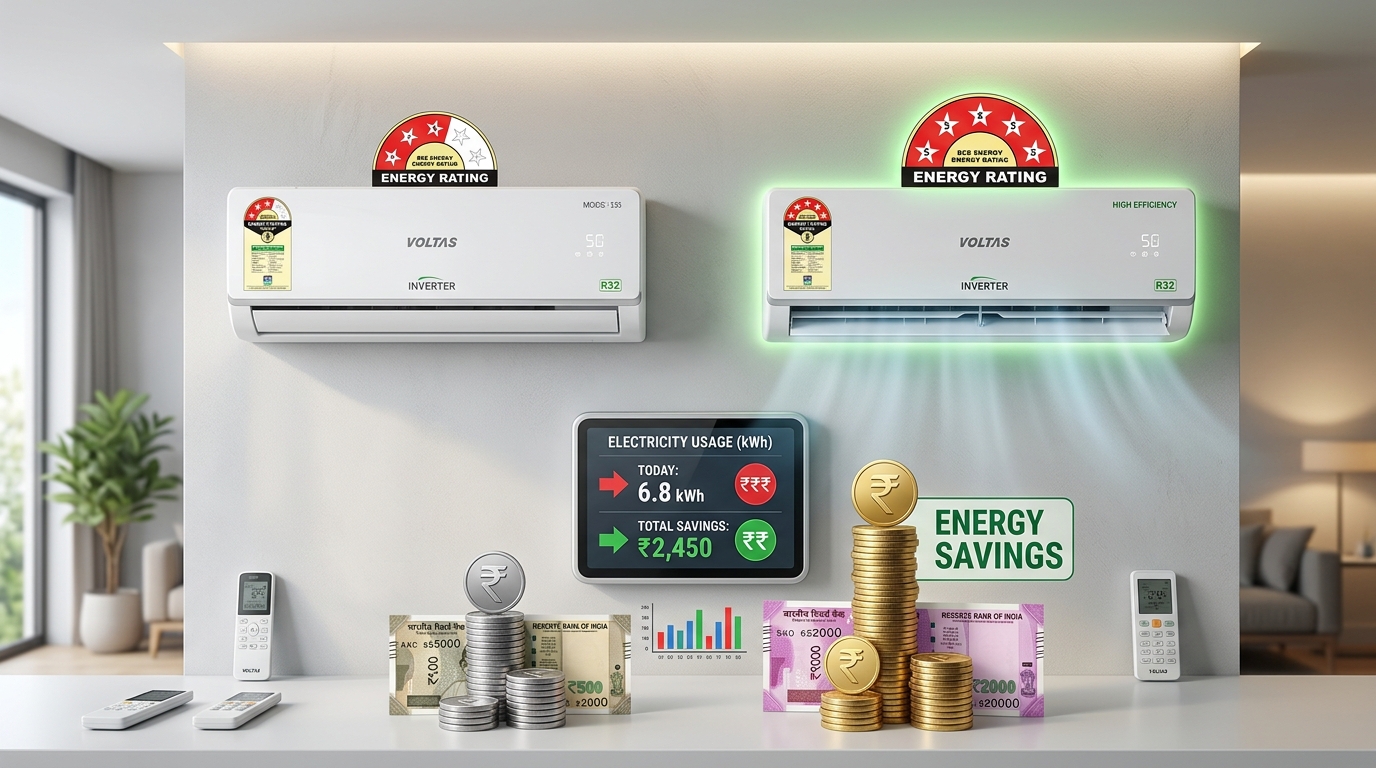
We decided to strip away the marketing hype and run the cold, hard numbers. Using standardized Bureau of Energy Efficiency (BEE) lab test data, real-world power consumption metrics from India's best-selling 1.5-ton inverter air conditioners, and average electricity tariffs across Indian cities (₹6 to ₹10 per unit), we calculated the exact 5-year total cost of ownership.
The result will surprise you: under standard usage, a 3-star AC and a 5-star AC cost almost the exact same amount of money over 5 years. In fact, for millions of Indian households living in rental apartments or using an AC for only 3 to 4 months a year, buying a 5-star AC is a guaranteed financial loss. For others running their air conditioner 12+ hours a day in brutal coastal humidity or north Indian heatwaves, a 5-star AC pays for itself in under 3 summers.
Here is how to calculate exactly which category wins for your home, your usage hours, and your monthly electric tariff in 2026.
- You use the AC less than 1,000 hours/year (under 5 hours/day for 6 months).
- You live in a rented home and might shift within 2–3 years.
- Installing in a guest room, dining hall, or study.
- You live in moderate summer zones like Bengaluru, Pune, or Nashik.
- You have a strict upfront budget capped under ₹35,000.
- You use the AC more than 1,500 hours/year (8–14 hours/day for 6+ months).
- You own your flat and plan to keep the machine for 7 to 10 years.
- Master bedroom AC running all night plus afternoon work-from-home shifts.
- Living in extreme heat/humidity zones (Delhi-NCR, Chennai, Mumbai, Hyderabad, Kolkata).
- Your electricity tariff is high (₹8 to ₹12 per unit).
What Do BEE Star Ratings Actually Mean in 2026?
Before we jump into the rupee calculations, let's clear up what that red and white BEE label on the front panel actually represents. The star rating is governed by the Bureau of Energy Efficiency (BEE) under India's Ministry of Power.
Since 2018, BEE evaluates all residential split and window air conditioners using the ISEER rating (Indian Seasonal Energy Efficiency Ratio). Unlike older EER standards that tested ACs at one single outdoor temperature (35°C), ISEER tests how well an inverter compressor ramps up and down across an entire spectrum of outdoor temperatures from 24°C all the way up to 43°C.
ISEER is calculated by dividing the total heat removed from the room over the cooling season (Cooling Seasonal Total Load, or CSTL in Watt-hours) by the total electricity consumed to do that work (Cooling Seasonal Energy Consumption, or CSEC in Watt-hours):
BEE Energy Efficiency Equation
ISEER = CSTL (Heat Removed) ÷ CSEC (Power Consumed)
Higher ISEER = Less units of power consumed for every ton of cooling delivered
The star rating is simply an easy visual bucket for this ISEER number. BEE tightens these brackets periodically to force manufacturers to build more efficient cooling systems. Here is the current 2026 ISEER band structure for residential Split Inverter ACs:
| BEE Star Rating | Required ISEER Range (2026) | Typical 1.5T Annual Units (BEE Label) | Efficiency Classification |
|---|---|---|---|
| ⭐ 1 Star | 3.30 – 3.49 | 1,250 – 1,350 kWh | Very Poor (Phasing out) |
| ⭐⭐ 2 Star | 3.50 – 3.79 | 1,150 – 1,240 kWh | Entry Level / Fleet Sales |
| ⭐⭐⭐ 3 Star | 3.80 – 4.39 | 1,020 – 1,150 kWh | Standard Sweet Spot (Mass Market) |
| ⭐⭐⭐⭐ 4 Star | 4.40 – 4.99 | 920 – 1,000 kWh | Rare (Brands jump straight to 5-Star) |
| ⭐⭐⭐⭐⭐ 5 Star | 5.00 – 5.80+ | 750 – 870 kWh | Maximum Energy Saver |
Notice how rare 4-star split ACs are in India. Almost no top manufacturer actively markets 4-star inverter models because the retail price sits awkwardly between the mass-volume 3-star price and the premium 5-star flagship tier. The genuine buying dilemma in 95% of consumer transactions is strictly 3-Star vs 5-Star.
Real Lab Data Benchmark: LG 3-Star vs LG 5-Star (1.5 Ton)
To make this comparison 100% realistic, let's avoid theoretical estimates and look at real, production-spec models from India's highest-volume AC brand: LG Electronics. Both are 1.5-ton split inverter units manufactured for the 2026 season with 100% copper condenser coils and R32 refrigerant.
LG 1.5 Ton 3 Star DUAL Inverter Split AC
Model: RS-Q19SWZD
- ISEER Rating:3.90
- Annual Units (BEE 1,600 hrs):1080 kWh / units
- Annual Power Cost (@ ₹8/unit):₹8,640
- Typical Street Price:₹33,000 – ₹35,000
- Key Features:Dual Inverter, 4-in-1 Modes, Basic Display
LG 1.5 Ton 5 Star AI DUAL Inverter Split AC
Model: TS-Q19YNZE / JS-Q18PWZD
- ISEER Rating:5.20
- Annual Units (BEE 1,600 hrs):836 kWh / units
- Annual Power Cost (@ ₹8/unit):₹6,688
- Typical Street Price:₹44,000 – ₹46,000
- Key Features:AI Dual Inverter, 6-in-1, Wi-Fi ThinQ, Auto-Clean
The Annual Power Savings Math
Let's look at the actual electricity gap between these two machines. The BEE label calculates annual consumption based on a standard 1,600 operating hours per year:
- LG 3-Star Annual Consumption: 1,080 kWh (units)
- LG 5-Star Annual Consumption: 836 kWh (units)
- Annual Units Saved: 1,080 − 836 = 244 kWh / year
- Annual Money Saved (@ ₹8/unit): 244 units × ₹8 = ₹1,952 per year
At standard BEE baseline usage, the 5-star AC saves you exactly ₹1,952 every year. That comes out to roughly ₹162 per month over a 12-month calendar year, or about ₹325 per month if you only run it across a 6-month summer cycle.
The Break-Even Formula
Now, let's compare that yearly savings against the upfront retail price difference:
- Average retail price of LG 3-Star: ₹33,000 to ₹34,000
- Average retail price of LG 5-Star: ₹44,000 to ₹45,000
- Upfront Price Premium for 5-Star: Approximately ₹10,000 to ₹11,000
The Payback Period Calculation:
Break-Even Period = Upfront Price Difference ÷ Annual Electricity Savings
₹10,000 ÷ ₹1,952 = 5.12 Years (~5 Years and 2 Months)
If the price premium is ₹11,000, your payback period stretches to 5.6 years. This means you have to run your 5-star AC for more than five full summers just to recover the extra cash you paid at the checkout counter!
The Massive 5-Year Total Cost Comparison Table
Most buyers only look at the purchase price tag or the monthly electric bill in isolation. What really matters is the Total Cost of Ownership (TCO): purchase price + electricity consumed over 5 years.
Here is how the numbers stack up side-by-side using the BEE 1,600-hour benchmark at an average Indian urban electricity rate of ₹8 per unit:
| Cost Component | 1.5 Ton 3-Star Inverter AC | 1.5 Ton 5-Star Inverter AC | Difference / Winner |
|---|---|---|---|
| Upfront Purchase Price | ₹33,000 | ₹44,000 | 3-Star is ₹11,000 Cheaper |
| Year 1 Electricity (@ ₹8/unit) | ₹8,640 (1,080 kWh) | ₹6,688 (836 kWh) | 5-Star saves ₹1,952 |
| Year 2 Electricity Cumulative | ₹17,280 | ₹13,376 | 5-Star saves ₹3,904 |
| Year 3 Electricity Cumulative | ₹25,920 | ₹20,064 | 5-Star saves ₹5,856 |
| Year 4 Electricity Cumulative | ₹34,560 | ₹26,752 | 5-Star saves ₹7,808 |
| Year 5 Electricity Cumulative | ₹43,200 | ₹33,440 | 5-Star saves ₹9,760 |
| 5-Year Total Cost of Ownership | ₹33,000 + ₹43,200 = ₹76,200 | ₹44,000 + ₹33,440 = ₹77,440 | 3-Star is ₹1,240 Cheaper! |
| 7-Year Total Cost (Average Life) | ₹33,000 + ₹60,480 = ₹93,480 | ₹44,000 + ₹46,816 = ₹90,816 | 5-Star saves ₹2,664 overall |
| 10-Year Total Cost (Max Life) | ₹33,000 + ₹86,400 = ₹1,19,400 | ₹44,000 + ₹66,880 = ₹1,10,880 | 5-Star saves ₹8,520 overall |
The Shocking Reality
Over the first 5 years of ownership at standard usage, the 3-star AC and the 5-star AC end up costing virtually the exact same amount. In fact, the 3-star model is ₹1,240 cheaper after 5 years because you kept your ₹11,000 in your pocket (or bank account) from day one. You only start realizing genuine financial savings from year 6 onwards.
How Usage Scenarios Completely Flip the Math
The 1,600 hours/year baseline used by BEE is an arbitrary government testing figure. Real life in India doesn't follow an arbitrary test script.
A software engineer working from home in a top-floor flat in Chennai runs their AC 14 hours a day for 9 months straight. Meanwhile, a family in a ground-floor flat in Bengaluru might only switch their AC on for 3 hours a night during April and May.
Let's see what happens to the break-even math across 4 realistic Indian household profiles:
| User Profile & Daily Usage | Annual Hours | 3-Star Annual Power Cost | 5-Star Annual Power Cost | Yearly Savings | Years to Break Even |
|---|---|---|---|---|---|
| Light User 4 hrs/day, 90 days/yr (Guest room / Bengaluru / Pune) | 360 hrs | ₹1,944 | ₹1,505 | ₹439 | 22.8 Years ❌ |
| Moderate User 8 hrs/day (night only), 150 days/yr (April to August) | 1,200 hrs | ₹6,480 | ₹5,016 | ₹1,464 | 6.8 Years ⚠️ |
| Heavy User 12 hrs/day (night + afternoon WFH), 240 days/yr (Delhi, Kolkata, Mumbai) | 2,880 hrs | ₹15,552 | ₹12,038 | ₹3,514 | 2.8 Years ✅ |
| Extreme User 16 hrs/day, 300 days/yr (Top floor flat / Joint family / Chennai / Hyderabad) | 4,800 hrs | ₹25,920 | ₹20,064 | ₹5,856 | 1.7 Years 🚀 |
Look at those numbers closely:
- If you are a Light User: You save only ₹439 a year. You will need almost 23 years to recover the ₹10,000 price gap. Your AC will literally leak its refrigerant, corrode its PCB, and end up at a scrap dealer before you ever break even. In this case, buying a 5-star AC is throwing money away.
- If you are a Heavy or Extreme User: You save ₹3,500 to ₹5,800 every single year. You recover the entire ₹10,000 upfront premium in just 1.7 to 2.8 summers. Over a 7-year ownership window, a 5-star AC puts over ₹15,000 to ₹25,000 back into your bank account.
Best Choice for Light & Moderate Usage
Looking for Budget-Friendly 3-Star ACs?
Save ₹10,000 upfront on reliable 1.5-ton inverter split ACs from LG, Voltas, and Daikin. Perfect for bedrooms, guest rooms, and rental apartments.
🛒 View Top 3-Star AC Deals on AmazonThe Electricity Tariff Factor: City-by-City Impact
Your electricity per-unit cost changes the break-even math dramatically. India does not have a single flat electricity tariff. Power distribution companies (DISCOMs) use tiered, slab-based billing where higher total consumption pushes your consumption into the highest per-unit bracket.
If adding an air conditioner pushes your home into the 500+ unit tier in Mumbai or Bengaluru, every additional unit consumed costs between ₹9 and ₹12.
| Metro / Region | DISCOM Provider | Average AC Tier Tariff | Annual Savings (LG 5T vs 3T) | Years to Break Even |
|---|---|---|---|---|
| Delhi-NCR | BRPL / BYPL / TPDDL | ₹6.50 – ₹8.00 / unit | ₹1,586 – ₹1,952 | 5.1 – 6.3 Years |
| Mumbai | Adani Electricity / Tata Power | ₹9.50 – ₹11.50 / unit | ₹2,318 – ₹2,806 | 3.5 – 4.3 Years ⚡ |
| Bengaluru | BESCOM | ₹7.50 – ₹8.50 / unit | ₹1,830 – ₹2,074 | 4.8 – 5.5 Years |
| Chennai | TANGEDCO | ₹6.00 – ₹8.50 / unit | ₹1,464 – ₹2,074 | 4.8 – 6.8 Years |
| Kolkata | CESC / WBSEDCL | ₹8.00 – ₹9.20 / unit | ₹1,952 – ₹2,245 | 4.4 – 5.1 Years |
| Hyderabad | TSSPDCL | ₹7.00 – ₹9.00 / unit | ₹1,708 – ₹2,196 | 4.5 – 5.8 Years |
| Tenant / Submeter Flat | Fixed Landlord Commercial Rate | ₹10.00 – ₹12.00 / unit | ₹2,440 – ₹2,928 | 3.4 – 4.1 Years |
If you are paying ₹10 or ₹11 per unit (common in Mumbai or on sub-metered rental villas in Gurugram and Bengaluru), the 5-star AC achieves payback almost two full years earlier than in subsidized regions.
Beyond the Power Bill: What Else Do You Get with a 5-Star AC?
Here is a secret air conditioner brands don't advertise: the extra ₹10,000 you pay for a 5-star AC does not just buy a more efficient sticker. It buys a completely superior machine.
Manufacturers like Daikin, LG, Panasonic, and Carrier use their 5-star lineup as their flagship tier. To reach that elusive 5.00+ ISEER threshold without compressor overheating, engineers are forced to upgrade key hardware components:
1. Larger Indoor & Outdoor Heat Exchangers
A 5-star AC outdoor unit (ODU) typically weighs 30 to 36 kg, compared to 24 to 28 kg for a 3-star AC of the exact same 1.5-ton capacity. Why the massive weight gap? More rows of pure copper tubing and denser cooling fins. The extra copper surface area allows the refrigerant to dissipate heat effortlessly even when outside temperatures touch 48°C to 52°C in peak north Indian May heat.
2. Advanced Twin-Rotary Inverter Compressors
Most budget 3-star models use standard single-cylinder rotary inverter compressors. Flagship 5-star models (like LG's AI DUAL Inverter or Daikin's Swing Inverter) feature dual-rotary mechanisms with dual compression chambers operating 180 degrees out of phase. This cancels out mechanical vibration, increases cooling speed, and drastically cuts compressor hum.
3. Whisper-Quiet Indoor Operation
Because 5-star indoor units feature larger cross-flow blower fans with aerodynamically contoured blades, they move larger volumes of air (up to 700–850 CFM) at significantly lower motor RPMs.
- Typical 3-Star AC Noise: 34 to 40 dB(A)
- Typical 5-Star AC Noise: 24 to 28 dB(A) (Whisper quiet — crucial for light sleepers and babies)
4. Premium Smart Features & App Controls
Almost all modern 5-star ACs now ship with built-in Wi-Fi connectivity and smartphone apps (like LG ThinQ or Panasonic MirAIe). You can turn the AC on from your car 15 minutes before reaching home, monitor exact real-time kWh power consumption, set custom hourly sleep temperature curves, and control the unit using Alexa or Google Assistant. Most 3-star models omit Wi-Fi to keep retail prices strictly below ₹35,000.
5. 4-Way Swing vs 2-Way Swing
Budget 3-star ACs frequently only have motorized up-and-down flaps; horizontal left-to-right airflow has to be adjusted manually with your fingers. 5-star flagships feature independent motorized 4-way swing flaps that actively circulate cool air into every corner of the room, preventing localized hot spots.
| Hardware / Feature | Typical 3-Star Inverter AC | Typical 5-Star Inverter AC |
|---|---|---|
| Outdoor Unit Weight (1.5T) | 24 – 28 kg | 30 – 36 kg (Denser copper coils) |
| Indoor Noise Level | 34 – 40 dB | 24 – 29 dB (Whisper quiet) |
| Smart Wi-Fi & Voice Assistant | Rare (Usually absent) | Standard on most top models |
| Air Filtration & Auto-Clean | Basic HD Dust Filter | PM 2.5 Filter + Frost Wash / Self-Clean |
| Airflow Louvers | 2-Way Auto (Up/Down only) | 4-Way Motorized Swing (3D Airflow) |
| Cooling at 52°C Ambient | Cooling capacity drops by 20–30% | Maintains robust cooling capacity |
Brand-Wise 3-Star vs 5-Star Comparison (2026 Models)
Different brands design their 3-star and 5-star tiers with distinct engineering priorities. Here is a side-by-side breakdown of how India's leading AC brands structure their models in 2026:
| Brand & Star Tier | Representative Model | ISEER | Annual Units | Price Range | Key Highlight |
|---|---|---|---|---|---|
| LG 3-Star | RS-Q19SWZD | 3.90 | 1080 kWh | ₹33k – ₹38k | Dual Inverter, reliable workhorse |
| LG 5-Star | TS-Q19YNZE / JS-Q18PWZD | 5.20 | 836 kWh | ₹44k – ₹54k | AI Dual Inverter, ThinQ Wi-Fi, 6-in-1 |
| Daikin 3-Star | FTKL50TV / MTKM50 | 3.95 | 1,020 kWh | ₹36k – ₹41k | Neo Swing compressor, ultra durable |
| Daikin 5-Star | FTKM50XV / FTKM50U | 5.00 | 870 kWh | ₹47k – ₹58k | Dew clean, patented Coanda airflow, PM 2.5 |
| Voltas 3-Star | 183V Vectra Elegant / Vectra Prime | 3.81 | 1150 kWh | ₹30k – ₹36k | Lowest purchase price, huge service network |
| Voltas 5-Star | 185V Vectra Elite / Vertis series | 4.70 | 930 kWh | ₹38k – ₹46k | Value-focused 5-star, 4-stage adjustable |
| Panasonic 3-Star | CS/CU-SU18YKYWT | 3.90 | 1,075 kWh | ₹34k – ₹39k | Twin Cool inverter, 7-in-1 convertible |
| Panasonic 5-Star | CS/CU-NU18BKY5WX | 5.80 ⭐ | 755 kWh | ₹44k – ₹52k | Highest ISEER in India (5.80), MirAIe Wi-Fi |
| Carrier 3-Star | ESTER NEO (CAI18ER3R34F0) | 3.88 | 1,090 kWh | ₹32k – ₹37k | Flexicool 6-in-1, Insta-Kool mode |
| Carrier 5-Star | ESTER EDGE Gxi (CAI18EE5R36W0) | 5.10 | 855 kWh | ₹40k – ₹48k | AI Flexicool, dual filtration, smart modes |
Special shoutout to Panasonic's CS/CU-NU18BKY5WX: with an industry-leading ISEER of 5.80 and annual consumption of just 755 kWh, it consumes nearly 325 fewer units per year than a typical 3-star AC, dropping your payback timeline down to just 3.9 years even under standard usage.
When You Should Definitely Buy a 3-Star AC
Don't let aggressive showroom salespeople make you feel guilty for picking a 3-star AC. In each of the following 5 real-world scenarios, a 3-star AC is by far the smarter financial move:
1. You Live in a Rented Apartment
If you might shift flats in the next 1 to 3 years, do not buy a 5-star AC. Every time an air conditioner is uninstalled and reinstalled, copper flare nuts can loosen, slight refrigerant gas leakage occurs, and installation technicians charge ₹1,500 to ₹3,000. Physical relocations often damage delicate cooling fins. The money you spent on a premium 5-star machine gets completely wiped out by moving expenses.
2. Short Summer Regions (Bengaluru, Pune, Hill Stations)
If you live in Bengaluru, Pune, Nashik, or upper elevation districts, true "AC weather" lasts only 60 to 90 days a year (March through May). Once the southwest monsoon arrives in June, pleasant evening breezes mean you barely switch the AC on. With only 300 to 400 run hours per year, a 5-star AC will take 20+ years to break even.
3. Guest Rooms, Dining Halls, and Home Gyms
Rooms that are occupied for only 1 to 3 hours a day or only when relatives visit on weekends should never get a 5-star AC. A quality 1.5-ton 3-star AC will cool the space just as fast, while keeping ₹10,000 extra in your bank account today.
4. Hard Upfront Budget Cap (Under ₹35,000)
Never take an expensive consumer durable EMI with high interest rates just to step up from a 3-star to a 5-star AC. If high EMI interest or processing fees cost you ₹2,000 to ₹3,000, your electricity savings are instantly negated. Buy a solid 3-star machine outright.
5. Homes with Rooftop Solar Net Metering
If you have already installed a 3 kW to 5 kW rooftop solar PV system under the PM Surya Ghar Muft Bijli Yojana, your daytime electricity is essentially free. Paying a ₹10,000 premium for marginal night-time efficiency makes zero economic sense when your rooftop is already generating surplus solar units.
When You Should Definitely Buy a 5-Star AC
Conversely, there are clear scenarios where stepping up to a 5-star inverter AC is one of the highest-return investments you can make for your home:
1. You Own Your Home and Plan to Stay 7+ Years
If you own your apartment or independent house, an air conditioner is a long-term fixture. Over a 7 to 10-year lifespan, the 5-star unit comfortably clears its break-even hurdle and nets you ₹8,000 to ₹20,000 in pure lifetime savings.
2. Long, Brutal Cooling Seasons (8 to 10 Months/Year)
In coastal metropolises like Chennai, Mumbai, and Kolkata, high humidity makes ceiling fans feel like hot hair dryers for 9 months of the year. In Delhi, Lucknow, Ahmedabad, and Jaipur, scorching heat starts in April and sticky post-monsoon humidity lingers well into October. High annual runtime makes 5-star efficiency a no-brainer.
3. Heavy Usage: Work From Home, Infants, or Senior Citizens
If someone is inside the bedroom 24/7 — whether you work remotely from home, have an elderly parent resting, or have a baby who needs constant 24°C climate control — the AC will easily run 12 to 16 hours every day. Under this load, the 5-star machine breaks even in under 2 years.
4. Top-Floor Flats and Direct Sun Exposure
If your room sits directly under an uninsulated terrace slab or has large west-facing glass windows, your AC will run at peak compressor capacity (80% to 110%) for hours before reaching the setpoint. The heavier heat exchangers and higher ISEER of a 5-star model maintain cooling efficiency without choking power.
5. Whisper-Quiet Sleep & Smart App Automation
If you are a light sleeper who gets woken up by compressor vibration or blower hum, or you want the convenience of pre-cooling your bedroom from your smartphone on your evening commute, the superior engineering and Wi-Fi features of a 5-star model are worth every rupee of the price tag.
Lowest Electricity Bills & Maximum Durability
Ready to Invest in a 5-Star Inverter AC?
Enjoy whisper-quiet cooling, AI smart modes, and the lowest monthly power consumption. Compare top models from Daikin, Panasonic, and LG with 10-year compressor warranties.
🛒 View Top 5-Star AC Deals on AmazonFrequently Asked Questions
1. Does a 5-star AC cool a room faster than a 3-star AC?
No. Star ratings measure energy efficiency, not raw cooling speed. A 1.5-ton 3-star AC and a 1.5-ton 5-star AC both deliver roughly 5,000 to 5,200 Watts of rated cooling capacity. In fact, many 3-star ACs cool a room down in the exact same time (10 to 15 minutes). The difference is that while delivering that identical cooling, the 5-star AC uses 15% to 25% less electric current because of its larger heat exchangers and more efficient compressor motor.
2. Is it true that a 3-star AC will cost ₹50,000 more in electricity over its life?
No, that is pure showroom sales exaggeration. As our detailed 5-year and 7-year total cost calculations prove, at standard usage (1,600 hours/year) and ₹8 per unit, the power gap between a 3-star (1,080 kWh) and a 5-star (836 kWh) is only ₹1,952 per year. Over a typical 7-year life, that totals approximately ₹13,664 in electricity savings. When you subtract the ₹10,000 higher upfront purchase price, the net lifetime financial advantage of the 5-star AC is only about ₹3,000 to ₹4,000.
3. If I have rooftop solar panels, should I buy a 3-star or 5-star AC?
If your home has a grid-tied rooftop solar system generating surplus power during the day, a 3-star AC is almost always the smarter choice. Since daytime air conditioning runs on solar energy that you produce at negligible marginal cost, spending ₹10,000 extra on a 5-star machine to save solar units yields very little economic return. Save the upfront capital and stick with a quality 3-star inverter model.
4. Can an old 2024 5-star AC perform worse than a new 2026 3-star AC?
Yes, absolutely. BEE tightens its star rating bands every 2 to 3 years. A model that earned 5 stars under older guidelines might only have an ISEER of 4.5. Today, modern 3-star ACs reach ISEER ratings of 3.90 to 4.20, narrowing the gap significantly. Always check the validity date printed on the red BEE label; if a heavily discounted showroom unit says "Validity: Jan 2022 to Dec 2024", you are buying outdated efficiency standards.
5. Does running a 3-star AC in "Eco" or convertible mode make it as efficient as a 5-star AC?
Running a 1.5-ton 3-star AC at 60% or 80% convertible mode does reduce its power draw (often down to 700–900 Watts), but it also reduces the cooling tonnage proportionally (down to roughly 1.0 or 1.2 tons). A 5-star AC operating at the same reduced tonnage will still consume less power than the 3-star AC. Convertible modes help manage peak power draw, but they cannot overcome the physical copper coil and compressor efficiency limitations of the 3-star hardware.
6. Are 5-star ACs more expensive to repair when out of warranty?
Yes. 5-star ACs pack significantly more electronic complexity, including multiple micro-controllers, Wi-Fi communication modules, stepper motors for 4-way louvers, and dual-inverter compressor driver boards. If an inverter power circuit board (PCB) fails outside the warranty window, replacing a 5-star PCB often costs ₹6,000 to ₹10,000, compared to ₹4,500 to ₹7,000 for a simpler 3-star inverter board. We always recommend purchasing an extended warranty covering the outdoor PCB.
7. Is a 1 Ton 5-Star AC better than a 1.5 Ton 3-Star AC for a 130 sq ft room?
For a 120 to 140 sq ft room with normal 9-foot ceilings and no direct roof sun, a 1 Ton 5-Star AC (such as the LG MS-Q12YNZA, consuming just 560 kWh/year) is a vastly superior pick compared to an oversized 1.5 Ton 3-Star unit. It will cost around the same upfront (₹34,000 to ₹37,000), fit the room's heat load perfectly, and slash your electricity bills by nearly 50% compared to a 1.5-ton unit.
8. Can lack of regular maintenance turn my 5-star AC into a 3-star AC?
Yes, and it happens faster than you think. When dust, soot, and pet hair coat the indoor air mesh and clog the outdoor condenser fins, heat transfer drops dramatically. The compressor is forced to work at higher discharge pressures and draw significantly more current. Testing shows that a neglected 5-star AC with clogged coils consumes up to 25% more electricity, completely erasing its efficiency advantage. Clean your indoor filters every 2 weeks and get a professional wet pump wash once a year.
9. Which brand offers the highest ISEER rating in India in 2026?
In the 1.5-ton residential split category, Panasonic currently holds the crown with its CS/CU-NU18BKY5WX model, boasting an extraordinary ISEER of 5.80 and consuming just 755 kWh annually. LG follows closely with its AI DUAL Inverter series at 5.20 ISEER, while Daikin and Carrier deliver 5.00 to 5.10 ISEER.
Related Guides & AC Comparisons
- Best 3 Star Inverter AC in India (2026 Reviews)
- Best 5 Star Inverter AC in India (Top Energy Savers)
- What is ISEER Rating in AC? The Complete Guide
- Best 1.5 Ton Split AC in India (Tested & Ranked)
- Best Inverter AC in India: Buying Guide & Top Picks
- Top 10 AC Brands in India Ranked by Reliability & Service