
Best 3 Star AC in India (October 2026): Stop Overpaying for 5-Star Models
Let’s get straight to the point. If you are hunting for the best 3 star AC in India, you have probably been bombarded with advice telling you to "just spend a little more and get a 5-star model." It’s the oldest trick in the appliance salesman's handbook. But honestly? For a massive chunk of Indian households, buying a 5-star AC is a total waste of upfront cash.
The truth is, 3-star inverter ACs have evolved dramatically over the last few years. The gap in power consumption between a modern 3-star inverter unit and a 5-star unit is shrinking. If you understand your actual usage patterns, you can save thousands on the purchase price without seeing a terrifying spike in your summer electricity bills. Today, we are breaking down the exact math, reviewing the top-performing models that actually deliver on their promises, and showing you the hidden installation costs the brands conveniently forget to mention. Let’s dive in.
The Real Math: 3-Star vs 5-Star ACs (Budget vs Running Cost)
Here is where most buyers get confused. They look at the energy label and assume a 3-star AC will bankrupt them by August. That’s simply not true anymore. The decision entirely boils down to how many hours a day you run the machine.
Let’s look at a typical 1.5-ton capacity unit. A standard 3-star inverter AC consumes roughly 950 to 1,050 units of electricity annually (based on 1,600 hours of standard lab testing). A 5-star model of the same capacity consumes about 750 to 800 units. That’s a difference of roughly 200 to 250 units per year. Assuming an electricity rate of ₹8 per unit, the 5-star AC saves you around ₹1,600 to ₹2,000 per year.
But here is the catch. A 5-star AC typically costs ₹6,000 to ₹8,000 more upfront than its 3-star twin. If you divide that price difference by your annual savings, it takes about 3.5 to 5 years just to break even. And that’s assuming you run the AC for roughly 4 to 5 hours every single day, year-round!
| Usage Pattern | Recommended Rating | Why? |
|---|---|---|
| 1 to 4 hours/day (Nighttime only) | 3-Star | You will never recover the premium paid for a 5-star unit. Stick to 3-star and enjoy the upfront savings. |
| 4 to 8 hours/day (Afternoon & Night) | 3-Star or 5-Star | The borderline zone. If you have a strict budget now, 3-star is totally fine. If you want peace of mind, go 5-star. |
| 8+ hours/day (Home office / All day) | 5-Star | The math heavily favors 5-star here. You will break even in less than 2 years. |
We noticed that many buyers in northern India only use their ACs for about 4 months of extreme summer, and maybe a month during the humid monsoon. For this demographic, a 3-star AC is hands-down the most logical financial choice. You keep your cash today, and the running cost is easily manageable thanks to modern inverter technology that dials down power consumption once the room reaches the target temperature.
The Top 5 Best 3-Star ACs in India (October 2026)
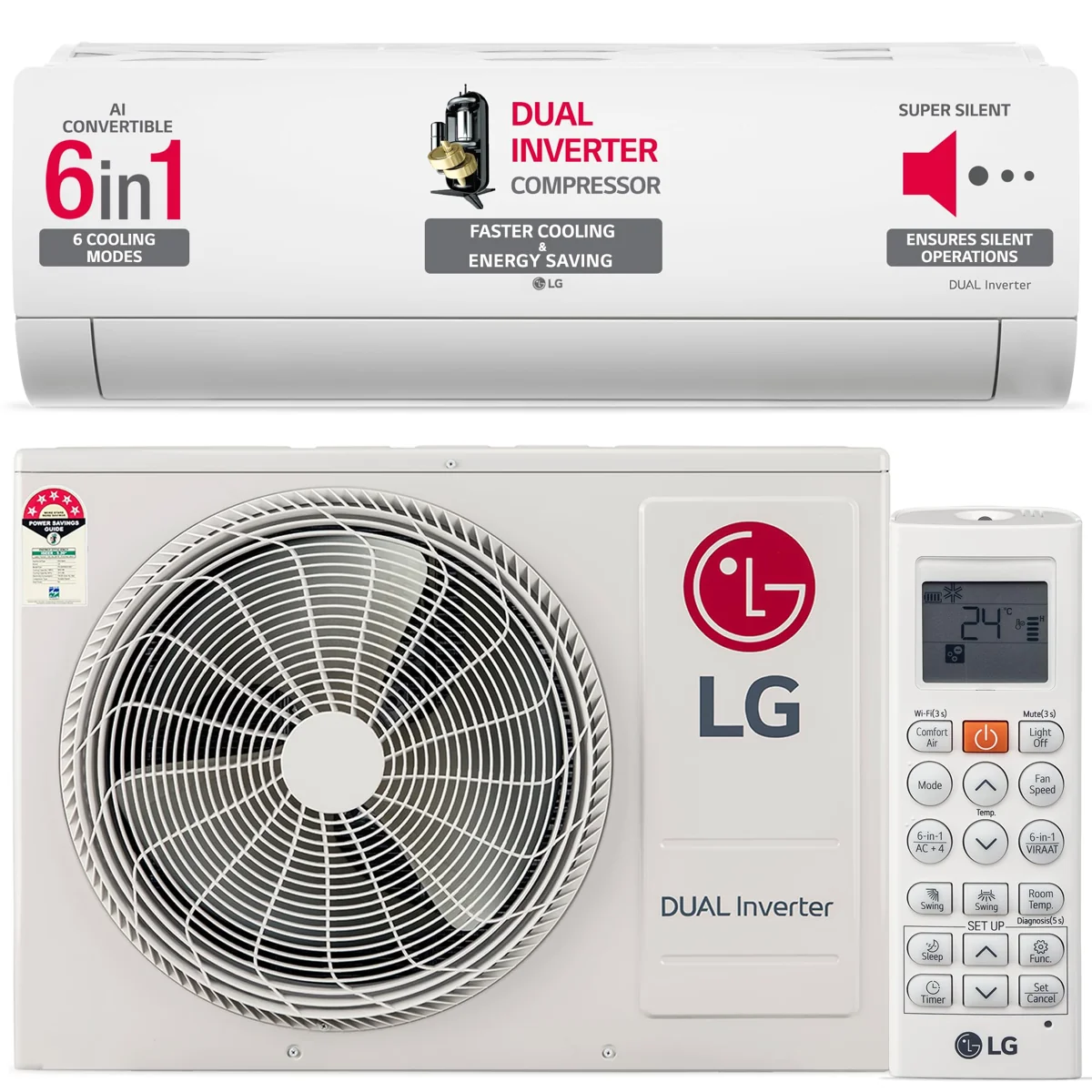
Estimated power consumption: 1080 kWh/year
LG 1.5 Ton 3 Star AI DUAL Inverter Split AC
Model: RS-Q19SWZD
LG has dominated the Indian AC market for years, and for good reason. Their dual inverter compressor is genuinely one of the quietest and most efficient on the market. Unlike traditional compressors that just turn on and off, the dual rotaries adjust their speed seamlessly. This means less vibration, less noise, and faster cooling.
What makes this specific 3-star model our top pick is the AI Convertible 6-in-1 cooling. You can run this 1.5-ton unit at 40%, 60%, 80%, 100%, or 110% capacity depending on how hot it is outside. If it's a mild rainy evening, drop it to 40% capacity, and it practically sips electricity like a ceiling fan.
✓What We Like
- •AI Convertible 6-in-1 mode lets you drop to 40% capacity on mild evenings
- •Dual rotary compressor minimizes vibration and runs whisper-quiet
- •Ocean Black Protection coating protects copper tubes from rust and open drain fumes
- •Extensive after-sales service network across all major Indian cities
!Keep In Mind
- •Remote control does not feature backlighting in dark rooms
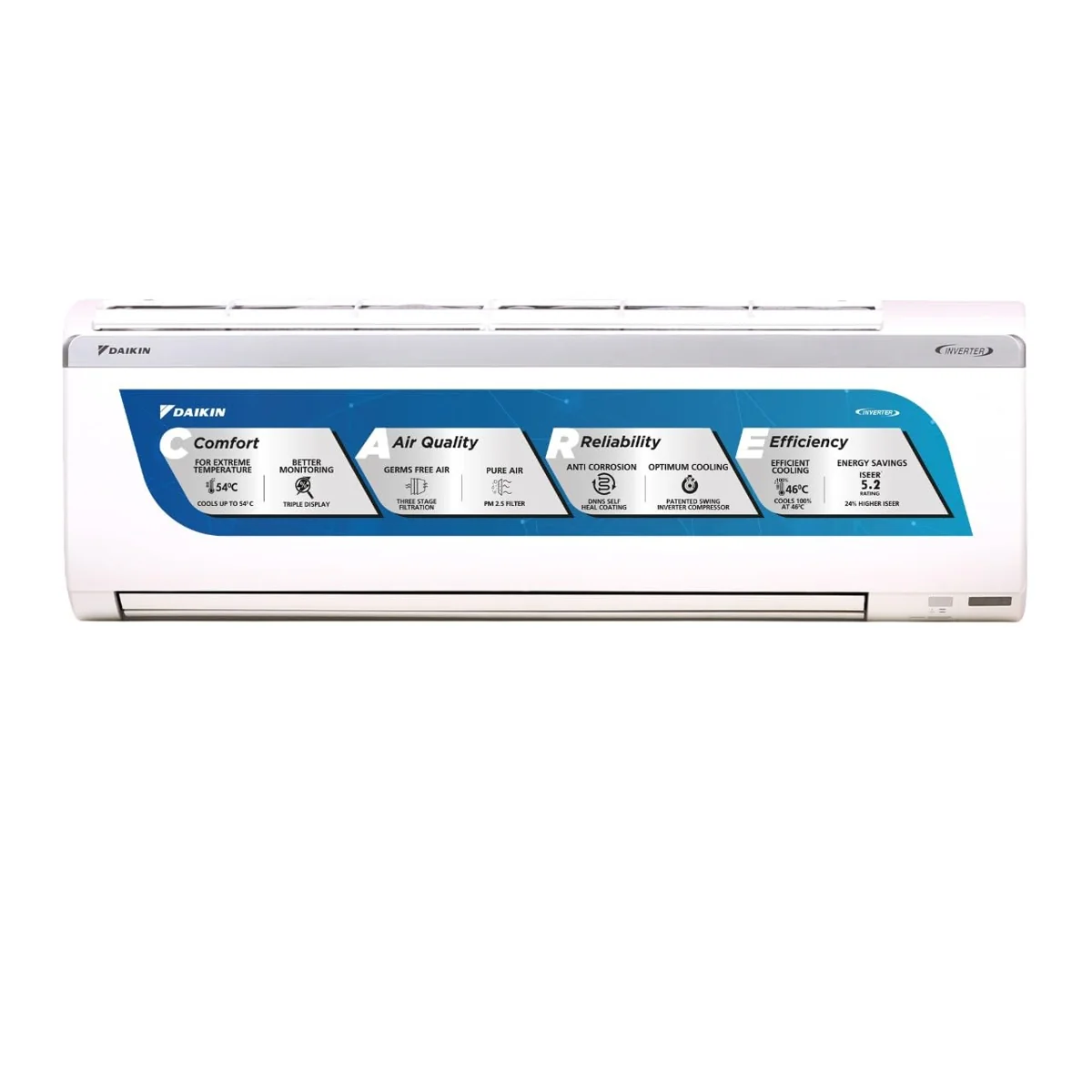
Estimated power consumption: 1060 kWh/year
Daikin 1.5 Ton 3 Star Inverter Split AC
Model: FTKL50TV / FTKM50
If you live in a place where summer temperatures routinely blast past 45°C (looking at you, Delhi and Rajasthan), Daikin is the brand you want. Daikin doesn't bother with gimmicks—they build absolute tanks that refuse to quit when the heat is unbearable.
Their Dew Clean Technology is a standout feature. With the press of a button, the AC uses condensate water to clean the indoor unit's heat exchanger. This removes dust and bacteria, ensuring that the air smells fresh and the cooling remains optimal without requiring you to manually wash the filters every other week.
✓What We Like
- •Cools effortlessly even at extreme 52°C ambient temperatures
- •Dew Clean Technology uses condensation to auto-wash the heat exchanger coils
- •Heavy-duty swing compressor built for 10+ years of rugged Indian summers
- •Strong, focused air throw that reaches every corner of large rooms
!Keep In Mind
- •Utilitarian boxy design without smart Wi-Fi integration in base trim
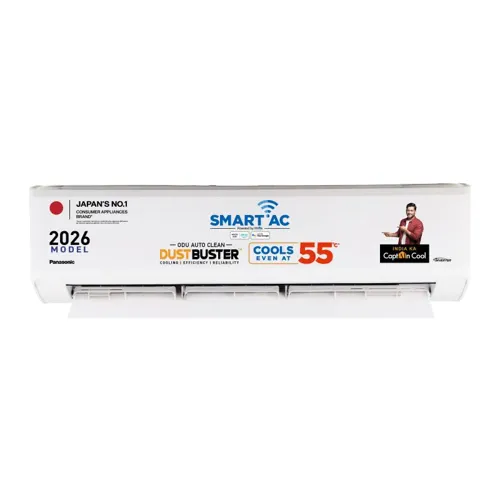
Estimated power consumption: 1050 kWh/year
Panasonic 1.5 Ton 3 Star Wi-Fi Inverter Smart AC
Model: CS/CU-SU18BKY3W
Panasonic has positioned itself as the king of smart ACs in India. Through their Miraie app, you get granular control over this AC that goes far beyond just turning it on and off. You can set custom sleep profiles—for instance, keeping the room at 22°C when you fall asleep, and naturally lifting it to 26°C by 3 AM so you don't wake up shivering.
Aside from the smarts, Panasonic excels in air quality. This model comes with PM 0.1 filter capabilities, acting like a true air purifier. In heavily polluted Indian cities, having your AC actively scrub the air of particulate matter is a massive health bonus.
✓What We Like
- •Best-in-class MirAIe mobile app with custom hourly sleep schedules
- •PM 0.1 fine particulate filtration scrubs city air clean while cooling
- •7-in-1 convertible modes to restrict wattage during low-heat days
- •Works seamlessly with Amazon Alexa and Google Assistant voice commands
!Keep In Mind
- •Blower fan is audible on maximum turbo setting before throttling down
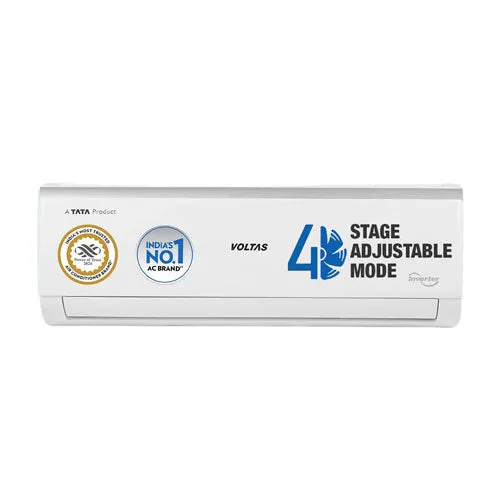
Estimated power consumption: 1150 kWh/year
Voltas 1.5 Ton 3 Star Inverter Split AC
Model: 183V Vectra Elegant
Voltas, backed by Tata, remains one of the highest-selling AC brands in India. Why? Because they are relatively inexpensive to buy, replacement parts are dirt cheap, and you can find a Voltas technician in literally any corner of the country. If you live in a tier-2 or tier-3 city, Voltas is often the safest bet simply because of service accessibility.
This 3-star model gives you the core necessities without the fluff. You get an adjustable inverter compressor that handles heat loads well, anti-dust filters, and 100% copper condenser coils.
✓What We Like
- •Highly accessible upfront purchase price with frequent discount deals
- •Unmatched service footprint across Tier-2 and Tier-3 Indian cities
- •Inexpensive replacement parts and widely available technicians
- •100% copper condenser coils with anti-dust air filtration
!Keep In Mind
- •Indoor unit plastic casing is lighter compared to Daikin or Panasonic
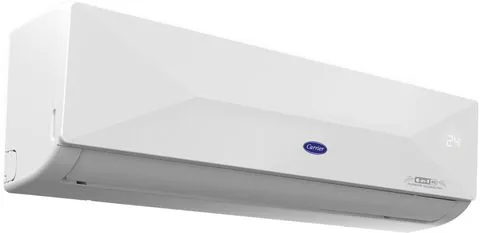
Estimated power consumption: 1120 kWh/year
Blue Star 1.5 Ton 3 Star Inverter Split AC
Model: IA318VNU
Blue Star has a massive pedigree in commercial refrigeration and central air conditioning. They know how to cool large spaces fast. When they apply that engineering to residential split ACs, you get a machine that drops the room temperature remarkably fast.
This model features Turbo Cool mode, which temporarily overclocks the compressor to instantly combat the heat when you walk in from a scorching afternoon outside. Acoustic jackets around the compressor also minimize outdoor vibration.
✓What We Like
- •Turbo Cool mode drops room temperature rapidly upon initial startup
- •Acoustic jacket around compressor dampens outdoor unit vibrations
- •Commercial HVAC engineering heritage ensures high reliability under thermal stress
- •Sleek and clean indoor chassis fits modern aesthetic rooms
!Keep In Mind
- •After-sales experience depends on local authorized franchise quality
The Hidden Costs Nobody Tells You About
You bought the AC online for a great price. You feel like a champion. Then the installation technician arrives, and suddenly you are handing over an extra ₹3,500. What happened? Most buyers don't factor in the hidden costs of setting up a new AC. Let's break them down so you aren't caught off guard.
- Standard Installation vs. Actual Installation: Brands usually charge ₹999 to ₹1,499 for "standard installation." But this only covers mounting the indoor unit, placing the outdoor unit, and connecting the free 3-meter copper pipe provided in the box.
- Extra Copper Piping: If your outdoor unit is placed far away on the roof or a distant balcony, you will need extra copper piping. Brands charge a premium for this—often ₹700 to ₹900 per meter. A few extra meters can double your installation cost instantly.
- Outdoor Unit Bracket: The metal stand to mount the outdoor unit on a wall is almost never included in the box. The technician will sell you one for about ₹750 to ₹1,000.
- Core Cutting: Need a clean circular hole drilled through a thick concrete wall for the pipes? That requires a heavy-duty core cutting machine. Technicians usually charge ₹300 to ₹600 for this specific drill work.
- Voltage Stabilizer: While most modern inverter ACs claim "stabilizer-free operation" between 140V and 280V, the delicate PCB boards inside them are extremely sensitive to sudden voltage spikes. If you live in an area with dirty power, a ₹2,000 stabilizer is cheap insurance to protect a ₹15,000 internal circuit board.
How to Keep Your 3-Star AC Running Like New
The difference between an AC that lasts 10 years and one that dies in 3 years is pure maintenance. You don't need a degree in HVAC to keep your unit healthy. Just follow a few basic rules.
First, clean your indoor filters every two weeks during heavy usage months. It takes exactly two minutes. Pop the front panel, slide the mesh filters out, run them under a tap, let them dry, and pop them back in. A choked filter forces the blower motor to work twice as hard, consuming more electricity and reducing cooling.
Second, watch out for the outdoor unit. Make sure it isn't choked by dry leaves, bird nests, or plastic bags. The outdoor unit needs to expel heat freely. If you trap it in a tight, unventilated corner, the compressor will overheat, trip, and eventually fail. Get a professional wet-service done at least once a year, right before summer kicks in.
Frequently Asked Questions (FAQ)
1. Do I really need a stabilizer for an inverter AC?
Brands market them as "stabilizer-free", but the fine print says they only handle slow voltage fluctuations within a specific range. They do not protect against sudden, massive voltage spikes (like lightning strikes or grid surges). Replacing a fried inverter PCB costs over ₹10,000. Just buy a ₹2,000 stabilizer for peace of mind.
2. What is the difference between an Inverter and Non-Inverter 3-Star AC?
A non-inverter compressor runs at a fixed 100% speed. Once the room is cool, it shuts off abruptly. When it warms up, it kicks back on with a heavy power surge. An inverter compressor never really turns off; it simply slows down its motor to maintain the temperature quietly and efficiently. Always buy an inverter model in 2026.
3. How much tonnage do I need for a 150 sq. ft. room?
A 1.5-ton AC is perfect for a 150 sq. ft. room. If your room is under 110 sq. ft., a 1.0-ton AC will suffice. However, if your room gets direct sunlight on the roof or walls, always upsize. A 1.5-ton AC running easily is better than a 1.0-ton struggling and running at max capacity all day.
4. Copper vs Aluminum condenser: Which is better?
Copper. End of debate. Aluminum is cheaper but extremely difficult to repair if it develops a micro-leak. Copper transfers heat better, lasts longer, and can be brazed (welded) easily by local technicians if a leak ever occurs. Always verify the AC has 100% copper coils.
5. Why is my new 3-star AC not cooling like the old window AC?
Modern ACs use R32 gas, which is highly eco-friendly but operates at different pressures than the older, now-banned R22 gas. Also, old window ACs blasted freezing air aggressively. Modern inverter ACs cool the room gradually to maximize energy efficiency. It is a feature, not a bug.
6. Can I use the convertible mode all the time to save power?
Yes, you can! If you are alone in a room, dropping a 1.5-ton AC to 40% (0.6 tons) will cool the space just fine while drastically slashing power consumption. Use 100% only when the room is fully occupied or when you first turn the AC on during a hot afternoon.