AC Electricity Bill Calculator India (2026): Exact Running Costs, Formula & State Tariffs
Every April, millions of Indian households face the exact same anxiety: switching on the air conditioner brings instant bliss against scorching 44°C heat, but that blissful relief is immediately followed by the dreaded anticipation of the next electricity bill. Most people think their AC draws maximum rated power every second it runs, while others blindly trust salesman claims that modern 5-star ACs run on “pennies.” Neither side knows how to calculate the actual rupee cost.
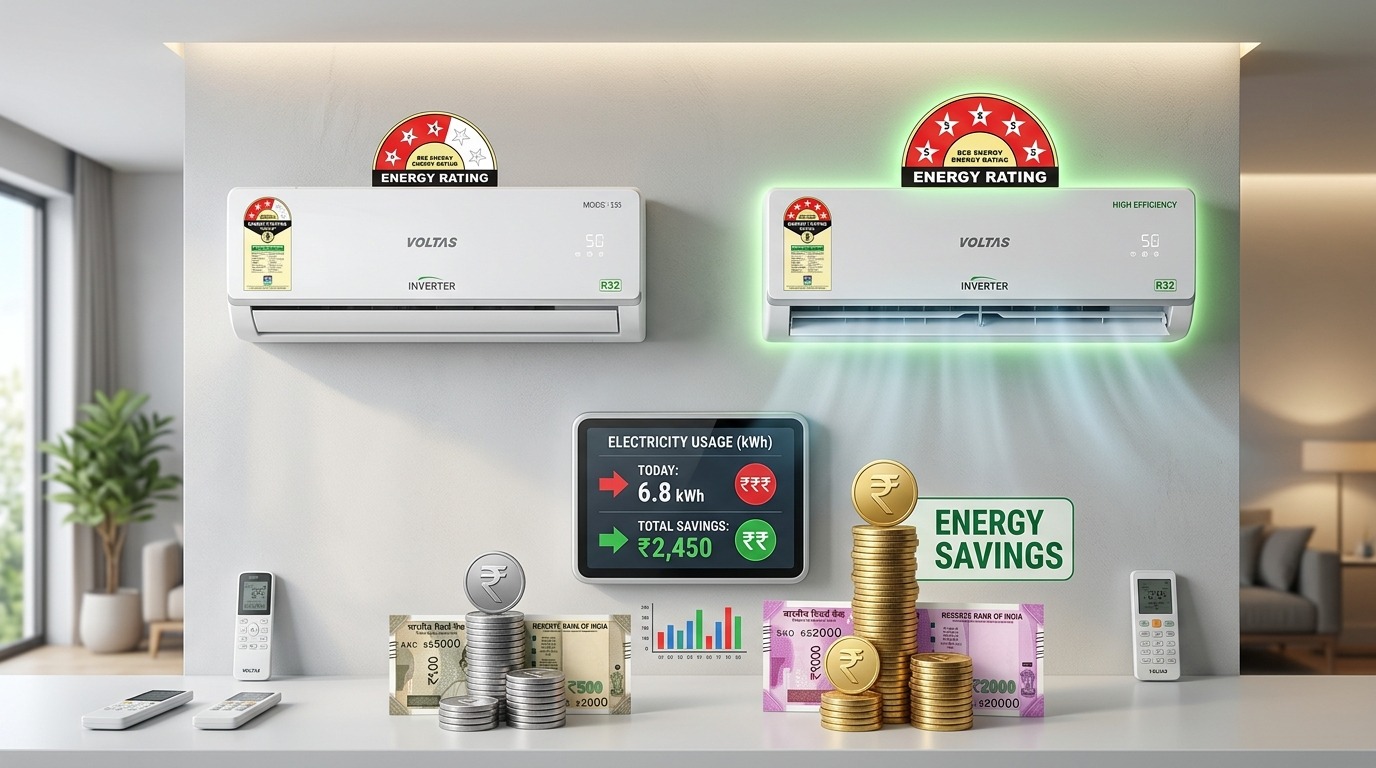
Calculating your AC power bill isn’t black magic. You don’t need an electrical engineering degree or expensive smart meters clamped inside your distribution board. In fact, you can calculate your exact hourly, daily, and monthly electricity expense in less than two minutes using a simple formula backed by the Bureau of Energy Efficiency (BEE).
In this complete 2026 calculation guide, we break down the official BEE formula, explain why inverter compressors use far less electricity than their sticker wattage suggests, provide an exhaustive cost comparison across all popular AC models sold in India, and tabulate state-by-state electricity tariffs so you know your real out-of-pocket costs down to the single rupee.
Interactive AC Running Cost Calculator
Use our quick interactive tool below to adjust wattage, running hours, and your local state tariff to see immediate daily, monthly, and seasonal costs.
AC Electricity Bill Calculator
Check the BEE label. A 1.5 Ton 5-Star is usually ~1500W, 3-Star is ~1700W.
How to Calculate AC Electricity Cost Manually
Before looking at specific models, let’s understand the underlying math. Many homeowners look at the technical specification sheet of a 1.5 Ton AC, spot “Rated Input Power: 1450 Watts,” and multiply 1.45 kW by 8 hours. They calculate 11.6 units per day, multiply by ₹8 per unit, and assume their AC will burn ₹92.80 every single night (almost ₹2,800 every month).
That calculation is entirely wrong for modern inverter ACs. An inverter compressor speeds up and slows down based on room heat. Once your room reaches the set temperature, an efficient inverter AC throttles down its power consumption to 250W–400W.
To solve this problem and give Indian buyers an accurate metric, the Bureau of Energy Efficiency established standardized testing procedures under the Indian Seasonal Energy Efficiency Ratio (ISEER) framework.
The Standard 1,600-Hour Benchmark
Every air conditioner legally sold in India must display a red-and-white BEE Star Label on its indoor unit. That label shows a certified figure titled “Electricity Consumption (Units per year)”. BEE calculates this figure assuming the AC operates for 1,600 hours per year across typical Indian temperature distributions (ranging from 24°C up to 43°C outdoor temperatures). 1,600 hours equals running your AC for roughly 8 hours a day over a 200-day cooling season.
The Official BEE Manual Formula
Because the annual consumption printed on the BEE label represents 1,600 hours of real-world seasonal operation, you can calculate your AC’s average hourly unit consumption by dividing that annual figure by 1,600:
Hourly Units (kWh) = Annual kWh (from BEE label) ÷ 1,600 Hours
Daily Units (kWh) = Hourly Units × Actual Daily Usage Hours
Monthly Units (kWh) = Daily Units × 30 Days
Monthly Cost (₹) = Monthly Units × Local Electricity Tariff (₹ per kWh)
When you combine these steps into a single mathematical equation, the formula simplifies to:
This single formula handles any tonnage, any star rating, and any electricity board in India. Let’s put this formula into action with real-world machines.
Real Math Examples: 5-Star vs 3-Star AC Head-to-Head
Buyers often wonder whether spending an extra ₹7,000 to ₹10,000 on a 5-star AC actually pays off in monthly bills. Let’s run the numbers using two of India’s most popular split ACs at an average residential tariff of ₹8 per unit.
LG 1.5 Ton 5 Star AI Dual Inverter
Model: TS-Q19YNZE / JS-Q18PWZD | ISEER: 5.20
- • BEE Annual Consumption: 836 kWh
- • Hourly Consumption: 836 ÷ 1600 = 0.5225 units/hr
- • Daily Consumption (8 hrs): 0.5225 × 8 = 4.18 units/day
- • Monthly Consumption (30 days): 4.18 × 30 = 125.4 units
- • Monthly Cost (@ ₹8/unit): 125.4 × ₹8 = ₹1,003 / month
- • Full 5-Month Summer Cost: 836 kWh × ₹8 = ₹6,688 / year (approx. ₹1,337/mo over 5 active months)
Voltas 1.5 Ton 3 Star Inverter Split AC
Model: 183V Vectra Elegant | ISEER: 3.81
- • BEE Annual Consumption: 1,150 kWh
- • Hourly Consumption: 1150 ÷ 1600 = 0.7188 units/hr
- • Daily Consumption (8 hrs): 0.7188 × 8 = 5.75 units/day
- • Monthly Consumption (30 days): 5.75 × 30 = 172.5 units
- • Monthly Cost (@ ₹8/unit): 172.5 × ₹8 = ₹1,380 / month
- • Full 5-Month Summer Cost: 1150 kWh × ₹8 = ₹9,200 / year (approx. ₹1,840/mo over 5 active months)
The Financial Payoff: Exactly How Much Do You Save?
A standard 1.5 Ton 5-star AC typically costs ₹42,000 to ₹45,000, while a 3-star AC costs around ₹32,000 to ₹35,000. That is a price gap of about ₹8,000. By saving ₹2,512 every year in electricity, the 5-star unit completely recovers its premium in just 3.2 seasons. For the remaining 4 to 6 years of the unit’s lifespan, you pocket over ₹10,000 in clean electricity savings. Read our detailed 3-Star vs 5-Star AC comparison guide for deeper insights.
Running Cost Comparison Across All 2026 AC Models
Let’s examine how India’s leading split air conditioners stack up when subjected to the BEE 1600-hour formula. Below is an exhaustive breakdown of every featured model in our database, calculated at a baseline tariff rate of ₹8.00 per unit (kWh) for both heavy 8-hour daily usage and light 4-hour daily usage.
| Brand & Model | Tons | Star | ISEER | Annual kWh | Monthly (8h/day) | Monthly (4h/day) | Summer (5 mos) |
|---|---|---|---|---|---|---|---|
LG 1.5 Ton 5 Star AI DUAL Inverter Split AC TS-Q19YNZE / JS-Q18PWZD | 1.5T | 5★ | 5.20 | 836 | ₹1,003 | ₹502 | ₹6,688 |
LG 1 Ton 5 Star DUAL Inverter Split AC MS-Q12YNZA / AS-Q12YNXE | 1T | 5★ | 5.10 | 560 | ₹672 | ₹336 | ₹4,480 |
LG 1.5 Ton 3 Star DUAL Inverter Split AC RS-Q19SWZD | 1.5T | 3★ | 3.90 | 1080 | ₹1,296 | ₹648 | ₹8,640 |
LG 2 Ton 5 Star AI DUAL Inverter Split AC TS-Q24YNZE | 2T | 5★ | 5.00 | 1100 | ₹1,320 | ₹660 | ₹8,800 |
Daikin 1.5 Ton 5 Star Swing Inverter Split AC FTKM50XV / FTKM50U | 1.5T | 5★ | 5.00 | 870 | ₹1,044 | ₹522 | ₹6,960 |
Daikin 1 Ton 5 Star Inverter Split AC FTKM35XV / FTKR35XV | 1T | 5★ | 5.00 | 580 | ₹696 | ₹348 | ₹4,640 |
Voltas 1.5 Ton 3 Star Inverter Split AC 183V Vectra Elegant / Vectra Prime | 1.5T | 3★ | 3.81 | 1150 | ₹1,380 | ₹690 | ₹9,200 |
Voltas 1.5 Ton 5 Star Inverter Split AC 185V Vectra Elite / Vertis series | 1.5T | 5★ | 4.70 | 930 | ₹1,116 | ₹558 | ₹7,440 |
Panasonic 1.5 Ton 5 Star Wi-Fi Inverter Smart Split AC CS/CU-NU18BKY5WX | 1.5T | 5★ | 5.80 | 755 | ₹906 | ₹453 | ₹6,040 |
Hitachi 1.5 Ton 5 Star Inverter Split AC iKasu / Yoshi series | 1.5T | 5★ | 4.55 | 970 | ₹1,164 | ₹582 | ₹7,760 |
Carrier 1.5 Ton 5 Star AI Flexicool Inverter Split AC ESTER EDGE Gxi (CAI18EE5R36W0) | 1.5T | 5★ | 5.10 | 855 | ₹1,026 | ₹513 | ₹6,840 |
*Note: All calculations assume a standard domestic tariff of ₹8.00 per unit (kWh). Monthly costs reflect a 30-day billing cycle. Annual summer cost reflects full 1,600 hours of seasonal cooling (approx. 5 months of active high-summer use).
Key Takeaways from the Product Data
- Panasonic CS/CU-NU18BKY5WX leads the pack: With a record-breaking ISEER of 5.80 and only 755 annual kWh consumption, Panasonic delivers the lowest running cost of any 1.5 Ton model on the Indian market in 2026. Running it for 8 hours daily costs roughly ₹906 per month.
- 1.0 Ton ACs slash bills in small bedrooms: If you are cooling a room under 120 sq ft, models like the LG 1 Ton 5 Star (MS-Q12YNZA) and Daikin 1 Ton 5 Star (FTKM35XV) drop your monthly expense to under ₹700, even when run continuously for 8 hours every single night.
- The 3-Star penalty is steep: The Voltas 1.5 Ton 3 Star (183V Vectra Elegant) consumes 1,150 kWh per year, costing ₹1,380 per month for 8 hours/day. That is 52% higher power consumption compared to the top-tier 5-star Panasonic model!
Want the Lowest Possible Electricity Bill?
Check live discounts on top 5-star inverter air conditioners with ISEER ratings above 5.0 on Amazon India.
State-Wise Electricity Tariff Rates Across India (2026)
Your air conditioner’s running cost depends heavily on your pin code. Electricity in India is billed on progressive (telescopic or non-telescopic) slabs. This means the more electricity your household uses, the higher the per-unit rate you pay for additional units.
Here is the critical detail most people overlook: your base household appliances (refrigerator, ceiling fans, LED lights, water heater, TV, and laptops) already consume your first 150 to 250 units every month. Because your baseline appliances soak up the cheaper lower slabs, every single unit of power your air conditioner consumes lands squarely in your electricity board’s highest tariff slab.
Below is an up-to-date summary of domestic residential electricity slab tariffs across 11 key Indian states for 2026, including the typical tariff rate applicable to AC usage:
| State | Major DISCOMs | Typical Base Slabs (₹/kWh) | Upper Slab (>300-400 units) | Effective AC Rate |
|---|---|---|---|---|
| Delhi | BRPL, BYPL, TPDDL | 0-200 (subsidized/free), 201-400 (₹4.50) | ₹6.50 – ₹8.00 | ₹7.50 / unit |
| Maharashtra | MSEDCL, Adani Electricity, Tata Power | 0-100 (₹5.88), 101-300 (₹11.26) | ₹15.72 – ₹17.81 | ₹12.50 – ₹16.00 / unit |
| Karnataka | BESCOM, MESCOM, HESCOM | Gruha Jyothi free up to cap; flat above | ₹7.00 – ₹8.25 | ₹8.00 / unit |
| Tamil Nadu | TANGEDCO | 0-100 (free), 101-400 (₹4.50) | ₹6.00 – ₹11.00 | ₹8.50 / unit |
| Gujarat | UGVCL, DGVCL, Torrent Power | 0-100 (₹3.40), 101-250 (₹4.25) | ₹5.20 + FPPPA fuel cess | ₹6.80 / unit |
| Uttar Pradesh | UPPCL, PVVNL, DVVNL | 0-150 (₹5.50), 151-300 (₹6.00) | ₹6.50 – ₹7.00 + 5% duty | ₹7.20 / unit |
| Madhya Pradesh | MPPKVVCL, MPMKVVCL | 0-50 (₹4.21), 51-150 (₹5.17) | ₹6.55 – ₹7.12 | ₹7.50 / unit |
| Rajasthan | JVVNL, AVVNL, JdVVNL | 0-150 (₹6.50), 151-300 (₹7.35) | ₹7.95 + urban cess | ₹8.20 / unit |
| Kerala | KSEB | 0-100 (₹4.05), 101-200 (₹6.80) | ₹7.50 – ₹8.80 (non-telescopic) | ₹8.00 / unit |
| Andhra Pradesh | APEPDCL, APCPDCL | 0-75 (₹3.80), 76-200 (₹5.30) | ₹7.10 – ₹9.95 | ₹8.80 / unit |
| Telangana | TSSPDCL, TSNPDCL | 0-100 (Gruha Jyothi), 101-200 (₹5.00) | ₹7.20 – ₹10.50 | ₹8.50 / unit |
Notice how wildly rates swing between states. A Mumbai resident under MSEDCL or Adani Electricity faces upper slabs of ₹15 to ₹17 per unit, meaning running a 1.5 Ton AC can cost over ₹2,000 per month for just 8 hours a night. In contrast, a resident of Ahmedabad or Vadodara paying Gujarat’s moderate ₹6.80 per unit will see a monthly bill under ₹900 for the identical air conditioner.
Inverter AC Compressor Duty Cycle Explained
Why is your AC’s real power draw so much lower than the rated wattage? To understand this, we need to look under the hood at how an inverter air conditioner actually operates compared to older fixed-speed machines.
Old Non-Inverter (Fixed Speed) vs Modern Inverter
Old Fixed-Speed Compressor
A non-inverter compressor is like an on-off light bulb. When turned on, it runs at 100% capacity (drawing ~1,500W to 1,800W). When the room reaches the set temperature, the compressor completely clicks off. As the room warms back up 2°C, the compressor kicks back on with a huge current surge.
Modern Inverter BLDC Compressor
An inverter AC uses a brushless DC (BLDC) motor with a Variable Frequency Drive. It modulates its motor RPM continuously. Instead of shutting off, it speeds up when rapid cooling is required, and slows down to a gentle whisper once the room reaches the thermostat target.
The Three Cooling Phases in an 8-Hour Night
When you turn on your inverter AC before sleeping, the night splits into three distinct operating phases:
- Phase 1: The Pull-Down Phase (0 to 45 minutes)
Your bedroom is 35°C, walls are radiating heat, and furniture is warm. The compressor ramps up to full speed (often 100% to 110% rated power, drawing roughly 1,400W to 1,600W) to extract heat as rapidly as possible. In this phase, it burns about 1.1 to 1.3 units of electricity in the first hour. - Phase 2: The Throttling Phase (45 to 90 minutes)
As the room temperature nears your set point (say, 24°C), the microprocessor signals the inverter circuit to lower motor frequency. Electrical draw drops steadily to 700W–900W. - Phase 3: The Steady-State Maintenance Phase (Hours 2 through 8)
This is where the magic happens. The room air is cool, walls have surrendered their surface heat, and outdoor night temperatures drop. The compressor drops its speed to just 20% to 35% of maximum capacity, drawing only 250W to 420W! That is roughly the power consumed by three old ceiling fans. During these 6 maintenance hours, the AC draws a mere 0.3 units per hour.
This is why an 8-hour sleep cycle on a modern 1.5 Ton 5-star AC consumes only 3.8 to 4.5 units of electricity rather than the 12 units people mistakenly calculate using peak wattage.
6 Proven Ways to Slash Your AC Electricity Bill by 25–40%
You don’t have to sweat through the summer to keep your power bill under control. By understanding thermodynamic heat loads and compressor physics, you can easily trim 25% to 40% off your monthly bill without sacrificing comfort:
1. Set the Thermostat to 24°C–26°C (The 6% Law)
According to BEE studies, every 1°C increase in AC temperature setting saves roughly 6% in electricity consumption. Setting your AC to 18°C doesn’t cool the room any faster (the air blowing out of the vents is at the same temperature regardless of set point); it simply forces the compressor to run at maximum power for hours. Switching from 20°C to 26°C cuts your cooling bill by an astonishing 36%.
2. Combine Your AC with a Low-Speed Ceiling Fan
Run your ceiling fan on speed 1 or 2 while your AC is set to 26°C. The gentle air movement creates an evaporative wind-chill effect across your skin, making 26°C feel like 23°C. An energy-efficient BLDC ceiling fan consumes just 28–32 Watts, while letting your AC compressor idle in low-power maintenance mode.
3. Block Radiant Heat with Blackout Curtains
Direct sunlight streaming through glass windows accounts for up to 40% of the heat gain in an Indian bedroom. Keep thick, light-coloured or blackout curtains drawn during peak afternoon hours (12 PM to 5 PM). This prevents solar infrared radiation from baking your room floors and furniture.
4. Clean Air Filters Every 15 Days
Indian cities suffer from heavy airborne dust. When indoor unit mesh filters get clogged with lint and dirt, airflow drops by up to 30%. The evaporator coil struggles to transfer heat, causing the compressor to run longer and consume 5% to 12% more power. Cleaning filters takes just 5 minutes under a running tap and pays off immediately.
5. Use Sleep Mode Every Night
When you sleep, your metabolic rate drops, and ambient outdoor temperatures fall between 2 AM and 5 AM. Activating your remote’s “Sleep Mode” automatically increases the set temperature by 1°C per hour for the first two hours. If you go to bed at 24°C, the AC will shift to 25°C by 1 AM and 26°C by 2 AM, preventing you from shivering under blankets while saving 12% power overnight.
6. Utilize Convertible / Flexicool Modes
Modern air conditioners from LG (AI Convertible 6-in-1), Carrier (Flexicool), and Panasonic come with convertible capacity modes. When only one person is in the room or when cooling at night, tap the remote to switch to 80% or 60% capacity mode. This puts an artificial ceiling on compressor frequency, preventing unnecessary power spikes.
Frequently Asked Questions
How much electricity does a 1.5 Ton 5 Star AC use per hour in India?
On average, a modern 1.5 Ton 5 Star inverter AC consumes between 0.45 and 0.65 units (kWh) per hour during regular room maintenance. In the initial 30 minutes of pulling down the room temperature from 35°C to 24°C, it draws roughly 1.2 to 1.4 units/hour. Once cooled, it throttles down to just 0.3 to 0.4 units/hour.
What is the average monthly electricity bill for a 1.5 Ton AC in summer?
For a typical Indian household running a 1.5 Ton 5-star inverter AC for 8 hours every night at ₹8 per unit, the monthly electricity cost is roughly ₹1,000 to ₹1,200 (around 125 to 145 units). If running a 3-star AC, the monthly bill rises to ₹1,350 to ₹1,550. Running the AC for 14 to 16 hours daily will push the bill above ₹2,200 to ₹2,800.
Is a 5-star AC really worth the extra money over a 3-star AC in 2026?
Yes, if you use your AC for more than 5 to 6 hours daily during summer. A 1.5 Ton 5-star AC saves approximately ₹2,500 every year compared to a 3-star model. Since the upfront price difference between 3-star and 5-star models is typically ₹7,000 to ₹9,000, you break even in about 3 years. After year 3, you earn pure savings for the remainder of the unit’s 8 to 10 year lifespan.
Why does the BEE Star Label base calculations on 1,600 hours?
The Bureau of Energy Efficiency established 1,600 hours as the national testing benchmark based on survey data of typical Indian climate usage patterns. 1,600 hours represents running an air conditioner for approximately 8 hours a day over an extended 200-day cooling season (from late March through October). It accounts for varying outdoor ambient temperatures across defined temperature bins.
Does setting my AC temperature to 18°C cool the room faster?
No, absolutely not. An air conditioner blows air at the exact same supply temperature (usually between 10°C and 14°C) whether your remote is set to 18°C or 24°C. Setting it to 18°C simply stops the compressor from throttling down, forcing it to consume maximum wattage continuously, resulting in sky-high electricity bills without cooling the room a single second faster.
Why is my AC bill so much higher in Mumbai compared to Delhi?
There are two reasons: electricity tariffs and humidity. First, Mumbai’s private distribution utilities (such as Adani Electricity and Tata Power) feature high residential upper tariff slabs ranging from ₹12 to ₹17 per unit, whereas Delhi offers subsidised slabs with upper tiers around ₹7.50 to ₹8.00 per unit. Second, Mumbai’s high coastal humidity forces ACs to expend extra energy condensing moisture from the air (latent heat load).
How much electricity does a 1 Ton AC consume compared to a 1.5 Ton AC?
A 1 Ton 5-star AC consumes roughly 30% to 35% less electricity than a 1.5 Ton 5-star AC. For example, the LG 1 Ton 5 Star consumes 560 annual kWh (around ₹672/month at 8 hours/day), while the LG 1.5 Ton 5 Star consumes 836 annual kWh (around ₹1,003/month). If your room is 110 sq ft or smaller, installing a 1 Ton unit yields significant upfront and recurring savings.
How can I check how many units my AC used yesterday?
Smart Wi-Fi enabled air conditioners from Panasonic (MirAIe app), LG (ThinQ app), and Carrier provide real-time and historical power consumption graphs directly on your smartphone. Alternatively, you can install a 16A smart plug with energy monitoring (like Wipro, Qubo, or TP-Link) or check your home’s digital smart electricity meter readings before and after running the AC overnight.
Does an inverter AC save power if I run it for only 2 hours a day?
The power savings will be minimal. During the first 45 to 60 minutes, an inverter AC runs at high capacity to pull down room temperatures. The deep energy savings occur during the subsequent steady-state maintenance phase (hours 2 through 8). If you run your AC for only 1 to 2 hours daily, the difference in monthly electricity cost between a 3-star and a 5-star inverter is barely ₹150–₹200 per month, extending your payback period to over 7 years.
Related Energy & AC Buying Guides
- AC Electricity Costs in India by Tonnage — In-depth breakdown of running costs for 1 Ton, 1.5 Ton, and 2 Ton air conditioners.
- 1 Ton AC Power Consumption & Monthly Bill Guide — Detailed calculations, star rating comparisons, and ideal room sizing for 1-ton models.
- Best 5 Star ACs in India (2026 Rankings) — Tested picks featuring the highest ISEER ratings from Panasonic, LG, and Daikin.
- 3 Star vs 5 Star AC: Which Should You Buy? — Complete break-even analysis, initial cost vs running savings, and usage threshold formulas.
- What is ISEER Rating in AC? — Learn how BEE tests cooling capacity and energy efficiency across seasonal climate zones.
- Inverter vs Non-Inverter AC: Complete Comparison — Why variable-speed compressors outperform fixed-speed units in longevity, noise, and electricity efficiency.