AC Maintenance Tips for Indian Homes (2026): Keep Your Cooling Sharp & Bills Low
India is notoriously brutal on air conditioners. Between May heatwaves crossing 46°C in Delhi, stifling 85% humidity during Mumbai monsoons, fine construction dust across Bengaluru, and corrosive coastal air in Chennai, your split AC works twice as hard as an air conditioner in Europe or North America. If you ignore it, you pay the penalty: sky-high electricity bills, foul mouldy smells, water trickling down your bedroom wall, and sudden breakdowns right in the middle of a sweltering Sunday afternoon.
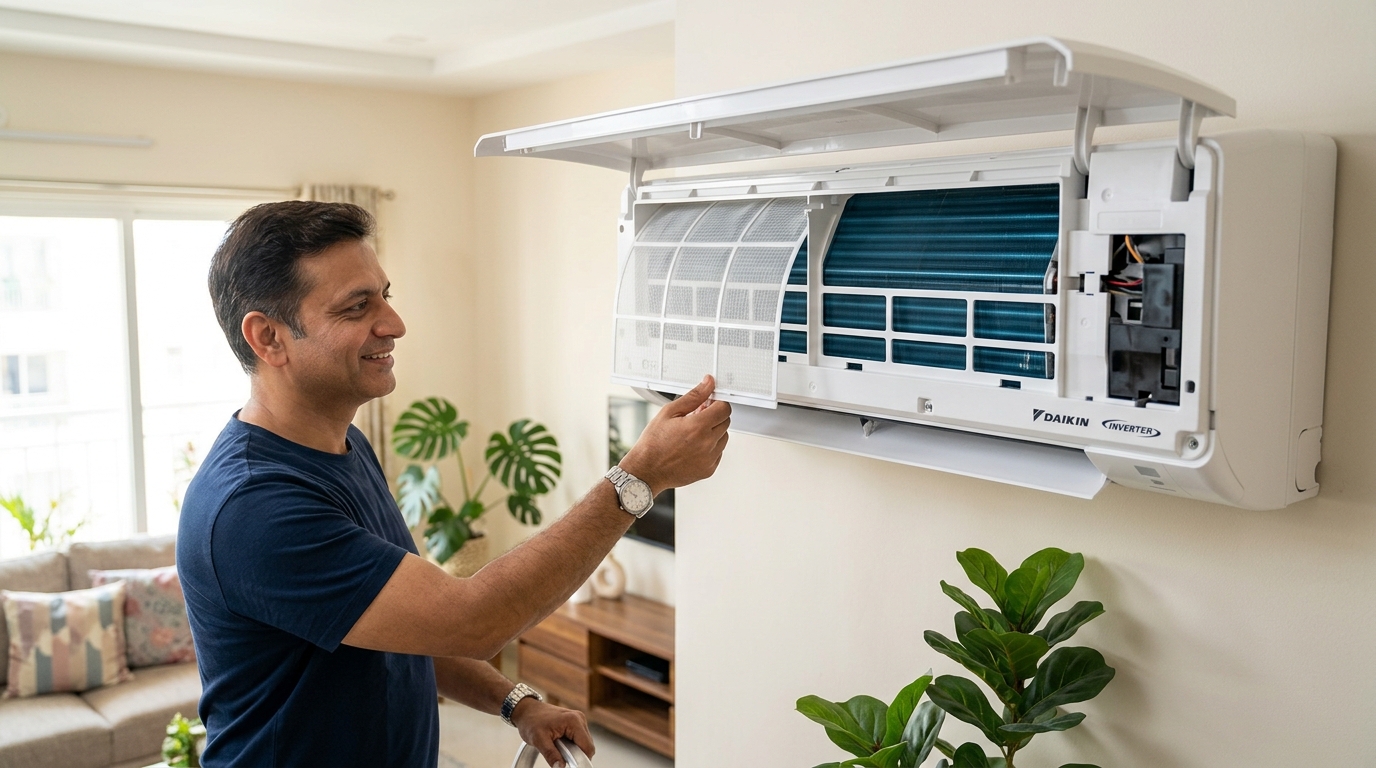
The good news? Keeping your split or window AC running in factory-fresh condition doesn't require an engineering degree or thousands of rupees every single month. By pairing a simple 15-minute DIY cleaning routine with well-timed professional servicing, you can extend your machine's lifespan past 10 years, protect your manufacturer warranty, and trim 15% to 25% off your monthly power bills.
The Golden Rule of AC Upkeep
An air conditioner doesn't produce cold out of thin air; it moves indoor heat to the outside through copper coils and chemical refrigerant. When dust coats your indoor mesh filters or outdoor condenser fins, heat transfer slows to a crawl. Your compressor runs hotter, spins longer, sucks more wattage, and wears out years ahead of schedule. Regular cleaning isn't just about clean air—it's your first line of defense against high power bills and premature hardware failure.
The Hidden Cost of Neglect: How Dirty ACs Spike Your Electricity Bill
Most Indian households only think about AC servicing when the unit completely stops blowing chilled air. But long before an air conditioner quits, neglect quietly bleeds your wallet.
According to field tests by the Bureau of Energy Efficiency (BEE) and leading HVAC manufacturers, a dust-choked mesh filter restricts indoor airflow by up to 35%. Because less warm room air crosses the evaporator coil, the refrigerant inside cannot absorb heat at its rated speed. The inverter sensor reads that the room hasn't reached your set temperature (say, 24°C), forcing the variable-speed compressor to operate at maximum capacity (100% to 110%) instead of dialling down to an energy-sipping 40% cruise load.
Here is how that penalty plays out in hard numbers during typical Indian summer usage:
| Maintenance State | Effective ISEER | Avg. Power (1.5 Ton) | Units/Day (8 hrs) | Monthly Bill (@ ₹8/kWh) | Added Cost / Month |
|---|---|---|---|---|---|
| Clean Filter & Fresh Coils | 5.10 (BEE 5-Star) | 920 W (avg cruise) | 7.36 kWh | ₹1,766 | Baseline (₹0) |
| Dirty Filter (1 Month Dust) | 4.35 (Drops ~15%) | 1,080 W | 8.64 kWh | ₹2,074 | +₹308 / mo |
| Clogged Filter + Dusty Blower | 3.80 (Drops ~25%) | 1,210 W | 9.68 kWh | ₹2,323 | +₹557 / mo |
| Choked Coils + Choked Outdoor Unit | 3.20 (Drops ~37%) | 1,390 W | 11.12 kWh | ₹2,669 | +₹903 / mo |
Take a look at that last row: ignoring a dirty filter and a muck-encrusted outdoor unit turns your premium 5-star inverter AC into a 2-star guzzler. Over a 5-month Indian summer season, you toss more than ₹4,500 straight to your state electricity discom in wasted power—far more than the cost of two professional pressure jet services.
Monthly DIY Maintenance Checklist (15-Minute Routine)
You don't need a technician for basic monthly maintenance. In fact, relying solely on an annual technician visit means your unit operates choked for at least 8 months of the year. Spend 15 minutes on the first Sunday of every month carrying out this quick home audit:
1Wash Primary Mesh Filters
Dust, pet hair, and airborne soot settle on the nylon mesh. Rinse them under normal tap water every 2 to 3 weeks during peak summer months.
2Wipe Louvers & Swing Flaps
Moist air over plastic louvers breeds grey-black mildew dots. Wipe the horizontal and vertical airflow louvers with a damp microfiber cloth.
3Check Outdoor Unit Clearance
Ensure minimum 2 feet of clear space around your outdoor unit. Clear dried leaves, pigeon droppings, hanging clothes, or balcony clutter blocking the condenser fan.
4Verify Drain Hose Flow
Check where your outdoor drain pipe empties. You should observe a steady drip when cooling a humid room. If the pipe is bone-dry while cooling, the internal tray might be clogging.
5Inspect Stabilizer & Power Plug
Feel the 16A power plug and wall socket. If it feels warm or shows black scorch marks, your plug socket has loose contacts—a major fire hazard in Indian homes.
6Check Remote Batteries
Cheap zinc-carbon AAA batteries leak potassium hydroxide paste inside the remote compartment within 6 months. Use leak-proof alkaline batteries and check for corrosion.
How to Clean Split AC Filters Yourself (Step-by-Step with Timings)
Cleaning your AC filter is genuinely straightforward. It requires zero tools, zero technical skills, and takes roughly 15 to 20 minutes from start to finish. Here is the safest, most effective method:
Required Supplies
- Lukewarm water (a bathroom hand-shower or normal tap works best)
- Mild dishwashing liquid or baby shampoo (avoid harsh detergents, bleach, or acidic cleaners)
- A clean microfiber towel
- A soft paintbrush or old soft-bristle toothbrush (for stubborn corner grime)
Power Down the AC at the MCB (Time: 1 min)
Never clean your air conditioner with power connected. Switch the unit off using the remote, then flip off the wall isolator switch or 16A MCB. This protects the internal PCB sensors and avoids any electrical shock risk while handling the unit.
Gently Open the Front Access Panel (Time: 2 min)
Locate the small recessed notches on the left and right sides of the indoor unit’s front panel. Place your thumbs into both notches and lift upward together. On almost all modern models from LG, Daikin, Voltas, and Panasonic, the panel will click upward and lock into an open kickstand position.
Unhook & Slide Out the Mesh Filters (Time: 2 min)
You will see two curved mesh screens resting over the aluminum coils. Push up slightly on the lower tab of each filter to unhook it from the plastic retaining clips, then pull downward and toward you. Handle them gently—the thin nylon mesh can tear if forced against metal edges.
Remove Secondary Specialty Filters (Time: 1 min)
Many modern units feature small clip-on rectangular inserts (PM2.5 micro-filters, catechin strips, or active carbon strips). Unclip these carefully. Check your user manual: high-density primary mesh is washable, but electrostatic PM2.5 or active carbon strips should usually be dry-brushed or vacuumed, as soaking them in water destroys their electrostatic charge.
Wash with Reverse Water Pressure (Time: 5 min)
Take the mesh filters to the bathroom. Turn them so that the water hits the clean side (the side facing the coil) first, forcing the trapped dust out from the front. If you spray water directly onto the dust-coated side, you will press the grime deeper into the pores. If grease has built up (common in studio apartments or open kitchens), mix 2 drops of mild liquid soap in lukewarm water and gently wash with your fingers or a soft brush.
Dry Completely in the Shade (Time: 30–45 min passive)
Shake off excess water and place the filters on an old towel in a well-ventilated indoor spot. Never place plastic filters under direct midday Indian sun or use a hot hair dryer—excess heat warps the plastic frame so it will never sit flush again. Reinstalling damp filters will immediately create a mold incubator inside your evaporator box.
Reinstall and Perform a Test Run (Time: 3 min)
Slide the dry filters back into their tracks until the bottom clips snap into place. Close the front grille, restore power at the MCB, and run the AC at 24°C on Fan High for 10 minutes to verify smooth, quiet airflow.
Auto-Clean & Self-Clean Features: Do They Replace Manual Cleaning?
Browse any brochure from LG, Daikin, Hitachi, Voltas, or Panasonic, and you will see buzzwords like "FrostWash", "Dual Inverter Auto Clean", "i-Clean", or "Dew Clean". Salespeople frequently claim: "Madam/Sir, you never have to clean this AC; it cleans itself automatically!"
Don't fall for this sales pitch. Let's look at what these features actually do, how they work, and their clear physical limitations:
How Brand Self-Clean Tech Works
- Hitachi FrostWash & Daikin Dew Clean: These systems intentionally drop the indoor evaporator coil temperature below freezing (0°C) to form a thick layer of frost. This frost traps dust and bacteria clinging to the aluminum fins. The system then rapidly switches to heating mode, melting the ice. The rushing meltwater flushes accumulated fine dust down the drain pan and out the pipe.
- LG Auto Clean & Blue Star Blow: When you press the power button to switch off the AC, the compressor shuts down, but the cross-flow blower fan continues running on low speed for 15 to 30 minutes. This blows ambient air over the cold, wet evaporator coils to dry out lingering condensation before mould and bacteria can germinate.
- Panasonic nanoe-X & Carrier Dual Filtration: Emits hydroxyl radicals (OH ions) into the indoor unit cavity to break down odor molecules and inhibit fungal spores on the internal surfaces.
The Reality Check: What Self-Clean Cannot Do
While auto-clean features are genuinely great at reducing bacterial slime and mold on the evaporator fins, they cannot clean your mesh filters. The nylon dust screens sit in front of the coils; ice meltwater cannot touch them.
Furthermore, self-clean systems cannot wash away sticky cooking oil mist, tobacco residue, thick pet fur coats, or the caked mud that builds up on your outdoor condenser coils. Think of auto-clean like a car's windshield wiper fluid: it keeps the glass clearer between washes, but it doesn't replace taking the car to the wash bay.
Seasonal Maintenance: Pre-Summer Prep, Monsoon Care, and Winter Shutdown
In India, our AC usage dramatically changes three times a year. Treating your AC the same way across all four seasons is the fastest route to early breakdown. Here is your seasonal action plan:
1. Pre-Summer Prep (Late February to Early March)
Do not wait until May when ambient temperatures hit 44°C and HVAC technicians charge surge pricing with a 4-day waiting list. Complete these steps in early March:
- Uncover and inspect the outdoor condenser: Remove any protective winter cloth covers. Check that birds or squirrels haven't built nests behind the fan blades or chewed through the copper pipe insulation.
- Inspect the refrigerant pipe insulation: The thick black/white foam wrapping (Armaflex) surrounding your copper pipes degrades rapidly under Indian UV sunlight. If the insulation has crumbled and bare copper pipe is exposed to ambient air, refrigerant absorbs outdoor heat before reaching your room, severely degrading cooling capacity. Re-wrap exposed sections with fresh insulation tape.
- Run a 30-minute stress test: Power on the AC at 22°C on Cool Mode. Place a thermometer at the return air grill (top of the indoor unit) and another at the supply air louvers (where air blows out). A healthy 1.5-ton AC should produce a temperature drop (Delta-T) of at least 8°C to 12°C within 15 minutes. If the air feels lukewarm, check our guide on troubleshooting an AC that is not cooling.
2. Monsoon Care (July to September)
Indian monsoons bring relief from scorching dry heat, but ambient humidity spikes past 80%–90%. This creates two acute headaches: indoor mould growth and water leakage.
- Use Dry Mode (Dehumidification): During humid rains, setting your AC to Cool Mode at 20°C makes the room feel unpleasantly cold and clammy without stripping enough moisture. Switch your remote to Dry Mode (symbolized by a water droplet 💧). This runs the compressor on low cycles with the fan at whisper speed, extracting up to 1.5 to 2.5 litres of water vapor from your room every hour without chilling the room into a refrigerator.
- Inspect the drain line weekly: High humidity means your AC produces up to 15–20 litres of condensation water per day. Algae, fungus, and dust mix inside the drain pan into a thick jelly. If the drain pipe backs up, water will overflow down your wallpaper. Read our detailed fix for AC indoor water leakage if you spot drops dripping down your wall.
- Prevent coastal salt rust: If you live within 5 km of the Arabian Sea or Bay of Bengal (Mumbai, Chennai, Kochi, Vizag), salt air attacks aluminum condenser fins. Ensure your AC has anti-corrosive coating (like Blue Fin, Gold Fin, or Ocean Black Protection), and rinse the outdoor fins with a low-pressure garden hose once a month to wash away salt crust.
3. Winter Shutdown Protocol (November)
In northern and central India (Punjab, Haryana, Delhi-NCR, UP, MP), air conditioners remain completely switched off from November through late February. Leaving an AC dormant without proper shutdown practically guarantees a musty, mold-choked machine when spring arrives.
The AC Dry Run Mode Explained: Why 90% of Units Stink in March
Have you ever turned on your air conditioner for the first time in spring, only to be hit in the face with an eye-watering smell of damp socks, vinegar, or rotting cabbage? That foul stench isn't coming from outside—it's coming from months of mold culture growing right on your blower wheel and coil.
When you use your AC on a warm October evening and simply switch it off with the remote, the evaporator coil and plastic drain tray remain dripping wet with condensation. If you turn off the power and let it sit dormant in the dark for four cold winter months, that moisture has nowhere to escape. It becomes the ultimate breeding ground for Aspergillus and Penicillium mold colonies.
The 3-Step Anti-Mold Winterizing Routine
- Step 1: Run in Fan-Only Mode for 2 Hours: On a sunny November morning before putting the AC to sleep, switch your AC remote to Fan Mode (compressor off, indoor blower running on high) for at least 2 full hours. If your remote lacks a dedicated fan-only button, set Cool Mode to 30°C or 31°C with the maximum fan speed. This evaporates every last droplet of condensation from the deep coil crevices, blower wheel fins, and condensate tray.
- Step 2: Wash & Bone-Dry the Mesh Filters: Remove the filters, wash away the season’s dust, dry them thoroughly in the shade, and slide them back into place.
- Step 3: Pop Out the Remote Batteries & Disconnect Power: Take the AAA batteries out of the remote control. Storing remotes with batteries installed over winter is the number one cause of ruined remote circuits from acid leakage. Finally, switch off the wall MCB.
Should you cover the outdoor unit? If you choose to cover the outdoor condenser to protect it from winter smog and construction dust, use a breathable canvas cover. Never wrap the outdoor unit in tight plastic sheets or cling film. Plastic traps rising ground moisture inside the metal chassis, turning the outdoor housing into a humidity chamber that rusts the compressor base and rots the inverter PCB box.
Professional AC Service: Jet Wash vs Foam Wash vs Chemical Wash
While DIY filter washing keeps everyday airflow healthy, micro-dust particles and airborne oils inevitably slip past the mesh over 6 to 12 months. They cement themselves into the microscopic gaps between the evaporator aluminum fins and coat the curved blades of the cylindrical blower fan.
When this happens, you need professional wet servicing. Here is an honest breakdown of the service tiers available in India, what they involve, and fair market pricing for 2026:
| Service Type | Typical Cost (₹) | What’s Included | Best Used For |
|---|---|---|---|
| Basic Dry Service | ₹349 – ₹499 | Filter tap wash, dry brush on indoor coil, blower air dusting, remote check. No water used on coils. | Lightly used ACs mid-season; largely inadequate for annual de-wintering. |
| Pressure Jet Service (Wet) | ₹699 – ₹999 | Waterproof AC jacket mounted on wall; high-pressure jet pump flushes indoor coil and blower fan; outdoor condenser coil jet-washed. | The gold standard for standard yearly servicing across Indian metro homes. |
| Deep Foam Chemical Jet Service | ₹1,099 – ₹1,499 | Alkaline/anti-bacterial foaming coil cleaner sprayed on coils; foam expands to push out grease, soot, and mold; followed by high-pressure jet rinse. | Units in kitchens, smoking homes, dusty roadsides, or ACs with persistent sour smells. |
| Dismantle / Overhaul Service | ₹1,800 – ₹2,500 | Complete pump-down of refrigerant, indoor unit unmounted from wall, taken to bathroom/balcony, disassembled, and acid/chemical cleaned. | Severely neglected units (3+ years unserviced) where the internal drain pan is locked with calcified sludge. |
Beware The Classic "Gas Top-Up" Scam
This is the most common scam run by unscrupulous local technicians and freelance platform workers across India. When you book a ₹499 service, the technician hooks up a manifold gauge, frowns, and declares: "Bhaiya/Didi, gas is down from 150 PSI to 80 PSI. AC will burn if you don't refill it right now. Cost is ₹2,500."
Here is the engineering truth: Air conditioners are hermetically sealed closed-loop systems. Refrigerant (R32 or R410A) is never consumed, evaporated, or used up like petrol in a car or engine oil in a scooter. If your gas is truly low, there is a physical hole or hairline crack in the copper pipe or flare joint. Simply "topping up" gas without brazing and fixing the leak is throwing money down the drain—the new gas will leak out within 2 to 4 weeks. If an AC cooled fine yesterday, it almost certainly does NOT need gas today!
Want to Clean Your Evaporator Coil Like a Pro?
You don't always need to call a technician for dirty fins. A no-rinse AC foaming coil cleaner penetrates deep between the aluminum fins, liquefies dust and mould, and drains automatically through the condensate pipe.
🛒 Check AC Cleaning Kits on Amazon IndiaIncludes foaming aerosol cleaners, fin straighteners & protective wash shrouds
Signs Your AC Needs Professional Servicing Right Away
Catching mechanical or electrical distress early keeps a ₹1,000 service job from turning into a ₹12,000 compressor or PCB replacement. Contact a qualified technician if you encounter any of these warning flags:
1. Ice on the Evaporator Coil or Outdoor Copper Pipes
If you open the front panel and see white frost coating the copper tubes, or ice on the brass suction valves outside, airflow is either choked beyond limits or refrigerant pressure has dropped dangerously low. Continuing to run an AC covered in ice risks liquid refrigerant entering the compressor, causing catastrophic hydraulic lock.
2. Water Spitting Out with the Air Flow
When tiny water droplets spray onto your face or bed along with the breeze, the internal blower fan has become choked with mold slime, or the condensate drainage tray is cracked or overflowing. Check our guide on diagnosing AC water leaks to pinpoint the source.
3. Grinding, Rattling, or High-Pitched Squealing Sounds
A gentle whoosh of air is normal. High-pitched squeals point to dried-out blower motor bearings. Rattling usually indicates loose outdoor mounting brackets, worn rubber vibration damper pads, or an unbalanced blower wheel missing balance weights. Read our guide to AC noise troubleshooting for step-by-step sound diagnostics.
4. Compressor Constantly Trips or Cycles Every 3 Minutes
If your inverter AC starts cooling, then abruptly stops with the outdoor fan shutting down, your outdoor unit’s condenser might be suffocating in 50°C heat with zero heat dissipation. The thermal overload protector (OLP) trips to save the compressor motor from melting.
5. Burning Plastic or Chemical Odors
A sour sock smell is mold; a sharp, fishy, or burning plastic odor means wiring insulation or a run capacitor is overheating inside the control box. Shut the MCB off immediately and do not restart until an electrician or brand technician inspects the terminals.
Annual Maintenance Contracts (AMC): Are They Worth It?
Every year as summer approaches, homeowners are bombarded with SMS messages and calls pitching AC Annual Maintenance Contracts (AMC). Brand authorized centers, platform aggregators like Urban Company, and local cooling shops all compete for your business. But does buying an AMC actually make financial sense?
To make an informed decision, you must first understand the two distinct types of AMC:
- Basic (Labor-Only) AMC (₹1,200 – ₹1,800/year): Covers 2 scheduled wet/dry servicing visits and unlimited breakdown call-outs. Does not cover any spare parts, PCB boards, fan motors, or refrigerant gas. You pay out of pocket for any component that fails.
- All-Inclusive (Full-Cover) AMC (₹2,800 – ₹4,500/year): Covers 2 scheduled servicing visits, labor, gas charging (including leak fixing), and critical internal components like the inverter PCB board, blower motor, sensor array, and capacitors. (Compressors are usually excluded because they carry a separate 5- or 10-year manufacturer warranty).
| Service Option | Annual Cost (1.5T) | Parts & Gas Covered? | Turnaround Time | Verdict |
|---|---|---|---|---|
| Brand All-Inclusive AMC (Daikin/LG/Voltas) | ₹3,200 – ₹4,200 | Yes (Genuine OEM parts + Gas) | 24 to 48 hours | Worth it if AC is 2–6 years old and in heavy use |
| Platform AMC (Urban Company/Onsitego) | ₹1,800 – ₹2,600 | Limited (Depends on exact tier; often gas-only) | Fast (Same/Next day) | Good value for pure maintenance & quick response |
| Brand Labor-Only AMC | ₹1,400 – ₹1,900 | No (Labor & 2 services only) | 24 to 48 hours | Poor value—cheaper to book on-demand jet washes |
| On-Demand Per-Visit Booking | ₹1,400 – ₹1,800 (2 visits) | No (Pay per part if broken) | On-demand | Best for ACs under 2 years old (covered under warranty) |
Our Recommendation on AMCs:
If your AC is in its 1st or 2nd year, do NOT buy an AMC. Your brand warranty already covers the PCB, condenser, compressor, and gas repairs for free. Just book two on-demand foam jet services per year.
If your inverter AC is between 3 and 7 years old and you live in a city with volatile power swings or coastal air, a Brand All-Inclusive AMC is well worth the money. An inverter outdoor PCB replacement costs ₹7,000 to ₹11,000 out of pocket. One fried circuit board over three years pays for the entire AMC contract.
Warranty Traps: How Skipping Service Can Void Your Compressor Protection
Almost all premier air conditioner brands in India—including LG, Daikin, Panasonic, Voltas, and Blue Star—heavily advertise "10-Year Compressor Warranty" and "5-Year Full PCB Warranty" on their marketing packaging. What they don't say on the billboard is that these extended warranties come with strict contractual conditions:
The Fine Print You Must Know:
- Mandatory Authorized Servicing: Several brands require that the AC be serviced at least once or twice every 12 months by an authorized brand service center. If you hire a third-party freelancer who cuts wires or punctures an aluminum tube, your warranty claim will be rejected on the spot.
- Preserve Invoices & Service Job Cards: Whenever a brand technician visits for standard or warranty maintenance, ensure they generate an official digital service ticket via SMS or email. If your compressor fails in Year 6, the brand may check their CRM database to verify that the unit was maintained under normal operating parameters.
- Unapproved Refrigerants: If an unauthorized technician tops up an R32 system with cheap adulterated gas or an R22 substitute, the chemical composition will damage the synthetic POE oil inside the rotary compressor. Brand forensic inspections immediately detect improper gas and void the entire warranty.
The Master AC Maintenance Schedule (Year-Round Calendar)
Save this handy reference schedule to keep your split or window air conditioner performing at peak ISEER efficiency year in and year out:
| Frequency | Maintenance Task | DIY or Pro? | Time Needed | Target Benefit |
|---|---|---|---|---|
| Every 2–3 Weeks (Summer) | Wash indoor nylon mesh filters with water | DIY | 15 mins | Restores unrestricted airflow; prevents 15% power spike |
| Monthly | Wipe louvers, check outdoor unit clearance & drain drip | DIY | 10 mins | Prevents mildew stains and outdoor condenser suffocation |
| Pre-Summer (March) | Deep wet pressure jet service on coils, fan & drain pan | Professional | 45–60 mins | Prepares machine for 45°C peak heat; flushes deep muck |
| Post-Monsoon (October) | Coil rinse, drain pipe purge & anti-fungal treatment | DIY or Pro | 30 mins | Eliminates monsoon mold and algae build-up in tray |
| Pre-Winter (November) | 2-hour dry run in Fan mode, battery removal, MCB off | DIY | 2 hours (passive) | Bakes out moisture; prevents foul spring odors & remote rust |
| Every 2 Years | Complete hardware inspection: electrical connections, copper pipe insulation, mounting brackets | Professional | 45 mins | Safety assurance; eliminates electrical shorts and gas pipe vibration wear |
Frequently Asked Questions About AC Maintenance in India
How often should I clean my split AC filter in an Indian city?
In heavy dust environments like Delhi-NCR, Ahmedabad, or homes facing busy roads, clean your primary mesh filters every 2 weeks during peak summer. In lower-dust residential areas or high-rise apartments above the 10th floor, once a month is sufficient. If you have indoor pets (dogs/cats), clean the filters every 10 to 14 days to prevent dander build-up.
Can I use water to wash the outdoor AC unit myself?
Yes, you can wash the outdoor condenser coil with a normal garden hose, but only with gentle tap water pressure. Never use an industrial high-pressure car wash nozzle directly on the aluminum fins, as the delicate metal blades bend easily, permanently blocking airflow. Always shut off the MCB first, avoid spraying water directly into the side electrical box where the inverter PCB sits, and let the unit dry for 2 hours before turning the power back on.
Why does my AC smell like vinegar or rotten socks when turned on?
This is known in the HVAC industry as "Dirty Sock Syndrome". It occurs when bacteria and fungal spores colonize the dark, moist cooling fins and condensate drain pan. To fix it, deep-clean the evaporator coil with an anti-bacterial foaming spray, flush the drain pipe with warm water and white vinegar, and always run the AC in Fan Mode for 20 minutes before switching it off to prevent moisture stagnation.
Does my inverter split AC need gas refilling every single year?
No, absolutely not. An air conditioner’s refrigeration circuit is completely hermetic (welded copper tubing). Under proper operating conditions, the factory refrigerant charge lasts 10 to 15 years without diminishing. Any technician claiming you need an annual "gas top-up" is either misinformed or trying to fleece you. If gas is actually low, you must locate and repair the copper leak before adding refrigerant.
Can I use Colin or Dettol to clean my indoor AC coil?
Never use Colin, Harpic, Dettol, or laundry detergents on your AC evaporator coil. Household glass cleaners contain ammonia and surfactants that chemically corrode the delicate aluminum fins and eat away copper protective coatings (like Blue Fin). Dettol leaves an oily chemical emulsion that clings to the coil, attracting twice as much dust and creating a lingering antiseptic odor. Stick to plain water or specialized pH-neutral AC coil cleaning foam.
Will skipping brand service void my 10-year inverter compressor warranty?
It can. Leading brands like Daikin, LG, and Voltas state in their warranty terms that the unit must be maintained according to manufacturer specifications. If an unauthorized technician damages the refrigerant lines, solders with improper flux, or replaces a capacitor with the wrong microfarad rating, the manufacturer will void your warranty. Keep digital records of all authorized servicing visits.
What is the real difference between normal service and jet pump service?
Normal service is typically a "dry" or low-effort wash: the technician removes the filters, washes them in your sink, and brushes the coil with a dry toothbrush. A jet pump service uses a dedicated high-pressure washing machine and a waterproof shroud jacket fitted over your indoor unit. The pressurized water penetrates all the way through the 2-inch-thick evaporator coil and dislodges heavy muck from the internal blower wheel that dry brushing can never reach.
How much electricity does a dirty air conditioner really waste?
BEE laboratory tests prove that a clogged filter increases energy consumption by 15% to 20%, while dirty outdoor condenser coils reduce heat dissipation efficiency by up to 30%. In rupee terms, for a 1.5-ton AC running 8 hours a day in peak summer at ₹8/kWh, neglect costs you ₹500 to ₹900 extra in electricity each month.
Should I put a plastic cover on my outdoor AC unit during winter?
Do not use plastic wrap or non-breathable vinyl covers. While you want to keep dust out, plastic wraps seal in ground condensation, creating a humid sauna that corrodes the metal chassis, copper tubes, and compressor terminals. If you want to protect your outdoor unit, use a specialized breathable canvas AC cover that permits natural air circulation while blocking falling debris.
Related Guides & AC Troubleshooting
8 step diagnostic guide to fix poor cooling, gas leaks, and compressor tripping.
How to unblock clogged drain pipes, level the indoor tray, and stop wall dripping.
Identify buzzing, rattling, and screeching sounds from indoor and outdoor units.
Clear electricity savings math, maintenance differences, and break-even analysis.
How BEE rates cooling efficiency and how to pick the right star rating for your room.
Our lab-tested picks for the most durable, low-maintenance 1.5-ton split ACs.