Best AC for Bedroom in India (2026): The Quiet Sleep Guide
Buying an air conditioner for your living room is simple: you want raw cooling horsepower that overcomes open doors, warm kitchens, and guests moving around. Buying an AC for your bedroom is completely different. When the house settles down at 2:00 AM, background ambient noise drops to an eerie 30 decibels. At that hour, a harsh compressor vibration through the wall, an irritating plastic rattle, a bright LED display shining right into your eyes, or a freezing draft blowing straight onto your neck can ruin your entire night.
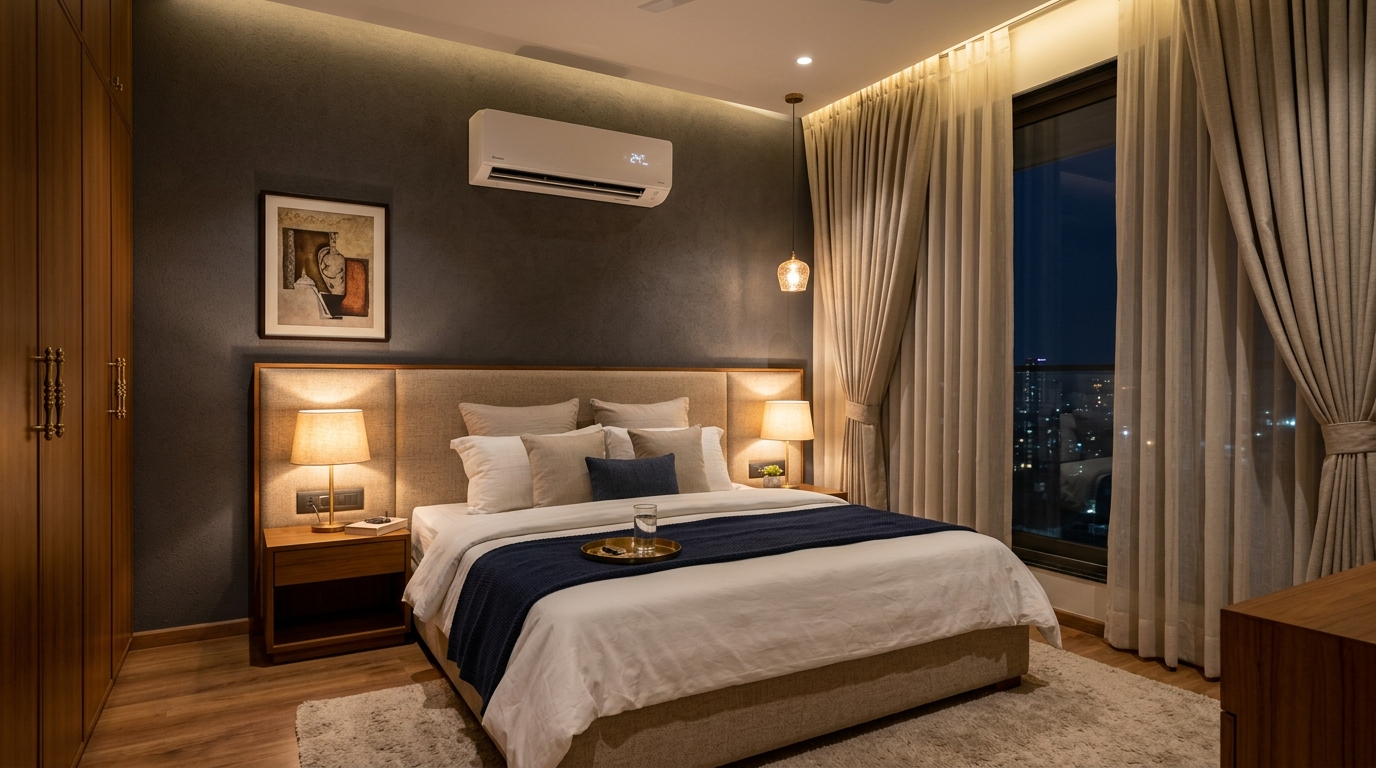
You spend a third of your life in bed. If your air conditioner wakes you up three times every night—either because it is rattling like an old diesel generator or because it chilled the room into an Antarctic freezer at 4:00 AM—it is failing its most fundamental job. In this guide, we break down the engineering behind quiet bedroom cooling, analyze noise levels down to the decibel, explain why smart sleep modes save over ₹500 every single month on electricity, and review the top five whisper-quiet split ACs designed specifically for uninterrupted sleep in Indian homes.
⚡ Quick Recommendations for Bedroom Air Conditioners (2026)
- Quietest Overall: Panasonic 1.5 Ton 5 Star (CS/CU-NU18BKY5WX) runs at a whisper-silent 26 dB with custom smartphone sleep curves and an industry-topping 5.80 ISEER.
- Best Automatic Sleep Cooling: LG 1.5 Ton 5 Star AI DUAL Inverter (TS-Q19YNZE) continuously tunes compressor frequency to avoid midnight temperature drops.
- Best for Draft Avoidance: Daikin 1.5 Ton 5 Star (FTKM50XV) features Coanda airflow that directs icy air across the ceiling instead of directly down on your bed.
- Best for Kids & Guest Bedrooms (Under 120 sq ft): LG 1 Ton 5 Star (MS-Q12YNZA) offers low 560 kWh annual consumption with minimal footprint.
- Best for Pitch-Black Rooms: Carrier 1.5 Ton 5 Star (ESTER EDGE Gxi) features a smart ambient light sensor that automatically shuts off the unit display when room lights turn off.
Why Bedroom ACs Have Completely Different Requirements
Most air conditioning buying guides focus exclusively on capacity and star ratings. While those numbers matter, they completely miss the environmental reality of a quiet Indian bedroom at night. When you evaluate an AC for your sleeping quarters, the hierarchy of priorities flips upside down:
1. Acoustic Comfort Is Priority #1
During the afternoon, your living room has an ambient sound level between 50 dB and 65 dB due to television chatter, ceiling fans spinning at maximum speed, kitchen mixer grinders, and outdoor road traffic. An air conditioner running at 42 dB blends right in.
At night, residential indoor sound floors drop to roughly 28 to 35 dB. In that silence, your ears become hyper-sensitive. If an AC indoor blower hums at 42 dB or its outdoor compressor sends low-frequency 50Hz vibrations through the masonry wall, your brain enters a state of micro-arousal. You might not wake up fully, but you drop out of deep slow-wave REM sleep, leaving you tired, groggy, and irritable the next morning.
2. Draft Direction and Thermal Stratification
Have you ever woken up at 3:30 AM with a stiff neck, throbbing temple headache, or a bone-dry throat? That is rarely caused by the room temperature itself; it is caused by air velocity. When a conventional split AC throws a focused jet of 10°C air directly onto your chest or head, your superficial blood vessels constrict rapidly, leading to muscle spasms and dried-out mucous membranes. A true bedroom AC must have advanced airflow redirection—such as ceiling-skimming louvers—to ensure air circulates gently throughout the room rather than dumping straight down on your mattress.
3. Circadian Thermoregulation (The Midnight Freeze Phenomenon)
When you jump into bed at 11:00 PM in peak June heat, your room feels hot, stuffy, and humid. You pick up the remote and set the AC to 22°C or 23°C to cool down quickly.
However, human physiology goes through a natural circadian rhythm: between 2:00 AM and 5:00 AM, your internal metabolic rate drops, and your core body temperature falls by about 1°C. At the same time, outdoor ambient temperatures drop significantly before dawn. If your AC maintains an aggressive 22°C all night long, you will inevitably wake up freezing, hunting for a blanket, or switching the AC off entirely—only to wake up sweating two hours later. A bedroom air conditioner must have an intelligent sleep profile that gradually lifts the setpoint by 1°C to 2°C as the night progresses.
4. Light Pollution in Darkened Rooms
Modern AC indoor units feature bright digital displays showing set temperature, Wi-Fi status, and mode indicators. While convenient during daytime, a bright green or white LED glowing on the wall casts sharp shadows across a pitch-black room. Many users end up sticking dark masking tape over their expensive unit's display panel just to sleep. Premium bedroom models offer single-touch display shutoff or intelligent ambient light sensors that extinguish the LEDs the moment you turn off your bedside lamp.
Noise Levels Explained: 26 dB (Whisper) vs 45 dB (Conversation)
Sound levels are measured in decibels on an A-weighted scale (dB(A)), which mirrors the human ear's sensitivity to different frequencies. What many homeowners do not realize is that the decibel scale is logarithmic, not linear.
An increase of 10 dB represents a tenfold increase in acoustic sound energy, and the human ear perceives it as roughly twice as loud. That means an air conditioner running at 36 dB does not sound slightly louder than a 26 dB unit—it sounds twice as loud! An AC blasting at 46 dB sounds four times louder than a 26 dB whisper-quiet model.
| Sound Level (dB) | Real-World Acoustic Example | Impact on Sleep Quality | Typical AC Equivalent |
|---|---|---|---|
| 20 – 26 dB | Rustling leaves, quiet recording booth, breathing | Undetectable. Promotes deep, uninterrupted REM cycles. | Panasonic & Daikin 5-Star Split (Quiet Mode) |
| 27 – 32 dB | Empty library reading room, soft whisper at 5 feet | Pleasant white noise. Easily masked by light ceiling fan. | LG & Carrier 5-Star Split (Low Fan) |
| 35 – 40 dB | Quiet suburban home at daytime, steady rainfall | Noticeable. May trigger light awakenings in sensitive sleepers. | Standard 3-Star Inverter Split (Medium Fan) |
| 42 – 48 dB | Normal office conversation, humming refrigerator nearby | Disruptive. Prevents restorative slow-wave sleep. | Budget Split AC at High Fan or Old Non-Inverter |
| 50 – 58 dB | Moderate rainfall on tin roof, active coffee shop | Severe sleep disruption. Constant ear strain. | Older Window AC or vibrating outdoor unit on thin wall |
Blower Noise vs. Compressor Vibration: Know the Difference
When shopping, you must distinguish between two different sources of bedroom noise:
- Airflow Hiss (Aerodynamic Noise): This is the sound of air passing over the evaporator coils and through the cross-flow fan blades. High-end units like the Panasonic CS/CU-NU18BKY5WX and Daikin FTKM50XV use larger-diameter fan rotors with aerodynamically contoured blades. Because the fan is larger, it moves the same volume of air at significantly lower rotational RPMs, dropping airflow hiss down to 26 dB.
- Low-Frequency Wall Resonance (Structure-Borne Noise): This is the deep, rhythmic thrum-thrum-thrum that resonates through your bedroom brickwork when the outdoor compressor ramps up. Single-cylinder fixed-speed compressors generate substantial lateral vibration. Dual-rotary compressors (featured in LG's AI Dual Inverter and Daikin's Neo-Swing designs) use twin compression chambers rotating 180 degrees out of phase. This mechanical symmetry cancels out centrifugal vibration, keeping your bedroom walls completely steady.
Sleep Mode and Timer Features: Why They Save ₹500+ Every Month
Most people assume sleep mode is just a marketing gimmick that turns down the fan speed. In reality, it is a sophisticated thermodynamic program calibrated to human biological sleep cycles—and one of the most effective electricity-saving features ever engineered into an air conditioner.
The Thermodynamics of Setpoint Temperature
According to testing standards verified by the Bureau of Energy Efficiency (BEE), every 1°C increase in your AC setpoint cuts power consumption by approximately 6%.
Here is how a standard intelligent Sleep Mode operates over an 8-hour bedtime:
- 11:00 PM: You retire to bed and set the AC to a comfortable 24°C. The compressor runs steadily to cool down the room.
- 12:00 AM: As you transition into deep sleep, the unit automatically increases the setpoint to 25°C. The compressor slows down, consuming 6% less electricity.
- 1:00 AM: The unit raises the setpoint to 26°C. The compressor drops its rotational speed further, reducing electricity draw by another 6% (12% total reduction).
- 2:00 AM to 6:00 AM: The AC maintains a rock-steady 26°C for the next 5 hours while running the indoor fan at lowest whisper speed. This matches your body's lowest metabolic rate, preventing morning shivering.
- 6:00 AM or 7:00 AM: The unit automatically shuts down via its timer or continues in ultra-low eco mode.
Monthly Savings Calculation: Flat 23°C vs. Dynamic Sleep Mode (24°C → 26°C)
| Operating Mode | Avg Nightly Power (8 hrs) | Monthly Units (kWh) | Monthly Bill (@ ₹8/unit) |
|---|---|---|---|
| Constant 23°C (No Sleep Mode) | 6.8 kWh | 204 kWh | ₹1,632 |
| Sleep Mode (24°C ramping to 26°C) | 4.6 kWh | 138 kWh | ₹1,104 |
| Net Monthly Savings | 2.2 kWh / night | 66 kWh / month | ₹528 / month saved! |
*Based on a standard 1.5 Ton 5-Star inverter AC in an average 150 sq ft master bedroom with outside ambient night temperatures between 30°C and 34°C, calculated at an average residential tariff of ₹8 per kWh (typical for state discoms like BESCOM, MSEDCL, Tata Power Delhi, and TANGEDCO).
Over an 8-month cooling season, that simple button press keeps over ₹4,200 in your pocket every single year. More importantly, it eliminates that 4:00 AM wake-up cycle where you find yourself shivering under a duvet.
Bedroom Sizing Guide: Master Bedrooms vs Kids & Guest Rooms
Getting the tonnage wrong in a bedroom creates immediate comfort problems. If you undersize the unit, the indoor blower will run at maximum high-speed RPM all night long trying to reach the set temperature, filling your room with loud wind turbulence. If you oversize the unit, the AC cools the room down within 10 minutes and shuts its compressor off before it has time to extract indoor humidity, leaving your bedroom feeling like a cold, clammy, sticky cave.
1. Indian Master Bedrooms (120 to 180 sq ft): 1.5 Ton Standard
In most Indian apartments and independent homes, the master bedroom spans between 130 and 170 square feet. It usually accommodates two adults, a king-sized mattress, wardrobes, and possibly an attached bathroom door that is frequently opened.
For rooms in this bracket, a 1.5 Ton 5-Star Inverter AC is the gold standard. A 1.5 Ton inverter unit will cool down the room quickly during the first 20 minutes, after which its variable-speed compressor throttles back to 30% or 40% capacity. At that low load, the unit operates in its quietest acoustic sweet spot while drawing as little as 300 to 450 watts of electricity per hour.
2. Kids Bedrooms, Studies, & Guest Rooms (80 to 120 sq ft): 1.0 Ton Sweet Spot
Secondary bedrooms, children's rooms, and compact guest rooms rarely exceed 110 square feet. Installing a 1.5 Ton unit here is a mistake: it leads to short-cycling, poor dehumidification, and unnecessary upfront cost.
A high-efficiency 1.0 Ton 5-Star Inverter AC has plenty of capacity for an 80 to 120 sq ft bedroom. Models like the LG MS-Q12YNZA consume just 560 kWh annually under BEE test cycles, providing pin-drop silent cooling with exceptionally low power draw.
Crucial Modifying Factors for Bedroom Sizing
- Top Floor / Roof Heat Gain: If your bedroom is situated on the top floor directly under an uninsulated concrete roof slab, the concrete absorbs solar heat all day and radiates infrared heat downwards long past midnight. You must add 0.5 Ton of capacity (e.g., upgrade a 120 sq ft top-floor room from 1.0 Ton to 1.5 Ton).
- West-Facing Master Windows: Windows exposed to intense afternoon sun heat up bedroom walls. Always install blackout curtains with thermal backing to avoid overloading your bedroom unit at night.
| Bedroom Floor Area | Middle Floor (Shaded) | Top Floor (Direct Sun on Roof) | Recommended Star Rating |
|---|---|---|---|
| Up to 110 sq ft (Kids / Guest) | 1.0 Ton | 1.0 Ton (High ISEER) | 5 Star (for daily sleep) |
| 110 to 140 sq ft (Standard Bedroom) | 1.0 Ton or 1.5 Ton | 1.5 Ton | 5 Star recommended |
| 140 to 180 sq ft (Master Bedroom) | 1.5 Ton | 1.5 Ton (Heavy Duty) | 5 Star (essential for 8+ hrs use) |
| 180 to 240 sq ft (Luxury Suite) | 1.5 Ton or 2.0 Ton | 2.0 Ton | 5 Star |
Top 5 Bedroom ACs in India (2026 Tested & Reviewed)
We evaluated indoor acoustic levels, compressor vibration suppression, sleep algorithms, display dimming capabilities, and seasonal energy efficiency to select the five best air conditioners for quiet bedroom cooling in 2026.
1. Panasonic 1.5 Ton 5 Star Wi-Fi Inverter Smart Split AC
If sound is your primary deal-breaker, this Panasonic split AC is the undisputed king of bedroom cooling. Running on its dedicated Quiet Mode, its indoor noise level drops to an astonishing 26 dB—quieter than a whispered conversation in an empty library. Combined with the industry's highest energy efficiency rating in this category (ISEER 5.80), this machine is built from the ground up for peaceful night routines.
Acoustic Level
26 dB (Lowest)
ISEER Rating
5.80 (Class-Leading)
Annual Power
755 kWh
Approx. Price
₹44,000 - ₹52,000
Why It Excels in the Bedroom:
Panasonic's proprietary MirAIe smartphone platform features a custom hourly sleep profile creator. Unlike standard ACs that enforce a rigid factory timer, MirAIe lets you set your personal temperature preferences for every single hour of the night (e.g., 24°C at 11 PM, 25°C at 1 AM, 26°C at 3 AM, and 27°C at 5 AM). The unit also features PM 0.1 particulate air purification, ensuring you breathe pristine, allergen-free air while your body recharges.
What Makes It Great for Sleep:
- ✓ Whisper-quiet 26 dB acoustic output on low fan
- ✓ Industry-leading 5.80 ISEER cuts electric bills
- ✓ Customizable hourly sleep temperature curves in app
- ✓ In-built PM 0.1 filter clears night airborne dust
Things to Keep in Mind:
- ✕ Remote control lacks backlighting for dark rooms
- ✕ Best sleep features require home Wi-Fi setup
2. LG 1.5 Ton 5 Star AI DUAL Inverter Split AC
LG's AI DUAL Inverter is India's most popular split AC for good reason. Its twin-rotary compressor operates with balanced counter-weights, dramatically cutting down the low-frequency vibrations that travel through bedroom walls. Its AI+ smart cooling mode detects room temperature dynamics and automatically transitions into a smooth nighttime thermoregulation curve without requiring complicated app configurations.
Acoustic Level
31 dB (Low Fan)
ISEER Rating
5.20 (High Efficiency)
Annual Power
836 kWh
Approx. Price
₹44,000 - ₹54,000
Why It Excels in the Bedroom:
LG's dedicated Comfort Sleep Mode raises the setpoint by 1°C every 30 minutes for the first hour and stabilizes at +2°C above your original setting for the rest of the night. Furthermore, pressing the "Light Off" button on the wireless remote instantly turns off the indoor digital temperature readout without affecting cooling, giving you complete darkness.
What Makes It Great for Sleep:
- ✓ Dual rotary compressor eliminates masonry hum
- ✓ Dedicated remote button to extinguish panel LEDs
- ✓ 6-in-1 convertible modes allow dialing down to 40%
- ✓ Ocean Black Fin coating resists monsoon corrosion
Things to Keep in Mind:
- ✕ Indoor acoustic floor (31 dB) is slightly higher than Panasonic
- ✕ Beep tone when changing settings cannot be muted
3. Daikin 1.5 Ton 5 Star Swing Inverter Split AC
If you hate feeling a cold draft blowing directly onto your body while sleeping, Daikin is the gold standard of Japanese airflow engineering. The FTKM50XV features Daikin's celebrated Coanda Airflow technology, which curves air upwards towards the ceiling rather than pointing it downwards toward the bed.
Acoustic Level
28 dB (Quiet Operation)
ISEER Rating
5.00 (Robust & Stable)
Annual Power
870 kWh
Approx. Price
₹47,000 - ₹58,000
Why It Excels in the Bedroom:
Daikin's patented Neo-Swing Compressor replaces the standard sliding vane with an integrated swing blade. This eliminates metal-on-metal friction and prevents refrigerant leakage over time, ensuring the outdoor unit stays virtually silent for years. Its Good Sleep Timer automatically prevents excessive over-cooling by controlling bedroom temperature through an engineered thermal curve.
What Makes It Great for Sleep:
- ✓ Coanda ceiling throw eliminates direct drafts on your bed
- ✓ Patented Neo-Swing compressor prevents friction vibration
- ✓ 28 dB indoor sound level in Quiet Mode
- ✓ Built-in PM 2.5 air purification filter
Things to Keep in Mind:
- ✕ Premium pricing compared to domestic competitors
- ✕ No built-in Wi-Fi (requires separate optional dongle)
4. LG 1 Ton 5 Star DUAL Inverter Split AC
For bedrooms up to 120 square feet—such as kids' bedrooms, nursery rooms, or guest bedrooms—installing a 1.5 Ton AC causes excessive humidity and rapid on-off cycling. This LG 1.0 Ton 5-Star model delivers whisper-quiet, proportionate cooling specifically tailored to compact sleeping quarters.
Acoustic Level
28 dB (Low Fan)
ISEER Rating
5.10 (5-Star)
Annual Power
560 kWh (Tiny Bill)
Approx. Price
₹33,000 - ₹40,000
Why It Excels in the Bedroom:
With an annual energy consumption of only 560 units under standard BEE conditions, you can run this machine for 8 to 9 hours every single night without worrying about massive power bills. It comes equipped with LG's 4-way horizontal and vertical auto-swing, allowing you to direct the airflow away from a child's crib or study desk while cooling the room uniformly.
What Makes It Great for Sleep:
- ✓ Extremely economical running cost (560 kWh/yr)
- ✓ Compact chassis fits easily above bedroom doorways
- ✓ 4-way air swing prevents stagnant heat pockets
- ✓ Low-vibration Dual Inverter technology
Things to Keep in Mind:
- ✕ Insufficient for rooms larger than 120 sq ft
- ✕ Not suitable for top-floor rooms exceeding 110 sq ft
5. Carrier 1.5 Ton 5 Star AI Flexicool Inverter Split AC
Light sleepers who are woken up by subtle ambient glows will love Carrier's ESTER EDGE series. It features a smart light sensor that tracks room illuminance: the moment you turn off the bedroom ceiling lights or bedside lamps, the AC's internal light sensor automatically extinguishes its hidden display screen, creating an immediate blackout environment for sleep.
Acoustic Level
32 dB (Low Fan)
ISEER Rating
5.10 (5-Star)
Annual Power
855 kWh
Approx. Price
₹40,000 - ₹48,000
Why It Excels in the Bedroom:
Carrier's Flexicool 6-in-1 technology lets you manually throttle the cooling capacity down to 50% or 40% with a single tap on the remote. For night use when outdoor temperatures cool down, running the unit capped at 50% capacity prevents the compressor from revving up aggressively, keeping power draw down to ~350 watts while maintaining a silent acoustic profile.
What Makes It Great for Sleep:
- ✓ Ambient light sensor automatically turns off display
- ✓ Flexicool modes throttle capacity down to 40%
- ✓ Hydrophilic Blue Fin coating preserves coil health
- ✓ Rapid Insta-Cool drops bedroom heat quickly before bed
Things to Keep in Mind:
- ✕ Slightly higher acoustic level (32 dB) on medium fan
- ✕ Plastic casing can produce occasional expansion clicks
Side-by-Side Bedroom AC Comparison
Compare the crucial sleep specifications, acoustic ratings, and energy numbers of our top five bedroom picks:
| Model | Capacity | Noise Floor | ISEER | Night Features | Approx. Price |
|---|---|---|---|---|---|
| Panasonic CS/CU-NU18BKY5WX | 1.5 Ton (5-Star) | 26 dB | 5.80 | MirAIe Hourly Sleep Curves + PM 0.1 | ₹44,000 - ₹52,000 |
| LG TS-Q19YNZE | 1.5 Ton (5-Star) | 31 dB | 5.20 | AI Sleep Algorithm + Display Off button | ₹44,000 - ₹54,000 |
| Daikin FTKM50XV | 1.5 Ton (5-Star) | 28 dB | 5.00 | Coanda Ceiling Throw + Neo-Swing Motor | ₹47,000 - ₹58,000 |
| LG MS-Q12YNZA | 1.0 Ton (5-Star) | 28 dB | 5.10 | Dual Inverter + 560 kWh Tiny Consumption | ₹33,000 - ₹40,000 |
| Carrier ESTER EDGE Gxi | 1.5 Ton (5-Star) | 32 dB | 5.10 | Ambient Light Sensor Auto Dim + Flexicool | ₹40,000 - ₹48,000 |
Where to Place the AC in Your Bedroom: Installation Layout Guide
You can buy the quietest, most expensive air conditioner in the world, but if your technician mounts it in the wrong spot, your sleep will suffer. The placement of your indoor blower unit dictates air circulation patterns, draft trajectories, and even drainage noise.
Position 1: Directly Opposite the Bed (The Worst Choice)
Mounting the indoor unit on the wall directly facing the foot of your bed pointing straight at your pillow is the most common mistake made by Indian contractors.
- The Problem: Even on low fan speed, the focused column of cold 10°C air travels across the room and strikes your face, forehead, and upper chest all night.
- The Consequence: You will wake up with dried nasal passages, sinus congestion, a scratchy throat, and severe neck stiffness caused by cold-induced muscle contraction.
Position 2: Centered Above the Bed Headboard (Acceptable with Conditions)
Mounting the split unit directly above your headboard is popular in compact bedrooms where wall space is limited by wardrobes and windows.
- The Advantage: The air is thrown outward toward the opposite wall and circulates back along the sides, meaning cold air is never blown directly down onto your face.
- The Risk: If the unit develops an internal filter rattle, blower hum, or condensation drip, the sound is right above your ears. Furthermore, servicing technicians must stand on your mattress or headboard during seasonal filter cleaning.
Position 3: On a Lateral Side Wall Throwing Across the Foot of the Bed (The Ideal Setup)
Acousticians and HVAC engineers agree that the best position for a bedroom split AC is on a lateral side wall, aligned so the air stream is projected across the open space at the foot of your bed.
- Why It Works: The air stream mixes with room air in the unoccupied portion of the bedroom before gently settling over your bed like a comfortable thermal blanket.
- Acoustic Buffer: The indoor unit is situated 6 to 10 feet away from your ears, providing natural acoustic decay that reduces perceived decibels by an extra 3 to 4 dB.
⚠️ Critical Installation Rules for Bedrooms:
- Ceiling Clearance: Leave at least 15 cm (6 inches) between the top of the indoor unit and your ceiling. The return air grille is on top of the AC; if you mount it flush against the ceiling, the blower suffocates, causing air turbulence whistle and reduced cooling efficiency.
- Drain Pipe Slope: Ensure the indoor drain pipe has a continuous downward gravitational slope of at least 1 inch per 10 feet. Stagnant water sitting inside the internal drain tray can create gurgling sounds at night and attract fungal mold.
- Outdoor Unit Bracket Isolation: Always insist that your technician installs thick rubber vibration-damping pads between the outdoor compressor unit's feet and the wall mounting brackets. Without rubber pads, compressor rotational pulses transfer straight into your bedroom masonry wall, creating a persistent low-frequency hum.
For a complete walkthrough on proper wall mounting, vacuuming lines, and copper piping lengths, read our dedicated AC Installation Guide for India.
Health Concerns: How to Sleep with AC Without Dry Eyes & Sore Throat
Many people believe that sleeping in an air-conditioned room is inherently unhealthy. In reality, the health issues people report—dry eyes, morning throat irritation, stuffy sinuses, and joint aches—are caused by air dryness and aggressive over-cooling, not the AC itself.
Why Air Conditioners Dry Out the Air
An air conditioner cools a room by pulling warm air over its aluminum evaporator coils, which run at temperatures around 4°C to 7°C. When humid air contacts these freezing coils, moisture condenses out of the air into liquid water and drains outside through the drain pipe.
While this dehumidification is a blessing during sticky July monsoon weather, during dry summer months it can drop bedroom Relative Humidity (RH) down to 25% or 30%. The optimal relative humidity range for human respiratory health and restorative sleep is 45% to 55%.
Proven Remedies to Fix Morning AC Dehydration:
- Stop Setting the AC to 18°C or 20°C: Running the compressor at full tilt strips every ounce of ambient moisture out of the air. Increasing your setpoint to 24°C, 25°C, or 26°C slows down excessive condensation, maintaining comfortable humidity levels.
- The Bedroom Water Bowl Technique: If you do not own an electric humidifier, place a wide-mouthed shallow bowl filled with clean water on your bedside table or dressing counter. As the dry AC air circulates, water evaporates naturally into the air stream, keeping humidity above the 40% threshold.
- Use Dry Mode During Monsoons: During humid rainy months, running your AC in standard cool mode often leaves the room cold and clammy. Switch to Dry Mode (indicated by a water drop icon on your remote). Dry mode runs the compressor in short bursts with an ultra-slow fan speed, pulling liters of moisture out of the air without freezing your room.
- Wash Pre-Filters Every 14 Days: Dust and pet hair trapped in your indoor mesh filters become breeding grounds for dust mites and spores. When the AC blows air through clogged filters all night, you inhale microscopic particles for 8 hours straight, waking up with sinus inflammation and itchy eyes.
The Science of the Perfect Sleep Temperature: Why 24°C–26°C Wins
There is a widespread myth in India that a "good" air conditioner is one that turns your bedroom into a walk-in refrigerator at 18°C. Setting your AC to 18°C is terrible for your sleep architecture, terrible for your physical health, and devastating for your electricity bill.
The Medical Consensus on Sleep Thermoregulation
Clinical sleep research published by the National Sleep Foundation demonstrates that the onset of sleep is triggered by a drop in human core body temperature. Blood vessels in your hands and feet dilate (a process known as vasodilation) to dump internal heat into the surrounding environment.
If your bedroom ambient temperature is too hot (above 28°C), your body cannot dissipate heat, resulting in restless tossing and fragmented sleep. However, if the room is chilled below 22°C:
- Your peripheral blood vessels clamp shut to prevent hypothermia.
- Your body triggers subtle muscular shivering to generate heat, preventing you from reaching Stage 3 deep restorative slow-wave sleep.
- Your body wakes up feeling stiff, tense, and exhausted.
The 24°C–26°C Sweet Spot
For Indian climatic conditions and typical sleeping attire (light cotton nightwear with a light sheet or thin dohar), medical researchers and the Bureau of Energy Efficiency (BEE) agree that 24°C to 26°C is the optimal bedroom temperature.
At 25°C, your body maintains thermal equilibrium with zero metabolic effort. To maximize comfort, pair your 24°C or 25°C AC setpoint with a ceiling fan running on Speed 1 or Speed 2. The gentle 0.2 m/s air breeze from the fan breaks up stagnant air pockets and provides a comfortable 1°C wind-chill effect on your skin, allowing you to enjoy the cooling sensation of 23°C while your AC runs efficiently at 25°C.
Ready to Upgrade Your Bedroom Sleep?
Check live discounts, verified buyer reviews, and installation offers on India's top whisper-quiet bedroom air conditioners on Amazon.
🛒 Check Today's Best Bedroom AC Deals on Amazon IndiaFrequently Asked Questions About Bedroom ACs
1. Which AC brand produces the least noise for bedroom use in India?
Panasonic and Daikin lead the Indian market for acoustic performance in bedrooms. The Panasonic CS/CU-NU18BKY5WX achieves an ultra-quiet 26 dB in Quiet Mode, while Daikin's FTKM50XV operates at 28 dB. Both models feature aerodynamically enlarged fan drums that move substantial air volumes at lower rotational RPMs, virtually eliminating airflow hiss.
2. Is a 1 Ton AC sufficient for a 10x12 ft master bedroom?
A 10x12 ft bedroom measures 120 square feet. If your bedroom is situated on a middle floor with shaded exterior walls, a 1.0 Ton 5-Star inverter AC is completely sufficient and will cool the space efficiently. However, if your bedroom is on the top floor directly under an uninsulated sunbaked concrete terrace slab, or has a large unshaded west-facing window, you should opt for a 1.5 Ton model to ensure the compressor does not strain during hot summer nights.
3. How does sleep mode actually save money on electricity bills?
Sleep mode automatically increases the target temperature by 1°C per hour for the first two hours (for example, raising your setpoint from 24°C to 26°C) and holds it steady until morning. Since power consumption drops by roughly 6% for every 1°C increase in AC temperature, running at 26°C during early morning hours cuts power draw by 12% to 18%, saving approximately ₹500 to ₹650 per month on an 8-hour nightly cycle.
4. Should the AC be mounted directly above the bed or on the opposite wall?
The ideal placement is on a lateral side wall throwing air across the foot of the bed. Mounting directly opposite your bed blowing at your face causes cold drafts, morning sinus headaches, and dry throat. Mounting directly above the headboard is acceptable only if you have Coanda ceiling louvers (like Daikin) or if wall space is limited, though servicing can be awkward above a mattress.
5. Why do I wake up with a sore throat or dry eyes when sleeping with the AC on?
When an air conditioner cools a room, it condenses airborne moisture on its freezing evaporator coils, which can drop bedroom relative humidity below 30%. This dry air dehydrates mucous membranes in your nose, throat, and eyes. To resolve this, increase your setpoint to 25°C or 26°C, keep a shallow bowl of water in the bedroom, and clean your indoor dust filters every two weeks.
6. Can I leave my bedroom AC running all night for 8 to 9 hours every day?
Yes, modern inverter split air conditioners are specifically engineered to run continuously for long periods. In fact, running an inverter AC continuously at 25°C or 26°C draws far less power than repeatedly switching a unit on and off. The variable-speed compressor will cruise smoothly at low speeds (drawing only 300 to 450 watts), maintaining steady cooling with minimal wear on mechanical components.
7. Is a 5-star AC worth the extra cost over a 3-star AC for a bedroom?
Yes, absolutely. Because bedroom air conditioners typically run for 8 to 10 hours every night throughout the 6 to 8 warm months of the year (accumulating 1,500+ operational hours annually), the electricity savings of a 5-star inverter AC easily recover the ₹6,000 to ₹8,000 upfront price difference within 2 to 2.5 years. Additionally, 5-star units invariably feature quieter fan assemblies and superior vibration insulation compared to budget 3-star models.
8. Does running a ceiling fan help when using an air conditioner in the bedroom?
Yes. Running your ceiling fan at a slow, gentle speed (Speed 1 or 2) while your AC is set to 25°C or 26°C circulates cooled air evenly across the room without creating noisy turbulence. The slow air movement creates an evaporative wind-chill effect of about 1°C on your skin, allowing you to enjoy the thermal comfort of 24°C while saving significant power on your AC unit.
9. What is Daikin Coanda airflow and why is it beneficial for bedrooms?
The Coanda effect is an aerodynamic principle where an air stream adheres to a nearby surface. Daikin's specialized louver design shoots cold air upwards along the ceiling line rather than dumping it downward. As the cold air travels along the ceiling, it cools the upper thermal boundary of the room and gently sinks downward across the entire floor area, eliminating cold drafts blowing straight onto your sleeping body.
10. How often should bedroom air conditioner filters be cleaned?
For a bedroom used every night, you should clean the indoor nylon mesh filters every two to three weeks. In bedrooms, blankets, sheets, and pillows shed fine textile lint that clogs AC filters much faster than in living rooms. Clogged filters restrict airflow, forcing the fan motor to work harder and louder, while recirculating trapped dust and allergens right above your bed.
Related Buying Guides & Calculators
- Best 1 Ton AC in India (2026) — Ideal models for compact kids' rooms and guest bedrooms under 120 sq ft.
- Best 1.5 Ton AC in India (2026) — Top-rated inverter split models for master bedrooms and medium-sized rooms.
- AC Installation Guide for India — Step-by-step checklist on bracket mounting, vacuuming lines, and rubber vibration isolation.
- Inverter vs Non-Inverter AC — Detailed electricity savings math, compressor mechanics, and payback periods.
- What is ISEER Rating in Air Conditioners? — How BEE calculates energy efficiency stars for Indian tropical weather.
- AC Electricity Bill Calculator — Estimate your exact monthly electricity costs based on your state's electricity tariff.