Best AC for Mumbai (2026): Surviving Coastal Salt, 85% Humidity & High Electric Tariffs
Buying an air conditioner in Mumbai isn't like buying one in Delhi, Pune, or Jaipur. Between corrosive marine winds blowing off the Arabian Sea, non-stop 85% relative humidity, and Adani or BEST electricity rates crossing ₹12 per unit, standard buying advice will leave you with rusted coils and monstrous power bills. Here is how to pick the right machine for maximum dehumidification, rust defense, and lowest lifecycle running cost.
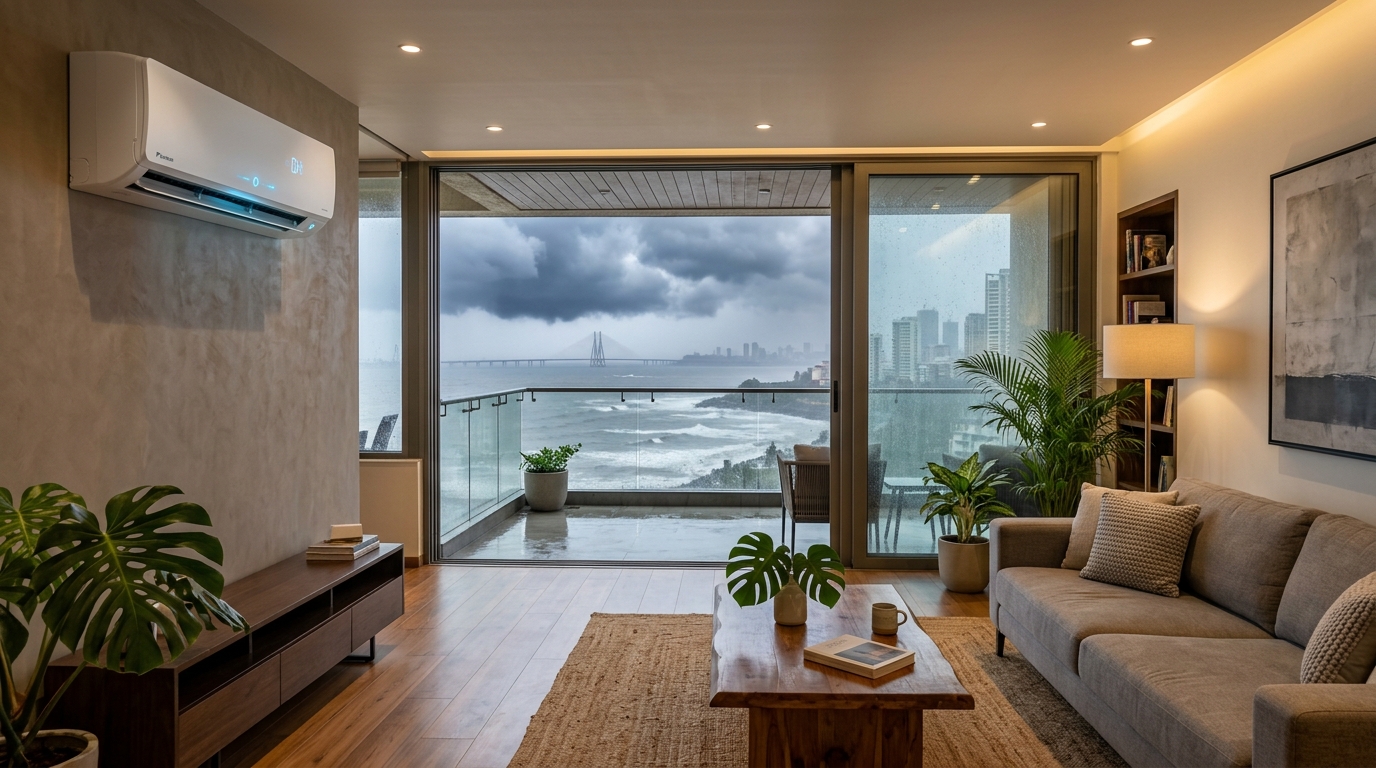
Key Takeaways for Mumbai Buyers
- Salt Air Attacks Coils: Never buy an AC with aluminium condenser coils or unshielded fins in Mumbai. Look for certified anti-corrosion coatings like LG's Ocean Black Fin or Panasonic's Shield Blu+.
- Humidity Dictates Cooling Load: 40% to 50% of your AC's power in Mumbai goes toward pulling moisture out of the air (latent cooling), not dropping temperature (sensible cooling). Dedicated dry modes and fast moisture removal rates are non-negotiable.
- Mumbai Cools 8 to 10 Months a Year: Because Mumbai rarely drops below 26°C with 75% humidity even in November, your AC runs 1,800 to 2,400 hours annually. A high ISEER 5-Star model pays back its price premium in under 18 months.
- High Electricity Slabs: With Mumbai DISCOM tariffs reaching ₹11 to ₹14 per kWh for tier-3 consumption, every 0.5-point jump in ISEER cuts your monthly summer bill by ₹450 to ₹700.
Why Mumbai's Climate Destroys Ordinary Air Conditioners
If you talk to an HVAC technician working in Bandra, Prabhadevi, Marine Drive, or Versova, they will tell you the same heartbreaking story. A homeowner spends ₹38,000 on a budget AC, and by month 22, the cooling drops to zero because the outdoor condenser coil has corroded into chalky white powder, venting R32 refrigerant into the sea breeze.
Mumbai sits on a coastal peninsula surrounded on three sides by the Arabian Sea and Thane Creek. The climate here creates a triple threat that standard laboratory tests do not simulate:
1. Relentless Humidity and the "Heat Index" Trap
On paper, Mumbai summers look mild compared to North India. Temperatures rarely cross 37°C or 38°C. But the relative humidity routinely hovers between 75% and 92%. In thermal engineering, this is known as the wet-bulb temperature problem.
When the air is at 35°C with 85% relative humidity, the Heat Index (what your body actually feels) shoots up past 49°C. Your sweat cannot evaporate off your skin. You feel sticky, suffocated, and exhausted. Ordinary ACs designed for dry heat focus solely on dropping the thermostat number quickly, leaving the room cold yet clammy—a recipe for muscle stiffness and disturbed sleep.
2. Coastal Salt Fog and Galvanic Rust
Sea breeze carries microscopic salt aerosols (sodium chloride and magnesium sulfate) several kilometers inland. If you live within 5 to 7 km of the coast—whether in Colaba, Worli, Juhu, or Navi Mumbai along the Palm Beach corridor—these salt particles settle directly onto your AC's outdoor condenser fins.
When salt mixes with morning condensation, it forms an electrolytic solution that sparks rapid galvanic corrosion. Bare aluminium fins disintegrate, thin-gauge copper bends crack, and the compressor housing begins to flake with red rust within two monsoons. Learn more about coil longevity in our guide on copper vs aluminium coil air conditioners.
3. The Dreaded "October Heat" and Monsoon Mold
Mumbai doesn't get autumn. From mid-June through late September, continuous monsoon rains soak the city with 95% ambient humidity. Indoor evaporator coils stay perpetually damp. Dark, moist indoor units become breeding grounds for black mold (Cladosporium) and bacterial slime, producing that rancid, vinegar-like smell every time you switch the unit on.
Then comes October. The rains stop, the cloud cover breaks, and intense solar radiation beats down on saturated soil and concrete. October in Mumbai often feels more punishing than May because stagnant, humid air traps urban heat between high-rises.
Humidity vs Heat: Latent Heat Removal Explained
To understand why certain ACs excel in Mumbai while others struggle, we need to look at the physics of cooling: sensible heat versus latent heat.
- Sensible Heat: The kinetic energy of air molecules. This is what you measure with a conventional dry-bulb thermometer. Lowering sensible heat makes the air colder.
- Latent Heat: The hidden thermal energy trapped inside evaporated moisture in the air. Lowering latent heat requires condensing water vapor back into liquid form.
In a dry desert climate like Bikaner or Ahmedabad in May (43°C, 20% humidity), around 85% of an AC's cooling capacity is dedicated to sensible heat removal. The coil easily chills the dry air.
In Mumbai (34°C, 85% humidity), nearly 45% of the total cooling capacity is consumed just by condensing water vapor! An air conditioner in an average Mumbai 150 sq ft bedroom must extract between 1.5 and 2.5 liters of liquid water from the air every single hour during the monsoon.
This is why ISEER ratings and variable-speed inverter compressors matter so much in coastal cities. If a compressor only runs full-blast and shuts off abruptly, it chills the air before it has time to squeeze out the humidity. You wake up shivering under a blanket while your bedsheets still feel damp. A modern dual-inverter compressor throttles down to run continuously at a low, steady frequency, keeping the evaporator coil just below the dew point to wring out pints of water without over-chilling the room.
The 3 Non-Negotiable Features for Any Mumbai AC
1. Heavy-Duty Anti-Corrosion Fin Protection
Standard blue epoxy coating is the bare minimum today. For Mumbai, you want multi-layered protective coatings specifically engineered for saline environments:
- LG Ocean Black Fin: Applies an electro-deposition cathodic primer covered by an acrylic resin layer with hydrophilic properties. It is tested to withstand salt spray test conditions for over 1,500 hours without fin degradation.
- Panasonic Shield Blu+: Features an advanced anti-corrosive coating on both indoor evaporator and outdoor condenser coils, protecting against both coastal salt winds and urban sulfur pollution.
- Daikin Patented Anti-Corrosion Treatment: Daikin coats both fin surfaces with an acrylic resin and hydrophilic film, specifically designed to let condensate water wash away salt deposits naturally without sticking.
2. Active Self-Cleaning & Coil Drying Tech
Because Mumbai's humidity keeps evaporator coils wet for months, mold buildup is inevitable unless the AC actively sanitizes itself. Look for technologies like:
- Dew Clean / Frost Wash: Featured in Daikin and Hitachi units, these systems freeze the evaporator coil to lock in airborne dust, pollens, and mold spores in ice, then rapidly melt the frost to flush the sludge out through the drain line, finishing with hot air blower drying.
- Auto Clean / AI Dry: Runs the indoor blower fan at low speed for 10 to 15 minutes after you switch off the AC, drying up every trace of leftover moisture on the fins so fungal spores cannot germinate.
3. Wide Voltage Operating Range & Tropic-Grade PCB
While Mumbai's island city (BEST) enjoys relatively stable power, suburban pockets in Thane, Navi Mumbai, Mira-Bhayandar, and Kalyan-Dombivli face sudden voltage sags during peak summer evening loads. Furthermore, salt-laden sea air can infiltrate outdoor unit electrical boxes, causing short circuits on exposed printed circuit boards (PCBs). Pick an AC with conformal silicon coating on the PCB and a stabilizer-free operating range between 140V and 290V.
| Brand & Model | Anti-Corrosion Tech | Dehumidification / Clean | ISEER | Annual kWh |
|---|---|---|---|---|
| LG 1.5T 5 Star AI DUAL | Ocean Black Fin (Indoor + Outdoor) | AI Dry + Auto Clean | 5.2 | 836 |
| Panasonic 1.5T 5 Star Wi-Fi | Shield Blu+ Advanced Coating | nanoe-G Air Purification + Clean | 5.8 | 755 |
| Daikin 1.5T 5 Star FTKM50XV | Anti-Corrosion Acrylic Resin | Dew Clean Deep Coil Wash | 5 | 870 |
| Hitachi 1.5T 5 Star Yoshi | Inner Grooved Copper + Hydrophilic | Frost Wash Technology | 4.55 | 970 |
| Carrier 1.5T 5 Star Flexicool | Aqua Clear Hydrophilic Shield | Auto Cleanser + PM 2.5 Filter | 5.1 | 855 |
Top 5 Air Conditioners for Mumbai in 2026
We evaluated dozens of models sold in Mumbai electronics hubs from Lamington Road to Vijay Sales outlets across Mumbai suburbs. These five air conditioners deliver the best combination of salt protection, dehumidification speed, and high-efficiency power savings.
1. LG 1.5 Ton 5 Star AI DUAL Inverter Split AC
LG is the gold standard for Mumbai apartments for one specific reason: Ocean Black Fin. Unlike generic blue fin coatings that only protect the outer edges, LG applies its anti-corrosive electro-deposition layer to both the indoor evaporator and outdoor condenser coils. In coastal buildings where sea wind strips ordinary coil protection in 18 months, LG units easily survive 7 to 10 years without leaking refrigerant gas.
The dual rotary compressor with twin rotors balances rotational inertia, which substantially cuts down vibration. If your outdoor unit is mounted on a hollow balcony grill or external RCC bracket in a Mumbai high-rise, this vibration dampening eliminates rattling noises through your bedroom wall. Its AI 6-in-1 convertible system uses embedded temperature and humidity sensors to modulate refrigerant flow automatically, preventing the room from feeling like a clammy refrigerator.
- Proven salt air durability with Ocean Black Fin coating
- Low vibration dual rotary compressor won't vibrate apartment grills
- AI Dry mode automatically maintains 50% relative indoor humidity
- ThinQ Wi-Fi allows pre-cooling your flat during the Mumbai commute
- Higher upfront purchase cost than 3-star alternatives
- Stock sells out rapidly in April and May across western suburbs
2. Panasonic 1.5 Ton 5 Star Wi-Fi Inverter Smart Split AC
At a staggering 5.80 ISEER, this Panasonic split AC is the single most energy-efficient 1.5-ton unit sold in India today. Its annual power consumption is rated at just 755 kWh. In Mumbai, where families run their air conditioners 10 to 14 hours every single day from March to October, this machine will slash your Adani or BEST electricity bill by ₹5,000 to ₹7,200 each year compared to a typical 3-star AC.
Panasonic protects against the coastal atmosphere using its Shield Blu+ coating across all copper tubes and fin assemblies. But its secret weapon for Mumbai is the MirAIe smart app combined with nanoe-G air purification. The nanoe-G generator releases billions of negative ions that deactivate microscopic mold spores and airborne bacteria, actively preventing the musty fungal odor that plagues Mumbai bedrooms during heavy monsoon showers.
- Unbeatable 5.80 ISEER delivers fastest electricity payback in Mumbai
- nanoe-G actively neutralizes monsoon mold and damp odor
- MirAIe app lets you program custom hourly sleep temperature curves
- Shield Blu+ dual-side coating resists salty atmospheric moisture
- Requires 2.4GHz home Wi-Fi for full smart feature set
- Outdoor unit casing is slightly bulky for compact duct ledges
3. Daikin 1.5 Ton 5 Star Swing Inverter Split AC
Ask any independent air conditioner technician in Mumbai which brand has the lowest compressor breakdown rate, and they will point to Daikin. The FTKM50XV features Daikin's patented Swing Inverter Compressor. In a conventional rotary compressor, the piston moves against the cylinder blade with friction, which eventually wears down the seal and lets gas leak out in harsh marine air. Daikin's swing blade is integrated directly with the roller, eliminating internal friction and preventing refrigerant leakage at compression joints.
For Mumbai homes, Daikin's Dew Clean Technology is an absolute lifesaver. At the touch of a button, the indoor unit operates the indoor heat exchanger to condense airborne moisture into a controlled water bath, thoroughly flushing away fine dust particles, salt residue, and bacterial grime into the condensate drain. It then heats the coil to dry it out completely, leaving zero residual moisture for mold to grow on.
- Swing compressor mechanics eliminate friction and gas leaks
- Dew Clean water wash purges salt and mold from indoor fins
- Coanda Airflow sends cold air along the ceiling, preventing icy drafts
- Exceptionally quiet indoor operation (under 32 dB)
- Does not include built-in Wi-Fi out of the box (requires optional adapter)
- Premium retail price point
4. Hitachi 1.5 Ton 5 Star Inverter Split AC
Hitachi's iKasu and Yoshi series bring Japanese thermal engineering directly targeted at high-humidity tropical conditions. The standout feature is Frost Wash. When activated, the air conditioner cools the heat exchanger down to -15°C, rapidly freezing ambient atmospheric moisture onto the fins into a thick layer of frost. This frost encapsulates trapped particulate matter, dust mites, and fungal growth.
The machine then heats the coil rapidly. The melting ice surges downward as a high-velocity wash, sweeping every bit of slime and dirt directly into the drain tray. In Mumbai, where coastal dust mixes with atmospheric soot and moisture to turn into sticky black grime on indoor coils, Frost Wash restores airflow efficiency without requiring expensive chemical pressure washing every few months.
- Frost Wash freezes and flushes sticky marine dust and biofilm
- Inner grooved copper tubes maximize rapid condensation
- Tropical compressor reliably cools during oppressive 42°C heat index peaks
- Super-silent fan speed profile ideal for noise-sensitive master bedrooms
- ISEER of 4.55 is respectable but lower than Panasonic or LG
- Hitachi authorized service network varies in northern suburbs
5. Carrier 1.5 Ton 5 Star AI Flexicool Inverter Split AC
Carrier's ESTER EDGE series is tailor-made for Mumbai apartment living. Most Mumbai flats—whether in Andheri, Goregaon, or Mulund—have compact floor layouts where the cooling requirement swings wildly between day and night. With Flexicool 6-in-1 technology, you can throttle the compressor down to 40% (0.8 Ton equivalent) or 60% with a single button press on the remote. When you are working from home alone in your bedroom, running at 40% consumes just 450 to 550 watts of electricity while maintaining constant dehumidification.
The outdoor condenser is protected by Carrier's Aqua Clear Protection coating. This specialized hydrophilic film prevents salt deposits from bonding to the aluminium fin surfaces, enabling rainwater during the monsoon to naturally wash away coastal residue. Combined with Insta Cool for rapid 60-second temperature pull-down when you walk in from 38°C outdoor humidity, it is one of the most practical everyday ACs in this price segment.
- Flexicool step-down modes let you run at 40% capacity to sip power
- Aqua Clear coating repels salt buildup on condenser coils
- Dual filtration handles both fine PM 2.5 and coastal dust
- Competitive pricing makes 5-star efficiency affordable
- Remote control display has no backlight for night use
- Indoor blower fan is slightly audible at maximum 100% turbo mode
Ready to Upgrade Your Mumbai Home?
Compare live prices, bank exchange offers, and fast delivery slots across 5-star inverter split air conditioners on Amazon India.
🛒 View Best 5-Star ACs for Mumbai on AmazonTonnage Sizing for Mumbai Homes: From 1BHKs to High-Rise Towers
Choosing the right AC tonnage in Mumbai is tricky because floor space is small, but heat load is disproportionately high. Mumbai apartments face specific structural factors:
1. Compact 1BHK & 2BHK Bedrooms (100 to 130 sq ft)
For a standard 100 to 125 sq ft bedroom in a mid-floor flat in Kandivali, Chembur, or Vile Parle with shaded walls, a 1 Ton 5-Star Inverter AC is plenty. It cools quickly and sips very little power. However, if that same bedroom has a large west-facing French window getting direct afternoon sun, jump to a 1.5 Ton AC.
2. SRA Flats and Redevelopment Housing Units
Slum Rehabilitation Authority (SRA) flats and compact MHADA redevelopments typically have carpet areas of 225 to 320 sq ft with ceiling heights under 9 feet. These buildings are densely packed, with minimal distance between facing wings. The lack of cross-ventilation creates stagnant indoor heat pockets, and having 4 to 5 family members in a single living-cum-bedroom space creates massive human latent heat load.
For an SRA unit, do not buy a 0.8 Ton machine. Install a sturdy 1.0 Ton or 1.5 Ton inverter AC with strong moisture extraction capacity. Ensure the outdoor unit is mounted where the hot discharge air does not hit a neighbor's window ledge directly, which can cause thermal cutoffs.
3. High-Rise Apartments (15th Floor and Above)
If you live on the 15th to 40th floor in Lower Parel, Wadala, or along the coastal link road in Malad:
- Direct Solar Radiation: Above neighboring tree lines and low-rises, your exterior walls and floor-to-ceiling glass balconies absorb uninterrupted sunlight all day.
- Severe Marine Wind: High-altitude winds buffeting against your outdoor unit can stall the condenser fan motor if the unit faces directly into the prevailing sea breeze.
- Top Floor / Penthouse Penalty: If you are on the top floor directly under the building's concrete terrace slab, the roof acts as a giant thermal radiator radiating heat into your ceiling all night.
Always add a 0.5 Ton safety margin for top-floor or high-rise sea-facing rooms. If a standard room calculator suggests 1.0 Ton, buy 1.5 Ton. If your living room is 190 sq ft, go for a 2.0 Ton model. Check our interactive AC tonnage calculator to fine-tune your room specifications.
| Room Type & Floor Area | Sun Exposure / Floor Level | Recommended Tonnage | Ideal Inverter Setting |
|---|---|---|---|
| 1BHK Master Bedroom (100–120 sq ft) | Intermediate floor, shaded or East-facing | 1.0 Ton | Standard Auto / Dry Mode |
| 1BHK Master Bedroom (110–130 sq ft) | Top floor or West-facing glass balcony | 1.5 Ton | Convertible at 80% to 100% |
| 2BHK Master Bedroom (130–160 sq ft) | High-rise (15th+ floor) or sea-facing | 1.5 Ton | Continuous 100% cooling |
| 1BHK / 2BHK Living Room (160–210 sq ft) | High occupancy + kitchen heat nearby | 1.5 to 2.0 Ton | Full 100% / Turbo during gatherings |
| SRA Flat / Studio (220–280 sq ft total) | Multi-person family living, poor breeze | 1.5 Ton | Dedicated Dry Mode at 24°C |
| Top Floor Penthouse / Duplex (220+ sq ft) | Direct roof sun + coastal west wind | 2.0 Ton | Heavy duty dual inverter cycle |
Mumbai Electricity Bills: Adani vs BEST vs Tata Power Tariffs
Electricity in Mumbai is among the most expensive in India. Unlike cities with flat tariffs or heavy residential power subsidies, Mumbai operates under strict multi-tier slabs regulated by the Maharashtra Electricity Regulatory Commission (MERC).
Depending on where your building stands, your power comes from one of four utility distributors:
- BEST Undertaking: Supplies the historic Island City (Colaba up to Sion and Mahim). Historically had the lowest base rates, but Fuel Adjustment Charges (FAC) have escalated summer bills.
- Adani Electricity Mumbai Limited (AEML): Supplies the entire Mumbai suburban corridor (Bandra to Dahisar on the western line, Kurla to Mankhurd on the harbour line). Highly reliable grid, but higher upper slab rates.
- Tata Power: Operates retail supply across suburbs and select south Mumbai pockets.
- MSEDCL (Mahavitaran): Serves extended urban nodes including Thane, Navi Mumbai, Mira Road, and Kalyan.
Understanding the "Upper Slab" Trap
The trap for Mumbai consumers is that your baseline household electricity—refrigerator, ceiling fans, induction stove, TV, washing machine, and lighting—already consumes 180 to 220 units per month. That pushes your baseline usage right to the edge of the second tariff slab.
When you turn on your air conditioner for 8 to 12 hours a day, every single unit consumed by the AC falls into Slab 3 (301–500 units) or Slab 4 (500+ units)!
- Slab 1 (0–100 units): ~₹4.50 to ₹5.50 per unit
- Slab 2 (101–300 units): ~₹8.20 to ₹9.80 per unit
- Slab 3 (301–500 units): ~₹12.00 to ₹13.80 per unit (including FAC & electricity duty)
- Slab 4 (500+ units): ~₹14.50 to ₹16.20 per unit
Because every AC unit is billed at your highest marginal tariff (roughly ₹12 per kWh on average), a cheaper 3-star AC will quickly drain thousands of extra rupees right out of your bank account. Use our AC electricity cost calculator to estimate your exact monthly payout.
| AC Type & Rating | Avg. ISEER | Monthly kWh (8 hrs/day) | Monthly Bill @ ₹12/kWh | 8-Month Season Total |
|---|---|---|---|---|
| Older 3-Star Fixed Speed (Non-Inverter) | 3.10 | 285 units | ₹3,420 | ₹27,360 |
| Standard 1.5T 3-Star Inverter AC | 3.90 | 195 units | ₹2,340 | ₹18,720 |
| Premium 1.5T 5-Star Inverter (LG / Daikin) | 5.20 | 145 units | ₹1,740 | ₹13,920 |
| Flagship 1.5T 5-Star (Panasonic CS/CU-NU18) | 5.80 | 128 units | ₹1,536 | ₹12,288 |
The Financial Reality: Upgrading from an older 3-star AC to a top-tier 5-star Panasonic or LG inverter unit saves over ₹15,000 every single year in Mumbai. Even comparing a new 3-star inverter with a 5-star inverter, the ₹5,000 to ₹7,000 retail price difference is recovered in under two cooling seasons. In Mumbai, buying a 3-star AC to save ₹6,000 upfront is the single most expensive mistake a homeowner can make.
Mumbai Installation & Maintenance Checklist
Even the highest-rated air conditioner will fail prematurely if improperly installed or neglected in coastal conditions. Follow these five practical rules:
- Angle the Condensate Drain Pipe Steeply: Because an AC extracts over 15 to 20 liters of water every day in July and August, water must flow freely. If the drain pipe has even a slight upward dip, water will back up into the indoor tray, breeding black slime that overflows onto your expensive wooden flooring or painted drywall.
- Install Outdoor Vibration Pads: Mumbai high-rise apartments often place outdoor units on cantilevered MS brackets or window box grills. Request your installer to place heavy vulcanized rubber vibration-absorbing pads between the AC feet and the bracket. This stops metallic hum from resonating into your bedroom.
- Position the Outdoor Unit Away from Kitchen Vents: Never mount your outdoor condenser unit right next to your kitchen chimney exhaust duct. The combination of hot oily vapors from tadka/cooking and marine salt forms an impenetrable sticky film over the condenser fins, suffocating heat transfer.
- Clean Mesh Filters Every 14 Days: Mumbai dust is humid and greasy. Dry air filters clog twice as fast here as in dry regions. Rinse your nylon indoor filters under tap water every other Sunday.
- Schedule Deep Chemical Coil Service Twice Annually: Standard water-spray servicing won't dislodge salt crystals embedded between micro-grooved fins. Have an authorized technician perform a specialized foam chemical coil wash once in March (before summer) and once in October (post-monsoon).
Frequently Asked Questions: ACs in Mumbai
1. Why do AC outdoor units leak gas and rust so quickly in Mumbai coastal areas?
Marine winds carry fine sodium chloride and magnesium salt aerosols that settle onto the exterior unit. When combined with morning dew and high humidity, galvanic corrosion occurs between the copper tubing and aluminium heat exchanger fins. Over 18 to 24 months, microscopic pinhole leaks form at U-bends and brazed joints, venting refrigerant gas. That is why choosing an AC with 100% grooved copper and factory anti-corrosion fin coatings (like LG Ocean Black Fin or Daikin anti-corrosion treatment) is mandatory within 10 km of the coastline.
2. Should I buy a 3-Star or 5-Star AC for my flat in Mumbai?
Always choose a 5-Star AC for Mumbai. In North India where cooling is restricted to 4 months, a 3-star AC can be a budget-conscious compromise. In Mumbai, you run your AC for 8 to 10 months because of persistent heat and humidity. Furthermore, upper electricity tiers on Adani and BEST tariffs reach ₹12 to ₹15 per kWh. A 5-star AC with an ISEER above 5.0 will save ₹4,000 to ₹7,000 annually, paying off its higher purchase price within 14 to 18 months.
3. How does Dry Mode work during the Mumbai monsoon, and does it save power?
In Dry Mode (represented by a water droplet icon on your remote), the AC prioritizes dehumidification over temperature drop. The indoor blower fan throttles down to its lowest speed while the inverter compressor runs steadily at low frequency. This keeps the evaporator coil icy cold, allowing maximum airborne moisture to condense and drain away without dropping the room temperature uncomfortably low. It saves electricity compared to running normal Cool Mode at 18°C because it avoids rapid high-power compressor cycling.
4. What AC capacity is needed for a top-floor flat or penthouse in Mumbai?
Top-floor flats directly beneath an exposed concrete building terrace absorb massive thermal energy throughout the day, radiating heat downward into your room well past midnight. Always add a 0.5-ton safety margin: install a 1.5-ton AC for a 100–120 sq ft bedroom, and a 2.0-ton AC for rooms exceeding 160 sq ft. Also consider applying solar-reflective cool roof paint on the terrace area above your flat to lower your cooling load by up to 20%.
5. How often must I service my air conditioner in Mumbai?
In Mumbai, clean your indoor nylon mesh filters every two to three weeks under running water. For machine maintenance, get a professional chemical foam service twice per year: once in February/March before the brutal pre-monsoon summer, and once in October after the monsoon rains stop. The post-monsoon service is critical to flush out mold colonies and salt sludge that accumulated over four months of dampness.
6. Are 100% copper coils really mandatory, or is aluminium acceptable?
100% copper coils are completely mandatory in Mumbai. Aluminium condenser coils have thinner tube walls and are virtually impossible to braze or repair once coastal salt causes micro-punctures. When an aluminium coil develops a gas leak, your only choice is replacing the entire condenser assembly at a cost of ₹10,000 to ₹14,000. Copper has far superior thermal conductivity, resists galvanic corrosion significantly better, and can easily be brazed on-site by any local technician.
7. Why does my AC smell like wet laundry or vinegar when turned on in July?
This is the infamous "dirty sock syndrome" caused by mold, mildew, and bacteria growing on the damp indoor evaporator coil and inside the blower blower fan drum. In July and August, moisture never dries off the coil naturally. When the AC switches off, dormant fungal spores multiply in the dark, warm chamber. To fix this, use an AC with auto-drying features (like Daikin Dew Clean, Hitachi Frost Wash, or LG Auto Clean) and run the unit in Fan-Only mode for 15 minutes before shutting it down completely.
8. Can a 1 Ton AC cool a bedroom in a high-rise sea-facing Mumbai apartment?
Only if the room is strictly under 110 sq ft and does not have unshaded western or southern glass facades. Sea-facing apartments on high floors (15th floor and above) face intense reflective glare off the ocean water and heavy wind resistance against outdoor exhaust fans. If your sea-facing bedroom has large sliding glass windows, upgrade to a 1.5 Ton 5-Star model to ensure the compressor doesn't stay locked at 100% capacity continuously.
9. Do I need an external voltage stabilizer for an inverter AC in Mumbai?
If you receive electricity from BEST in South Mumbai or have stable underground distribution from Adani Electricity in modern suburban societies, modern inverter ACs with built-in stabilizer-free operation (typically 145V to 290V) will operate smoothly without an external stabilizer. However, if you reside in older societies in Dombivli, Kalyan, Vasai-Virar, or Mira Road where frequent power fluctuations and transformer overloads occur, an external 4kVA copper-wound voltage stabilizer is well worth the ₹2,500 investment to protect expensive inverter PCBs.
Related AC Guides & Sizing Tools
- Best 1.5 Ton AC in India (Tested & Ranked)
- Best 1 Ton AC for Small Bedrooms
- Copper Coil vs Aluminium Coil AC: Which Lasts Longer?
- What is ISEER Rating in AC? How to Read Energy Labels
- Inverter vs Non-Inverter AC: Real Power Consumption Compared
- Room AC Tonnage Calculator (Interactive Tool)
- AC Electricity Cost Calculator for Indian Cities