Copper Coil vs Aluminium Coil AC in India: Which Condenser Really Lasts Longer?
Walk into any Croma, Reliance Digital, or local appliance shop in India, and the salesperson will immediately pitch: “Sir, take this one, it has 100% pure grooved copper coils.” Meanwhile, an e-commerce flash sale shows a budget split AC priced ₹5,000 cheaper with an aluminium or micro-channel condenser. Is copper really worth the extra money, or is it just clever marketing? Let's look at the thermal physics, real repair bills, and coastal corrosion facts.
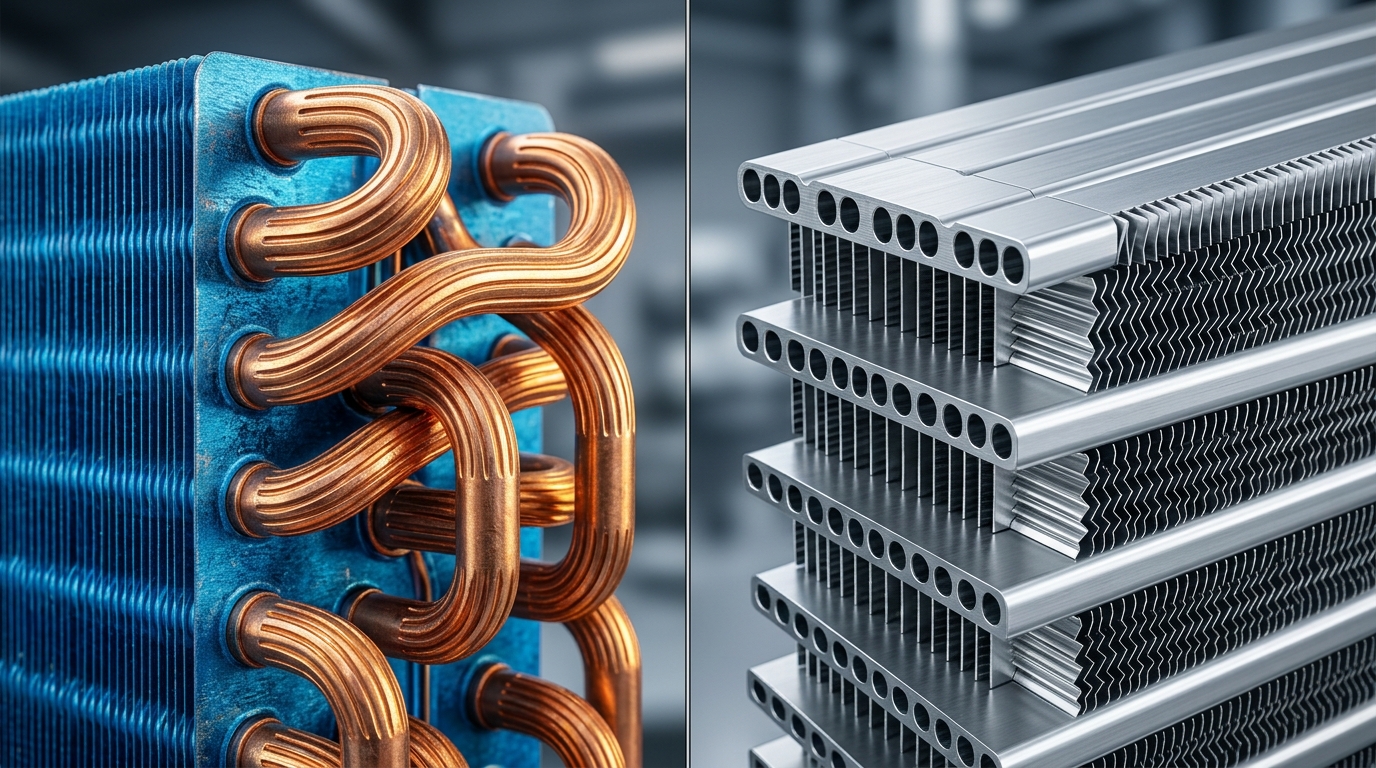
The Short Answer for Indian Buyers (2026 Verdict)
Always buy a 100% copper coil AC with an anti-corrosion coating (like LG Ocean Black Fin, Daikin Blue Fin, or Panasonic Shield Blu+). While an aluminium coil AC costs ₹3,000 to ₹6,000 less upfront, a single refrigerant gas leak on an aluminium condenser costs ₹9,000 to ₹14,000 to replace because local technicians can't reliably braze aluminium. Over a 7-year ownership window, copper saves you over ₹12,000 in repair charges and power bills.
What Are Condenser Coils and Why Do They Dictate Your AC's Life?
To understand why condenser material matters so much, you have to look at how an air conditioner actually operates. An AC doesn't magically generate coldness inside your bedroom; it acts as a thermal sponge. It extracts heat from your indoor air and dumps that heat outside into the harsh summer atmosphere.
This thermal cycle relies on two separate coils working in tandem:
- The Evaporator Coil (Indoor Unit): Located inside your room behind the plastic air filter. Liquid refrigerant enters at low pressure and boiling-cold temperature (roughly 4°C to 7°C). As indoor air blows over these tubes, the refrigerant absorbs your room's heat and evaporates into a cool, low-pressure vapour.
- The Condenser Coil (Outdoor Unit): Housed inside the metal cabinet mounted outside your window or balcony. The compressor pumps hot, highly compressed refrigerant vapour (often exceeding 75°C to 90°C) into this coil. The outdoor fan pulls outside air across the fins to extract that heat, forcing the vapour to condense back into a high-pressure liquid.
Here is where Indian climate makes life brutal for your outdoor unit. In peak summer months across Delhi, Ahmedabad, Nagpur, or Hyderabad, ambient outdoor temperatures routinely hover between 42°C and 48°C. Your AC's compressor must push the refrigerant gas up to intense pressures—often between 350 PSI and 450 PSI with modern R32 refrigerant—just so the condenser coil can release heat into air that is already scorching hot.
If your condenser coil metal has poor thermal conductivity, or if dirt and corrosion clog the fins, the refrigerant can't dump its heat fast enough. Head pressure skyrockets, the compressor pulls massive current, your electricity bill explodes, and the thermal expansion eventually bursts the weakest weld on the coil. In short: your condenser coil is the most abused mechanical component in your entire air conditioning setup.
Copper Coils: Why They Remain the Gold Standard
Copper has been the undisputed king of air conditioning manufacturing for over half a century. While raw copper commodity prices have surged over recent years, top tier air conditioning manufacturers still rely on it for their flagship residential machines.
1. Outstanding Thermal Conductivity (386 W/m·K)
Pure copper boasts a thermal conductivity rating of approximately 386 to 401 Watts per meter-Kelvin (W/m·K). This means heat transfers through the metal wall of a copper tube nearly twice as fast as it moves through standard aluminium (~205 W/m·K).
Because heat escapes rapidly, the refrigerant condenses faster, allowing the compressor to run at lower RPMs once your room hits the set temperature. That translates directly into higher ISEER energy efficiency ratings and lower monthly power bills under scorching Indian heatwaves.
2. Inner Grooved Tubing Technology
Modern copper coils aren't smooth pipes on the inside. Brands like Daikin, LG, and Panasonic utilize inner-grooved copper tubes (also called rifled tubing). The inner bore features microscopic spiral ridges.
These internal grooves serve two critical purposes:
- They increase the internal contact surface area between liquid refrigerant and metal by 30% to 45%.
- They introduce controlled turbulence into the flowing refrigerant, preventing a stagnant insulating layer of oil and liquid from sticking to the tube wall.
Aluminium is far more brittle and ductile-limited during high-speed factory extrusion, making complex microscopic inner-grooving much harder and costlier to manufacture reliably.
3. Effortless Field Brazing and Repairability
This is the single biggest operational advantage of copper in India. When an AC springs a refrigerant leak after 4 or 5 years, where does it leak? Almost always at the U-bends or brazed joints of the condenser coil.
With a copper condenser, any local AC mechanic carrying an oxy-acetylene or portable LPG brazing torch can fix it on your balcony in 45 minutes:
- They locate the pinhole bubble using soapy water or nitrogen pressure testing.
- They heat the copper joint with a torch. Copper has a high melting point (1,085°C), while standard silver-copper brazing rods melt around 650°C to 750°C.
- The technician flows the brazing filler into the seam, creating a permanent metallurgical bond.
- They pull a deep vacuum, refill R32 refrigerant, and your AC is back to 100% cooling capacity for ₹1,500 to ₹2,500 in labour.
4. Superior Mechanical Strength Under R32 Pressures
Older air conditioners used R22 refrigerant, which operated at moderate discharge pressures of around 220 to 260 PSI. In 2026, virtually all 5-star and 3-star split ACs sold in India run on eco-friendly R32 refrigerant.
R32 operates at roughly 1.6 times higher pressure, frequently touching 380 to 450 PSI on a 44°C summer afternoon. Copper possesses high tensile strength and resilience against cyclic pressure pulses. It expands and contracts with compressor start-stop cycles without developing metal fatigue micro-fissures.
Aluminium Coils: Why Brands Use Them and Why Mechanics Hate Them
If copper is superior in almost every metric, why did manufacturers introduce aluminium coils in the first place? The answer boils down to one word: cost.
Aluminium is roughly one-third the raw material cost of copper per kilogram, and it weighs roughly 70% less. By switching to aluminium coils, an AC brand can shave ₹2,500 to ₹4,000 off manufacturing expenses, allowing them to undercut competitors on Flipkart or Amazon during festive sales.
The Critical Flaws of Aluminium Condensers
- Low Melting Point & Oxide Layer: Aluminium melts at approximately 660°C—dangerously close to the melting point of common brazing solders. Furthermore, the instant aluminium meets air, it forms a stubborn aluminium oxide skin that prevents molten solder from sticking.
- The Balcony Brazing Nightmare: Trying to weld an aluminium coil with an open flame in an Indian residential balcony usually results in the thin aluminium tube dissolving into a melted puddle. 95% of field technicians in India will flat out refuse to weld an aluminium condenser. They will give you the dreaded diagnosis: “Sir, coil badalna padega (the entire coil must be replaced).”
- Corrosion Sensitivity: Pure aluminium reacts violently with chloride ions (sea salt mist) and sulphur compounds. In coastal Indian cities, untreated aluminium fins degrade into a white powdery substance (aluminium hydroxide), causing fins to flake away and drop to the floor within 2 to 3 monsoon seasons.
- Galvanic Corrosion at Bimetallic Joints: An AC cannot be made entirely of aluminium. The compressor discharge stub and connecting service valves are almost always copper or brass. Where copper connects to aluminium, a bimetallic galvanic couple is formed. When atmospheric humidity or condensation settles on this joint, aluminium acts as a sacrificial anode and corrodes at 5x normal speed.
Micro-Channel Condenser Coils: Innovation or Indian Headache?
You might see certain modern ACs boasting about “Micro-Channel Condensers” or parallel-flow heat exchangers. Brands like Daikin, Hitachi, and commercial chiller manufacturers popularized this technology from the automotive industry.
What Exactly is a Micro-Channel Coil?
Instead of standard round copper tubes threaded through aluminium fins, a micro-channel condenser uses flat, extruded aluminium multi-port tubes with microscopic internal fluid passages (measuring less than 1 mm wide). Thin zigzag aluminium fins are vacuum-brazed between these flat tubes.
The Advantages
- 30% Less Refrigerant: The micro-passages require much less R32 gas volume to operate.
- Higher Lab Efficiency: Flat aerodynamic tubes offer less air resistance, allowing quieter fan operation.
- Zero Galvanic Corrosion: Because tubes, fins, and manifolds are all aluminium, there is no dissimilar metal junction inside the core.
- Lighter Outdoor Units: Outdoor units weigh 5 to 8 kg less, making wall-bracket installation easier.
The Indian Reality Checks
- Monsoon Mud Clogging: The tiny fin pitch traps airborne fine dust, pollen, and vehicle soot. During monsoon rains, this turns into concrete-like mud.
- Fin Crushing: Standard 120-bar water pressure washers used by local service techs bend the microscopic fins instantly, choking airflow forever.
- Zero Field Repair: If a flying stone or vibration punctures one micro-tube, no technician in India can weld it. You must buy a complete new assembly.
While micro-channel condensers work brilliantly in clean, dry environments with professional chemical maintenance, the dusty, humid, and polluted conditions of urban India have led major brands back to round-tube copper condensers for their mainline 2026 residential split AC lineups.
Ocean Black Fin, Blue Fin, Gold Fin, and Shield Blu+: What Are These Coatings?
Even pure copper coils are vulnerable to one specific menace found across Indian cities: airborne chemical pollutants.
If you live within 500 meters of an open drainage canal (ganda nala), a sewage line, or a polluted marsh in cities like Delhi, Bengaluru, Mumbai, or Kolkata, the water releases Hydrogen Sulphide (H2S) gas. This acidic gas attacks bare copper, forming copper sulphide (black flaky crust). Within 18 to 36 months, it eats microscopic pinholes right through 0.7 mm copper tube walls. This phenomenon is known as formicary corrosion.
To stop both coastal salt spray (NaCl) and sewer gas (H2S) from destroying condensers, manufacturers apply specialized polymer coatings over the coils:
| Coating Name | Primary Brands | Chemical Composition | Corrosion Resistance Rating | Best Suited For |
|---|---|---|---|---|
| Ocean Black Fin | LG | Double-layer: Hydrophilic film + modified epoxy resin coating | Highest (ASTM-B117 Salt Spray 10-Yr) | Coastal zones, open drains, high-pollution metros |
| Blue Fin | Daikin, Voltas, Blue Star | Anti-corrosive hydrophilic acrylic resin film | Very High (5–7 Years Protection) | Humid climates, monsoon areas, standard urban cities |
| Gold Fin | Panasonic, Lloyd, Godrej | Golden hydrophilic anti-oxidant silicone/epoxy coating | Very High (Resists Acid Rain & Rust) | Industrial belts, acid-rain prone zones, urban apartments |
| Shield Blu+ | Panasonic | Nano-fluorine coating on 100% inner grooved copper | Exceptional (Marine Grade) | Coastal cities, high-humidity sea facing apartments |
Hydrophilic Benefit: These coatings aren't just paint. The hydrophilic chemical structure ensures that water condensation doesn't form round beads that trap dust. Instead, water forms a continuous micro-sheet that effortlessly slides off the coil surface, washing away loose dirt and smog particles naturally.
Real-World Durability: 5-Year vs 10-Year Lifecycle Showdown
Let's see what actually happens to both coil types over a decade of Indian summers:
🟤 100% Copper Coil with Coating
⚪ Standard Aluminium Coil
Which Brands Use Copper vs Aluminium in 2026?
Because of consumer backlash over gas leaks and high warranty claim costs, the Indian AC industry has undergone a massive shift over the last four years. In 2026, almost every top-tier manufacturer has standardized on 100% copper condenser and evaporator coils for their mainline split ACs.
Here is how the leading brands in India configure their coils in 2026:
- LG Electronics: 100% Grooved Copper tubes across the entire AI DUAL Inverter split range (e.g., TS-Q19YNZE). LG adds its proprietary Ocean Black Fin anti-corrosion coating to both indoor and outdoor heat exchangers, backed by a 5-year full warranty on the PCB and 10-year warranty on the compressor.
- Daikin India: 100% Copper condensers with Blue Fin hydrophilic coating across all premium residential models (like the FTKM50XV series). Daikin reserves micro-channel coils strictly for commercial VRV/chiller units where maintenance contracts ensure regular chemical cleaning.
- Panasonic: 100% Pure Copper with Shield Blu+ technology on their smart Wi-Fi series (such as CS/CU-NU18BKY5WX). Boasts the segment-highest ISEER rating of 5.80 and offers industry-leading anti-corrosion protection.
- Voltas: 100% Copper on mainstream Vectra and Vertis split lineups (e.g., 183V Vectra Elegant). Voltas previously used aluminium coils on select entry-level 3-star models in 2018–2020, but consumer demand forced a return to copper.
- Hitachi: 100% Inner Grooved Copper tubes across Yoshi and iKasu inverter series, paired with tropical compressors rated for 52°C ambient heat.
- Carrier: 100% Copper coils with Aqua Clear hydrophilic coating on their AI Flexicool line (like the ESTER EDGE series), preventing water droplet accumulation and premature rust.
Brand-Wise Coil Material & Anti-Corrosion Comparison (2026)
Before putting down your hard-earned money, compare the coil specifications of the most popular 1.5-ton split ACs sold in India today:
| Brand & Popular Model | Condenser Coil | Evaporator Coil | Anti-Corrosion Fin Coating | Compressor Warranty | Coastal Suitability |
|---|---|---|---|---|---|
| LG 1.5T 5-StarTS-Q19YNZE / JS-Q18PWZD | 100% Grooved Copper | 100% Copper | Ocean Black Fin | 10 Years | Excellent |
| Daikin 1.5T 5-StarFTKM50XV / FTKM50U | 100% Copper | 100% Copper | Blue Fin Hydrophilic | 10 Years | Very Good |
| Panasonic 1.5T 5-StarCS/CU-NU18BKY5WX | 100% Inner Grooved Copper | 100% Copper | Shield Blu+ Nano Coating | 10 Years | Outstanding |
| Voltas 1.5T 3-Star183V Vectra Elegant | 100% Copper | 100% Copper | Anti-Corrosive Blue Coating | 10 Years | Good |
| Hitachi 1.5T 5-StariKasu / Yoshi Series | 100% Inner Grooved Copper | 100% Copper | Hydrophilic Coated Fins | 10 Years | Good |
| Carrier 1.5T 5-StarESTER EDGE (CAI18EE5R36W0) | 100% Copper | 100% Copper | Aqua Clear Hydrophilic | 10 Years | Very Good |
The Geographic Rulebook: Coastal Cities vs Inland Sewer Zones
Where your house is located in India determines what type of coil protection you need. One size does not fit all.
Zone 1: Coastal Belt (Within 10 km of the Coastline)
Locations: Mumbai, Chennai, Kochi, Visakhapatnam, Kolkata, Goa, Mangaluru, Surat.
The Danger: Extreme relative humidity (75% to 95%) combined with sea breeze containing dissolved sodium chloride (NaCl) salt. Salt mist is a powerful electrolyte that triggers rapid galvanic and pitting corrosion.
The Recommendation: Never buy an aluminium coil AC here—it will fail within 2 to 3 years. You must choose a 100% Copper AC with heavy-duty anti-corrosion coating. Look specifically for LG Ocean Black Fin or Panasonic Shield Blu+. Both feature multi-layered polymer resins that have cleared 1,000+ hours of continuous salt spray testing (ASTM B117 standards).
Zone 2: Urban Sewer & Nullah Proximity (Within 500 Meters)
Locations: Localities near Najafgarh Drain (Delhi), Bellandur/Varthur canals (Bengaluru), Musi riverbed (Hyderabad), or open drainage channels in Kanpur, Patna, and Lucknow.
The Danger: Decaying organic sewage releases high concentrations of Hydrogen Sulphide (H2S) and ammonia fumes. H2S attacks bare copper aggressively, forming black copper sulphide crust that turns the tube porous. This is the infamous reason why people living near open drains complain: “My AC gas leaks every single summer!”
The Recommendation: Untreated bare copper is actually vulnerable here! You must buy an AC with double-sided coated coils on both the outdoor unit AND the indoor evaporator coil (such as LG Ocean Black Protection). Ask the installing technician to avoid pinching or scraping the fin coating during mounting.
Zone 3: Dry Northern & Central Plains
Locations: Jaipur, Jodhpur, Bhopal, Nagpur, Chandigarh, western UP.
The Danger: Extreme summer heat (up to 47°C–49°C) and heavy dust storms (loo).
The Recommendation: Pure thermal conductivity is the priority here. Inner grooved copper tubes with standard Blue Fin or Gold Fin protection are ideal. The copper coil will maintain fast heat rejection even when outdoor air is roasting hot.
Price Difference Analysis: Upfront Cost vs 7-Year Total Cost of Ownership
Let's look at the actual economics. Assume an entry-level aluminium coil split AC costs ₹31,000, while a 100% copper coil model with anti-corrosion coating costs ₹36,000. That is a ₹5,000 upfront premium. Does it pay back?
Here is a realistic 7-year ownership cost breakdown based on prevailing Indian service charges in 2026:
| Expense Category | 100% Copper Coil AC | Aluminium Coil AC | The Real Difference |
|---|---|---|---|
| Upfront AC Purchase Price | ₹36,000 | ₹31,000 | Aluminium is ₹5,000 cheaper |
| Year 3–4 Gas Leak Repair | ₹2,200 (Brazing spot + gas top-up) | ₹9,500 (Full coil replacement + R32 gas) | Copper saves ₹7,300 on first repair |
| Year 5–6 Second Leak Event | ₹0 (No leak or minor brazing: ₹1,800) | ₹9,500 (Second replacement or scrapped) | Aluminium fails again or unit replaced |
| Efficiency Loss (Electricity Bill) | ₹0 baseline (Maintains clean heat transfer) | ₹4,200 extra (Corroded fins drop ISEER ~12%) | At ₹8/kWh, dirty aluminium pulls more units |
| Resale / Scrap Value at Year 7 | ₹4,500 (Copper has high scrap value) | ₹1,200 (Aluminium scrap carries minimal value) | Copper yields ₹3,300 more |
| Net 7-Year Total Cost of Ownership | ₹35,500 | ₹54,000 | Copper saves ₹18,500 Net! |
Even with the most conservative assumptions, an aluminium AC turns out to be substantially more expensive over its operating life. Saving ₹5,000 at the cash counter costs you almost four times that amount in maintenance calls and frustrating summer breakdowns. Check our AC Electricity Cost Calculator to model exact savings for your state's power tariff.
Ready to Upgrade to a 100% Copper AC?
Don't compromise on condenser durability. Browse the highest-rated 100% copper split ACs with verified anti-corrosion fin coatings on Amazon India.
🛒 Check Best Copper AC Deals on AmazonPrices verified for 2026 summer lineup • Free delivery & no-cost EMI available
7 Pro-Tips to Protect Your Condenser Coil from Early Failure
Regardless of what coil material your AC has, regular maintenance determines whether it runs for 5 years or 12 years. Here is how you can protect your outdoor unit:
- Never let technicians use high-pressure spray wands close up: Local technicians often blast commercial pressure washers directly into the delicate fins at point-blank range. This bends the aluminium fins flat like closed blinds, choking airflow. Always insist on low-pressure water sprays directed straight (at a 90° angle), never diagonally.
- Give the outdoor unit 1.5 feet of rear breathing room: Don't shove the outdoor condenser cabinet flush against a brick wall. It needs at least 15 to 20 cm of clearance on the intake side and 1 meter in front to vent hot air freely. Trapped hot air causes condenser temperatures to spiral.
- Wash out dry dust every 60 days: Dust creates an insulating blanket over the fins. Every two months during the cooling season, switch off the AC power isolator switch and gently rinse the rear coil fins with a garden hose to clear away settled dust and pollen.
- Install a sun shade canopy if facing South or West: If your outdoor unit sits directly under scorching afternoon sun on a rooftop or open balcony, installing a simple sheet metal or fiberglass shade canopy 1.5 feet above the unit drops ambient intake temperatures by 3°C to 5°C.
- Do not apply cheap spray paint on fins: Some homeowners spray standard black enamel paint over coils thinking it stops rust. In reality, paint acts as a heavy thermal insulator, crippling your AC's cooling capacity and driving up power draw. Only use certified HVAC hydrophilic anti-corrosion sprays (like coil guard aerosols with polyurethane resin).
- Inspect for dog urine or animal waste: In ground-floor or low balcony installations, dog urine is one of the fastest killers of AC coils. Urine contains urea and uric acid that will eat through copper and aluminium fins in under six months. Keep the unit mounted on a wall bracket at least 2 feet above ground level.
- Use a dedicated digital voltage stabilizer: Voltage fluctuations cause compressor torque dips and sudden pressure shocks in the condenser tubing. If your area experiences voltage swings below 190V or above 260V, pair your unit with a quality stabilizer to keep compressor RPMs stable.
Frequently Asked Questions About AC Coils
1. How can I verify if an AC has copper or aluminium coil before buying?
Check the official Bureau of Energy Efficiency (BEE) star rating label attached to the indoor unit or published in the brochure. Look under the specifications row labeled “Condenser Coil Material”. It will explicitly state either “Copper” or “Aluminium”. Additionally, reputable brands like LG, Daikin, and Panasonic emboss “100% Copper” directly on the carton and outdoor unit cabinet.
2. Can an aluminium AC coil be repaired if it leaks refrigerant?
In theory, aluminium can be brazed using specialized low-temperature aluminium-zinc flux-cored rods. In real-world Indian conditions, however, virtually no local technician possesses the tools or temperature control required to braze thin-walled aluminium without burning a giant hole through the tube. 95% of the time, an aluminium leak necessitates replacing the entire condenser assembly, costing between ₹9,000 and ₹14,000 including gas refilling.
3. Why does copper cool faster than aluminium?
Thermal conductivity is the rate at which heat conducts through a material. Copper has a thermal conductivity rating of approximately 386 W/m·K, whereas aluminium sits around 205 W/m·K. Because copper transfers heat nearly twice as fast, it rapidly sheds heat from the compressed refrigerant vapour into the ambient air, allowing the cooling cycle to reach your target room temperature significantly faster.
4. Why do copper coils turn black and leak gas near open drains?
Open sewage canals and storm drains emit Hydrogen Sulphide (H2S) gas. When H2S reacts with bare copper in the presence of atmospheric humidity, it creates a chemical reaction producing black copper sulphide. This corrosive process eats tiny microscopic pinholes into the tube wall (formicary corrosion), causing total refrigerant loss. To prevent this, homes near drains must use an AC with anti-corrosion coated coils, such as LG Ocean Black Fin.
5. Is a 100% copper AC mandatory for coastal cities like Mumbai and Chennai?
Yes, absolutely. In coastal belts within 10 km of the sea, salt mist (sodium chloride) acts as an intense chemical catalyst. An uncoated aluminium coil in a sea-facing apartment will typically pit, oxidize into white powder, and leak within 2 to 3 years. For coastal regions, you should always choose 100% copper combined with marine-grade hydrophilic protection like Daikin Blue Fin or Panasonic Shield Blu+.
6. Does a copper coil AC consume less electricity than an aluminium coil AC?
Yes. Higher thermal conductivity means the compressor doesn't have to work as hard or build up excessive discharge head pressure to dump heat. An AC with clean, grooved copper coils typically achieves a higher ISEER rating (up to 5.20–5.80 on top 5-star models) compared to aluminium units, saving roughly 80 to 150 units (kWh) of electricity every summer season.
7. What is the average lifespan of a copper condenser AC in India?
With basic pre-season servicing and regular filter cleaning, a 100% copper coil split AC with anti-corrosion fin coating easily lasts between 8 and 12 years in Indian conditions. Even if a minor leak develops around year 5 or 6, it can be spot-brazed inexpensively and restored to full cooling power without replacing the unit.
8. What is the difference between Blue Fin and Gold Fin coatings?
Both are hydrophilic polymer coatings applied over heat exchanger fins. Blue Fin uses an acrylic resin base with anti-corrosion properties designed primarily to resist water accumulation and salt spray. Gold Fin incorporates silicone or modified epoxy additives that provide slightly superior resistance to acidic conditions and industrial smog. Both perform exceptionally well in Indian climates compared to bare, unprotected metal.
9. Can I replace a leaked aluminium coil with a copper coil later?
Yes, third-party aftermarket HVAC workshops sell retrofit universal copper coils that can be installed inside old aluminium AC outdoor cabinets. However, this retrofit costs ₹8,000 to ₹12,000 (including brazing, vacuuming, and gas recharging), and aftermarket coils rarely match the original factory airflow and ISEER efficiency curves. It is far smarter to buy 100% copper from day one.
Related AC Guides and Buying Recommendations
Explore our other research-backed resources to make the smartest cooling decision for your home:
- Best 1.5 Ton AC in India (2026) — Our lab-tested rankings of the top 1.5-ton split ACs with grooved copper coils and highest ISEER.
- Best 1 Ton AC in India — Ideal compact copper coil cooling units for bedrooms up to 120 sq ft.
- Best 5 Star Inverter ACs — High-efficiency models that cut electricity bills by up to 35% compared to 3-star ACs.
- LG AC Review & Lineup (2026) — Deep dive into LG's AI DUAL Inverter technology and Ocean Black Fin protection.
- Daikin AC Review & Technology — Why Daikin's Neo Swing compressors and Blue Fin copper condensers lead reliability charts.
- Panasonic AC Smart Features — Exploring Shield Blu+ anti-corrosion and MiraIE smart connectivity with 5.80 ISEER.
- Voltas AC Buying Guide — India's largest AC brand analyzed for cooling performance and after-sales service reach.
- What is ISEER Rating in AC? — Understand the BEE star rating formula and how seasonal efficiency is calculated.
- Inverter AC vs Non-Inverter AC — Comparing power draw, compressor cycling, and long-term running costs.
- AC Electricity Cost Calculator — Calculate your exact monthly cooling bill based on tonnage, daily usage hours, and state power tariffs.