How to Use Air Conditioners & Coolers During Viral Outbreaks (2026 Guide)
When respiratory infections, seasonal flus, or viral fevers strike a household, one frantic question dominates family discussions: “Should we switch off the AC completely, or is it safe to keep running?” In the blistering heat of an Indian summer crossing 44°C, shutting off mechanical cooling is neither realistic nor medically sound for a recovering patient. However, operating a standard split AC in a 100% sealed, airtight room without outdoor air dilution creates a high-density aerosol trap.
Safe cooling balances thermal comfort, respiratory mucosal protection, and fresh air ventilation.
First formulated during the COVID-19 pandemic by the Indian Society of Heating, Refrigerating and Air Conditioning Engineers (ISHRAE) and the Central Public Works Department (CPWD), and reaffirmed by modern ASHRAE Standard 241 (Control of Infectious Aerosols), scientific guidance is unequivocal: you do not need to suffer without an air conditioner. By applying four fundamental physical parameters—temperature, relative humidity, cross-ventilation, and air filtration—you can keep your family cool while actively suppressing airborne pathogen loads.
The 4 Non-Negotiable ISHRAE Operating Rules
The golden indoor air quality benchmark for residential homes
1. Temperature: 24°C to 30°C
Never dial down to 18°C–20°C. Cold air dries respiratory mucus membranes and triggers chills in fever patients. 24°C–27°C is the clinical sweet spot.
2. Humidity: 40% to 70% RH
Arid air (<40%) causes respiratory droplets to shrink into floating aerosol nuclei. High moisture (>70%) invites mold. Maintain 50%–60% RH.
3. Crack Window 1–2 Inches
Split ACs recirculate 100% stale room air. Keep a window cracked 2.5–5 cm and run an exhaust fan to continuously flush airborne contaminants.
4. Evaporative Desert Coolers
Must draw 100% outdoor air with an opposite window kept open for cross-exhaust. Tanks must be drained and disinfected weekly.
1The Aerobiology: Why Sealed Split AC Rooms Trap Viruses
To understand why running an AC recklessly can accelerate disease transmission, one must grasp how a ductless split AC operates compared to centralized hospital HVAC systems:
Common Misconception: “My split AC brings fresh, chilled oxygen from the outdoor compressor unit.”
The Engineering Reality: The outdoor unit only circulates chemical refrigerant (R32 or R410A) through copper piping. Zero outdoor air enters your room. A residential split AC draws warm room air into the top grill, blows it across the cold evaporator coil, and dumps the exact same air back into the room. It is a 100% closed-loop recirculation device.
When an individual infected with SARS-CoV-2, Influenza A/B, Rhinovirus, or Respiratory Syncytial Virus (RSV) speaks, coughs, or breathes, they expel two categories of respiratory particles:
- Ballistic Respiratory Droplets (>10 microns): Heavy droplets that fall to the ground or bedsheets within 1 to 2 meters due to gravity.
- Aerosol Droplet Nuclei (≤5 microns): Microscopic moisture droplets that, within milliseconds of exhalation, lose moisture through evaporation and become ultra-light bio-aerosols. These aerosols behave exactly like cigarette smoke—they remain suspended in buoyant room air for 2 to 4 hours, riding the indoor blower currents generated by your split AC.
In a sealed bedroom with closed windows and no mechanical exhaust, the viral aerosol concentration multiplies with every breath the patient takes. Healthy family members entering the room inhale thousands of virions per minute, vastly exceeding the minimum infectious dose.
2The Temperature Rule: Why You Must Never Set AC to 18°C–20°C
When people fall sick in peak summer, their instinct is often to blast the AC at 18°C or 20°C to “beat the fever.” Medical experts and respiratory physiologists warn that this is dangerous for two critical physiological reasons:
- Mucociliary Clearance Paralysis: Nasal airway cilia slow down by over 50% in cold air, impeding the expulsion of inhaled pathogens.
- Local Vasoconstriction: Cold air constricts nasal blood vessels, inhibiting infection-fighting white blood cells from reaching mucosal tissues.
- Hypothermic Shivering: Fever patients experience violent chills and shivering spasms, dangerously elevating metabolic stress.
- Optimal Mucosal Hydration: Prevents airway dehydration and dry, irritable coughing fits during recovery.
- Stable Thermal Regulation: Delivers calming relief without inducing shivering or vasoconstriction.
- Energy Efficiency: An inverter AC cruising at 25°C consumes 40% less wattage, keeping inverter batteries stable during summer power cuts.
ISHRAE Recommendation: Set your thermostat between 24°C and 30°C. For most Indian households, 25°C or 26°C with the indoor fan set to low or medium provides gentle, uninterrupted cooling that protects both the patient and caregivers.
3Relative Humidity (40% to 70%): The Aerosol Weight Dynamic
Indoor humidity is the single most overlooked factor in airborne virus transmission. Decades of atmospheric physics research, including studies published in the Journal of the Royal Society Interface, demonstrate that droplet evaporation dynamics dictate aerosol float times:
- Low Humidity (<40% RH): In bone-dry air, warm respiratory droplets rapidly dehydrate in under 0.5 seconds, shrinking by 50% to 70% into microscopic salt-and-protein crystal nuclei (1 to 3 microns). These ultra-light cores float indefinitely and penetrate deep into human pulmonary alveoli upon inhalation.
- Target Humidity (40% to 70% RH): In this equilibrium zone, droplets retain their moisture weight. They settle downward onto floors and hard surfaces within seconds via gravitational sedimentation, where they can be neutralized by regular disinfectant wiping rather than lingering in the breathing zone.
- Excessive Humidity (>70% RH): In coastal regions (Mumbai, Chennai, Kolkata) or during monsoon season, indoor humidity can climb past 80%. While this suppresses viral suspension, sustained humidity above 70% promotes black mold (Aspergillus), dust mites, and mildew on the AC's damp cooling coils, triggering allergic asthma and secondary bronchial complications.
How to Control Humidity on Your Remote Control
During heavy monsoon rain or coastal dampness, switch your AC mode from Cool Mode to Dry Mode (denoted by a water droplet icon). Dry Mode runs the compressor at low frequency while slowing down the indoor blower to maximize water condensation on the evaporator fins, extracting 1.5 to 2.5 liters of moisture per hour without over-cooling the room.
4The “Window Crack” & Exhaust Blueprint for Split ACs
The most revolutionary directive issued in the ISHRAE COVID-19 guidelines was the explicit recommendation to run an air conditioner with a window cracked open. To traditional homeowners taught that an open window “wastes cold air,” this feels counterintuitive.
However, when illness is present, your objective changes from purely saving power to preventing viral infection. Here is how to configure the optimal fresh air loop in an apartment or house:
The 3-Step Fresh Air Displacement Loop
Crack Open a Window (1 to 2 Inches / 2.5 to 5 cm)
Choose a window located away from direct harsh sun. A 1–2 inch opening allows a constant stream of oxygen-rich outdoor air to seep into the room, diluting indoor carbon dioxide (CO2) and aerosol concentrations.
Run an Attached Bathroom or Kitchen Exhaust Fan
Leaving the attached bathroom door slightly ajar while the exhaust fan is running creates a continuous low-pressure draw. The exhaust pulls stale, aerosol-laden room air out through the bathroom duct, expelling it harmlessly to the outdoor atmosphere.
Keep Ceiling Fan on Low Speed
Avoid high ceiling fan speeds that create turbulent micro-vortices blowing straight from the patient to caregivers. A gentle low speed keeps room air homogenous and facilitates displacement toward the exhaust.
5Evaporative Desert Coolers: Are They Safer than Split ACs?
In North and Central India (Delhi-NCR, Rajasthan, Madhya Pradesh, UP), millions of homes rely on evaporative desert coolers rather than split ACs. Interestingly, from an epidemiological ventilation standpoint, desert coolers are inherently safer than split ACs—when operated correctly.
Why? A desert cooler mounted in an outdoor window pulls in 100% fresh outdoor ambient air, cools it adiabatically through saturated honey-comb pads, and pressurizes the room with high volumetric flow. This achieves 15 to 30 Air Changes per Hour (ACH)—far higher than any split AC.
Critical Hygiene Directives for Desert Coolers
- Mandatory Cross-Exhaust: Never run a desert cooler in a closed room. An opposite window or door must remain wide open to exhaust moist air. If sealed, relative humidity quickly crosses 85%, preventing sweat evaporation and fostering fungal growth.
- Daily Water Replacement: Empty and refill the water tank daily. Stagnant cooler water breeds bacteria (such as Legionella pneumophila) and acts as a nursery for dengue and chikungunya mosquito larvae.
- Disinfecting the Tank: Add 2 to 3 drops of liquid disinfectant or a quarter teaspoon of sodium hypochlorite solution (household bleach) per 50 liters of fresh water to kill waterborne microbes.
- Clean Honeycomb Pads: Wash cooling pads with clean running water every 10 to 14 days to dislodge trapped airborne dirt, pollen, and fungal spores.
6Cooling Appliance & Infection Risk Comparison
The table below breaks down the aerobiological characteristics of common cooling systems during home respiratory illness:
| Cooling System | Fresh Air Intake | Air Changes/Hr (ACH) | Infection Transmission Risk | Mandatory Precaution |
|---|---|---|---|---|
| Ductless Split AC | 0% (Recirculates 100%) | 0.2 – 0.5 ACH (Sealed) | High (if sealed) | Crack window 1–2 in + run exhaust fan continuously. |
| Window AC | 0% to 10% (Vent lever) | 0.5 – 1.2 ACH | Moderate | Slide open the built-in fresh air ventilation lever. |
| Evaporative Desert Cooler | 100% (From outdoor window) | 15 – 30 ACH | Low (if cross-ventilated) | Opposite window wide open; daily water disinfection. |
| Centralized HVAC (Offices/Malls) | 15% to 25% Outdoor Air | 4 – 8 ACH | Moderate | Upgrade to MERV 13+ filters; run economizers at 100%. |
| Ceiling Fan + Open Windows | 100% Fresh Air | 10 – 25 ACH | Very Low | Only effective when ambient outdoor temp is below 36°C. |
7Can Modern AC Filters Neutralize Viruses? (2026 Tech Review)
In recent years, AC brands have marketed aggressive air purification claims. It is crucial to separate engineering reality from marketing hyperbole:
| Filter / Technology Type | Particle Size Captured | Traps Viral Aerosols? | Found In |
|---|---|---|---|
| Standard Nylon Mesh | >50 – 100 microns (coarse dust, hair) | ❌ No (Viruses pass freely) | All standard split & window ACs |
| PM2.5 Micro-Dust Filter | Up to 2.5 microns (smog, pollen) | ⚠️ Partial (Only large droplet clusters) | Daikin, LG, Voltas mid-tier models |
| True HEPA (H13 Grade) | 0.3 microns at 99.97% efficiency | ✅ Yes (Captures ≥99.97% aerosols) | Dedicated standalone air purifiers |
| Hydroxyl Radical Gen (nanoe™ X) | Molecular OH radicals denature lipid envelopes | ✅ Yes (Inhibits airborne & surface viruses) | Panasonic premium inverter ACs |
| Streamer Discharge / Plasma | High-speed electron plasma oxidation | ✅ Yes (Decomposes allergen proteins) | Daikin FTKM series ACs |
| UV-C LED / UVnano | 254nm ultraviolet germicidal irradiation | ✅ Yes (Sterilizes fan & cooling coil) | LG Artcool & premium AI DUAL Inverters |
Verdict: While advanced active air technologies like Panasonic's nanoe™ X, Daikin's Streamer Discharge, and LG's UVnano provide real bactericidal and virucidal efficacy on coil surfaces, they do not replace fresh-air dilution. Think of them as a secondary defense layer alongside the window-crack ventilation protocol.
8The Official BestAC Infographic: ISHRAE Guidelines Visualized
Below is our original, widely-cited educational infographic outlining the four core principles of safe air conditioner and evaporative cooler usage during viral outbreaks. Free for media outlets, academic institutions, and health bloggers to download or embed:
BestAC Infographic: AC & Cooler Usage in Viral Outbreaks
Certified by ISHRAE guidelines & CPWD indoor air safety standards.
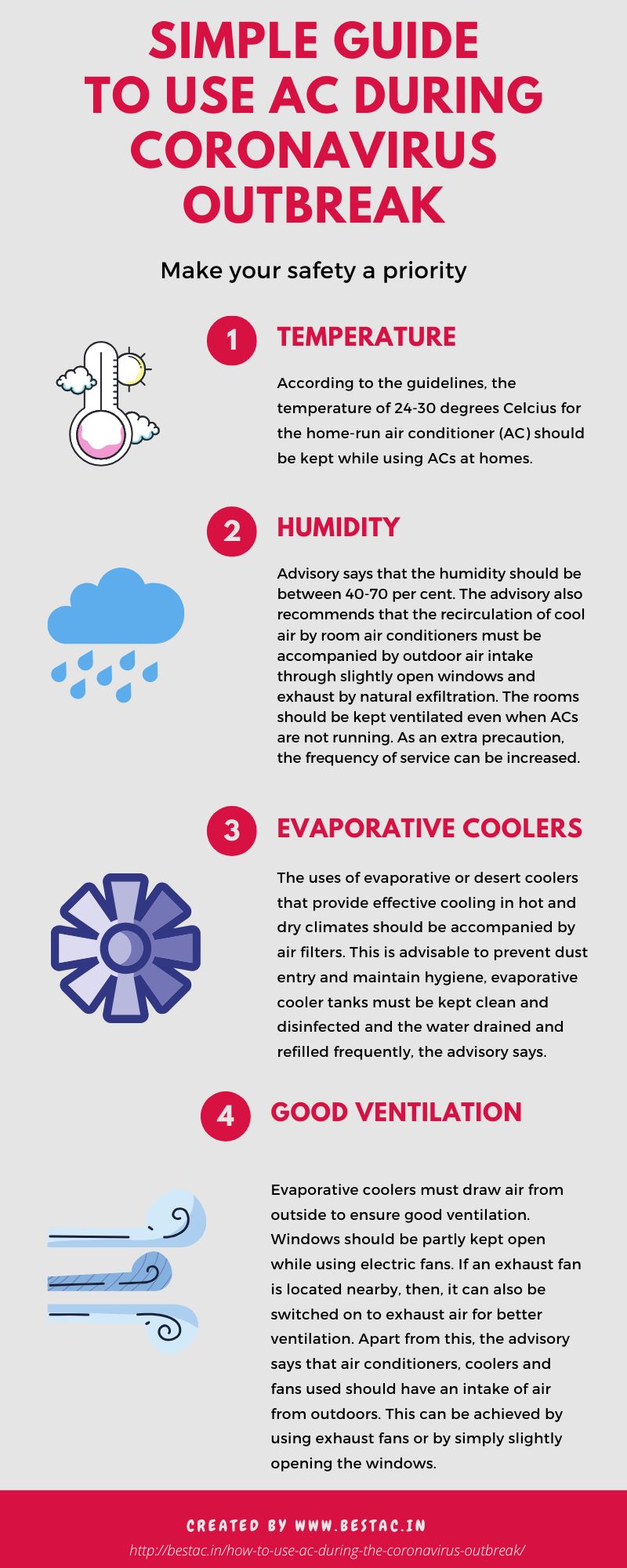
🔍 Click or zoom image to read the full high-resolution ISHRAE guidelines checklist.
9Quarantine Room Architecture: The Negative Pressure Blueprint
If someone in your home tests positive for a respiratory virus (COVID-19, swine flu, severe bronchitis), configuring their bedroom with directional negative pressure guarantees that contaminated air never leaks into shared living spaces, hallways, or children's bedrooms:
Home Isolation Bedroom Checklist
Frequently Asked Questions (FAQs)
Can coronavirus or flu spread through a split air conditioner?
An air conditioner cannot produce or multiply viruses on its own. However, because a standard split AC recirculates 100% internal room air without fresh outdoor exchange, if an infected person coughs or breathes in a sealed room, infectious aerosols accumulate over hours. Without ventilation, anyone sharing the room has a very high risk of inhalation transmission.
Why shouldn't you run your AC at 18°C or 20°C when someone has a fever?
Chilly air below 21°C causes hypothermic chills and severe shivering in fever patients, elevating metabolic stress. Furthermore, dry cold air paralyzes the microscopic cilia in the nasal passage, slowing mucociliary clearance by over 50% and crippling the body's natural first-line defense against respiratory pathogens.
Won't cracking open a window make my electricity bill skyrocket?
No. Field measurements on modern inverter split ACs reveal that cracking a window 1 to 2 inches (2.5 to 5 cm) introduces only a minor thermal penalty. The inverter compressor increases power output by just 4% to 8% to compensate—costing approximately ₹4 to ₹7 extra per night. This tiny expenditure buys invaluable respiratory protection.
How often should AC filters be cleaned if a family member has been sick?
During an active illness, wash the indoor nylon mesh filters every 7 to 10 days using lukewarm water and mild dish soap or disinfectant liquid. Wear an N95 mask while removing the filters to avoid inhaling dislodged dust and viral particles. Allow the filters to dry completely in indirect sunlight before refitting.
Is a central AC or ducted HVAC system safe during an outbreak?
Central ducted systems that recirculate air between multiple bedrooms present a cross-contamination hazard. In such setups, dampers to the sickroom should be closed completely, or the building management must upgrade central air handling units (AHUs) to MERV 13 or HEPA filtration and maximize outdoor air economizer dampers to 100%.
Does keeping a bucket of water in an AC room help with humidity?
In hot, dry regions during pre-monsoon heatwaves (May/June), a split AC can pull indoor humidity down to 25%–30%. Placing a wide, shallow bowl of clean water in the corner of the room or using an ultrasonic cool-mist humidifier helps restore indoor relative humidity back to the target 40%–60% zone.
Cite This Dataset & Analysis
Academic, journalistic, and policy citation formats
BestAC Research Team. (2026, October). How to Use Air Conditioners & Coolers During Viral Outbreaks: The Definitive Indoor Air Quality Guide. BestAC.in. https://bestac.in/how-to-use-ac-during-the-coronavirus-outbreak/
Engineering & Epidemiological References
- ISHRAE COVID-19 Task Force: “Guidelines for Air Conditioning and Ventilation in Residential and Commercial Establishments” (Indian Society of Heating, Refrigerating and Air Conditioning Engineers).
- CPWD Office Memorandum: “Guidelines for Operation of Heating, Ventilation and Air Conditioning (HVAC) Systems in Government Buildings” (Central Public Works Department, Ministry of Housing and Urban Affairs, Govt. of India).
- ASHRAE Standard 241-2023: “Control of Infectious Aerosols — Assessment, Equivalent Clean Airflow Rates, and Continuous Ventilation Verification” (American Society of Heating, Refrigerating and Air-Conditioning Engineers).
- World Health Organization (WHO): “Roadmap to Improve and Ensure Good Indoor Ventilation in the Context of COVID-19 and Airborne Respiratory Pathogens”.
- Marr, L. C., et al. (2019): “Mechanistic insights into the effect of humidity on airborne virus survival, transmission and host immunity.” Journal of The Royal Society Interface, 16(150), 20180298.