Best AC for Delhi 2026: Surviving 46°C+ Heatwaves, Dust Storms, and Voltage Drops
Buying an air conditioner in Delhi isn't like buying one in Pune, Bengaluru, or Mumbai. Delhi's climate is among the most unforgiving in urban India. When May and June hit, daytime temperatures regularly touch 46°C to 48°C in pockets like Najafgarh, Mungeshpur, and Aya Nagar. The infamous loo winds blast scorching dry air, dust storms choke outdoor condenser coils, and evening voltage swings push sensitive electronics to the brink.
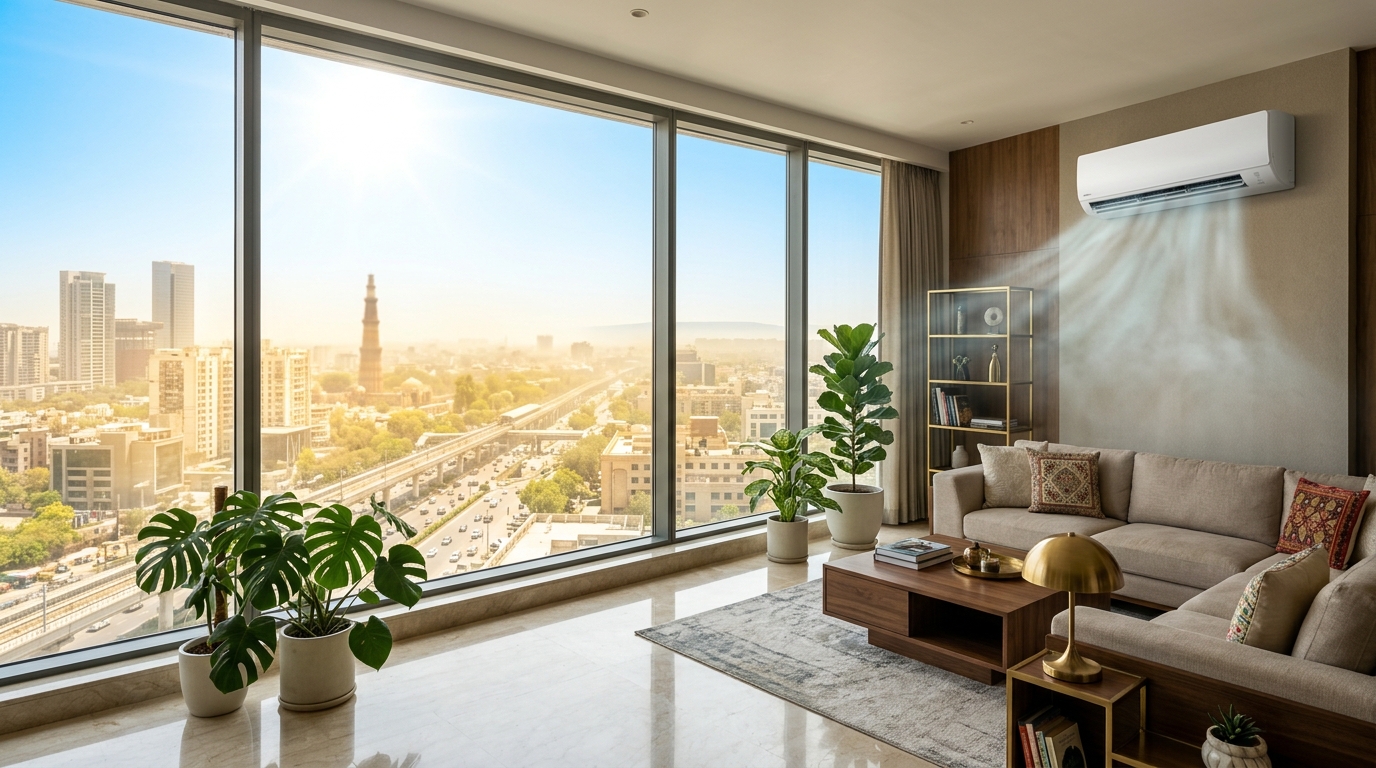
Come July and August, the capital turns into a muggy pressure cooker with 80% relative humidity. In November and December, winter smog spikes AQI past 450, while January drops night temperatures down to 4°C. An ordinary budget AC that runs fine in mild coastal conditions will choke, trip its compressor, or spring a refrigerant gas leak within two seasons in Delhi NCR.
We evaluated the top cooling systems on the market through the lens of Delhi's harsh ground reality. Below, you'll find our top 5 tested recommendations for 2026, an honest breakdown of whether you need a voltage stabilizer, architectural tonnage sizing for Delhi builder floors and DDA apartments, and the real math behind your BSES or Tata Power summer electricity bills.
⚡ Quick Picks: Best ACs for Delhi NCR at a Glance
LG 1.5 Ton 5 Star AI Dual Inverter
AI dual-rotary compressor adapts instantly to 46°C heat; dual-vane airflow cools deep builder floor rooms.
Check Amazon Price →Daikin 1.5 Ton 5 Star FTKM50XV
Survives up to 54°C ambient heat without tripping. Neo Swing compressor with unmatched durability.
Check Amazon Price →Panasonic 1.5 Ton 5 Star MirAIe
Segment-topping 5.80 ISEER, built-in PM 2.5 air filtration for Delhi smog, and seamless app automation.
Check Amazon Price →Voltas 1.5 Ton 3 Star 183V Vectra
Affordable upfront ticket price, fast cooling for mid-sized bedrooms, and widest service network across Delhi.
Check Amazon Price →Why Delhi Needs a Specially Selected Air Conditioner
Most air conditioners sold in India are rated and tested under standard Bureau of Energy Efficiency (BEE) conditions: an indoor temperature of 27°C and an outdoor ambient temperature of 35°C. But Delhi in late May laughs at 35°C. By 1:30 PM, your outdoor unit perched on a west-facing balcony wall or directly on a tarred rooftop absorbs radiant ambient temperatures exceeding 50°C.
Here are the four unique environmental challenges your air conditioner faces every single day in the National Capital Region:
1. The 46°C to 50°C Ambient Cut-off Crisis
As outdoor air temperatures approach 45°C, standard compressors run under massive head pressure. In cheaper units, the thermal overload protector kicks in, cutting off the compressor motor to prevent it from burning out. The indoor blower fan keeps running, but it simply blows warm, humid air into your bedroom. You wake up sweating at 2:30 PM wondering why your AC stopped cooling. To avoid this, you need an air conditioner engineered with a heavy-duty tropicalized rotary or swing compressor designed to pull heat effectively up to 52°C or even 54°C ambient conditions.
2. Summer Dust Storms (Andhi) and Choked Heat Exchangers
Between April and June, strong westerly winds carry fine desert dust from Rajasthan right across Haryana and Delhi. This fine silt cakes the thin aluminum condenser fins on the outdoor unit (ODU). When the condenser fins clog, heat cannot dissipate into the air. The compressor works 40% harder, electricity draw spikes, and the cooling drops drastically. ACs with auto-cleaning cycles, hydrophobic coil coatings, and wider fin spacing survive Delhi's dust seasons far better than entry-level units.
3. Open Drains, Hydrogen Sulfide, and Pinhole Gas Leaks
If you live anywhere within 500 meters of an open drain—such as the Najafgarh drain, Barapullah nullah, Shahdara trunk drain, or local drainage canals cutting through Rohini, Mayur Vihar, Lajpat Nagar, Indirapuram, or Noida Sector 62—your AC faces chemical corrosion. Stagnant sewage releases hydrogen sulfide (H2S) gas. H2S reacts aggressively with bare copper coils, creating copper sulfide scale that eats tiny pinholes through the piping.
This is why thousands of Delhi residents face gas leakage within 14 to 18 months of buying a new AC. The fix? You must look for 100% grooved copper coils protected by specialized anti-corrosive epoxy treatments like LG's Ocean Black Protection, Daikin's Blue Fin coating, or Carrier's Aqua Clear shield.
4. Summer Evening Voltage Sags and Surcharges
While parts of central and New Delhi (NDMC zones) enjoy stable 230V power, vast residential swathes served by BSES Rajdhani (BRPL), BSES Yamuna (BYPL), and Tata Power-DDL experience severe voltage drops during peak summer nights. Between 10 PM and 2 AM, when every household powers up their cooling appliances, grid voltage can plunge from 230V down to 155V. If your AC doesn't feature an ultra-wide low-voltage operating range or isn't paired with a dedicated voltage stabilizer, the electronic printed circuit board (PCB) risks sudden component burnout. A replacement PCB on a 5-star inverter unit costs ₹8,000 to ₹14,000 out of pocket.
Tonnage Sizing for Delhi Homes: Flat vs Builder Floor vs High-Rise
Standard sizing charts tell you that a 100 to 120 sq ft room requires a 1 Ton AC, while 120 to 170 sq ft calls for a 1.5 Ton AC. In Delhi, applying these generic rules will leave you under-cooled on the hottest afternoons. Delhi's intense solar radiation load requires architectural adjustments:
| Delhi Housing Type | Typical Room Size | Recommended Capacity | Critical Heat Load Factors |
|---|---|---|---|
| DDA Middle Floor Flat | 110 – 140 sq. ft. | 1.0 Ton or 1.5 Ton | Shaded by upper floors; standard 9-inch brick walls hold heat moderately well. |
| DDA Top Floor (No Roof Insulation) | 110 – 140 sq. ft. | 1.5 Ton (Mandatory) | Direct rooftop sun turns concrete into a radiant heater well past midnight. |
| Builder Floor Master Bedroom | 160 – 210 sq. ft. | 1.5 Ton to 2.0 Ton | Large glass sliding balcony doors facing west or south demand higher tonnage. |
| Builder Floor Top Floor / Penthouse | 160 – 220 sq. ft. | 2.0 Ton | Unshaded rooftop slab plus floor-to-ceiling glass creates an extreme greenhouse effect. |
| Gurgaon / Noida High-Rise (10th+ Floor) | 130 – 175 sq. ft. | 1.5 Ton | Thin modern plasterboard/concrete walls, windy exposure, cramped balcony ODU ventilation. |
| Ground Floor / Basement Study | 100 – 130 sq. ft. | 1.0 Ton | Naturally cooler thermal mass; minimum direct solar gain. |
If you want exact numbers calculated for your window orientation, ceiling height, and family headcount, use our free AC Tonnage Calculator before booking your installation.
The 5 Best Air Conditioners for Delhi in 2026
We reviewed over two dozen split air conditioners sold across Delhi NCR, checking real compressor performance curves, fin coatings, noise ratings, and post-sales service coverage. These five models proved their ability to tackle Delhi's heatwaves reliably.
1. LG 1.5 Ton 5 Star AI DUAL Inverter Split AC
LG's AI DUAL Inverter remains the most balanced, trouble-free split AC you can mount on a Delhi wall. Powered by a dual rotary compressor with twin compression chambers offset by 180 degrees, it operates smoothly with minimal vibration even when pushing maximum refrigeration output in 46°C ambient heat.
Why It Excels in Delhi:
- Ocean Black Protection: Both indoor and outdoor copper heat exchangers get a specialized anti-corrosive coating that shields the tubing from industrial pollution and corrosive gases drifting from Delhi's sewer nullahs.
- AI 6-in-1 Convertible Modes: When May demands 110% cooling capacity, the AC ramps up instantly. When you run it on mild April nights, you can dial it back to 40% or 60% cooling capacity to conserve units on your power meter.
- Stabilizer-Free Operation (120V–290V): Handles brief voltage drops comfortably without sudden system resets.
- LG ThinQ App: Allows you to power up cooling 20 minutes before driving home from your Connaught Place or Cyber Hub office.
Official Compressor Warranty
10 Years with Gas Charging Included
2. Daikin 1.5 Ton 5 Star Swing Inverter Split AC
If your outdoor unit has to sit directly on an unshaded rooftop in Rohini, Dwarka, or Greater Noida where afternoon ambient surface temperatures touch 52°C, Daikin is the undisputed heavy-weight champion. While other units start panting and tripping, Daikin's patented Neo Swing compressor keeps operating reliably up to 54°C ambient heat.
Why It Excels in Delhi:
- 54°C Ambient Ceiling: Japanese engineering provides an oversized condenser coil and enhanced fan motor to dump heat under brutal heatwave conditions without thermal cutoff.
- Patented Neo Swing Compressor: Eliminates internal friction and refrigerant gas leakage inside the cylinder, delivering longevity that easily surpasses standard rotary units.
- Dew Clean Technology: Auto-condenses moisture on the indoor evaporator coil to wash away trapped dust particles and flushes it down the drain pipe with a single remote press—essential after a Delhi dust storm.
- Coanda Airflow: Drafts cool air upward along the ceiling rather than blasting cold air directly onto your bed, creating uniform cooling across deep rooms.
Best For
Top Floor Apartments, West-Facing Rooms & Severe Heat
3. Carrier 1.5 Ton 5 Star AI Flexicool Inverter Split AC
Carrier's Ester Edge series is built for households that host guests frequently or have fluctuating room occupancy. Its AI Flexicool technology allows you to adjust the cooling capacity across 6 distinct stages (from 0.8 Ton up to 1.65 Ton), letting you match the exact heat load on any given evening.
Why It Excels in Delhi:
- Insta Cool Mode: Drops blower output to maximum rapid cooling mode for 45 minutes, bringing a sweltering 38°C room down to a comfortable 25°C in roughly 12 minutes.
- Hydrophilic Blue Fins: Protects condenser tubes from moisture accumulation during July monsoon humidity, stopping premature electrolytic pitting.
- Dual Filtration (PM 2.5 + HD Filter): Helps strip particulate matter and dust storm residue from the indoor air stream before circulating.
- Competitive Price Point: Delivers 5-star efficiency at ₹4,000 to ₹6,000 less than Japanese premium brands.
Best For
Living Rooms, Variable Occupancy & Rapid Pull-Down
4. Panasonic 1.5 Ton 5 Star Wi-Fi Inverter Smart Split AC
With a certified ISEER of 5.80, this Panasonic model is the single most energy-efficient 1.5-ton split AC currently sold in India. For Delhi residents facing steep 800+ unit electricity consumption slabs during the summer quarter, this unit pays back its price premium faster than any competitor on our list.
Why It Excels in Delhi:
- Built-in PM 2.5 Air Filter: Actively traps fine particulate smog. When Delhi's winter AQI spikes past 400, running this AC in fan/air purifier mode removes dangerous micro-pollutants inside your bedroom.
- MirAIe Smart App Ecosystem: Hands down the best smart AC software in India. You can configure hourly temperature curves (e.g., start at 23°C at 11 PM, bump to 25°C by 3 AM, and 26°C by 6 AM) to prevent early-morning chills and slash power waste.
- Shield Blu+ Anti-Corrosion: 100% copper condenser tubing with nano-coating engineered to withstand acidic industrial emissions and sulfur fumes.
- Whisper Quiet Operation: Lowers fan sound to an imperceptible 19 dB in quiet mode—ideal for light sleepers.
Best For
Lowest Electric Bills, Smart Home Automation & Clean Air
5. Voltas 1.5 Ton 3 Star Inverter Split AC
Not everyone owns a four-bedroom builder floor in Greater Kailash or a luxury high-rise in Gurgaon. If you are renting a flat in Laxmi Nagar, Mukherjee Nagar, Malviya Nagar, or Mayur Vihar, or furnishing a student PG, spending ₹50,000 on a 5-star Japanese unit doesn't make financial sense. Voltas's 183V Vectra delivers reliable Tata-backed cooling at a friendly budget price.
Why It Excels in Delhi:
- Widest Service Reach in Delhi NCR: Voltas has authorized service technicians and third-party mechanics in literally every corner of Delhi, from Narela to Badarpur. When peak June demand breaks other brands' call centers, getting a Voltas repair tech is significantly faster.
- High Ambient Cooling (Up to 52°C): Built specifically for Indian climatic extremes with a robust rotary compressor that doesn't back down under high head temperatures.
- Low Upfront Investment: Leaves ₹12,000 to ₹18,000 in your pocket compared to top-tier 5-star models—making it the smart choice for 2 to 3-year rental stays.
- 4-in-1 Adjustable Cooling: Allows dialing capacity down to 20% or 50% for lower power consumption on cloudy monsoon days.
Best For
Renters, Students, PGs, and Secondary Guest Rooms
Master Comparison Table: Delhi's Top 5 ACs
Compare the essential specs side-by-side to find the right balance of cooling endurance, energy efficiency, and upfront investment for your home:
| Brand & Model | Capacity / Star | ISEER Rating | Max Ambient Temp | Anti-Corrosion / Air Clean | Price Range | Amazon Deal |
|---|---|---|---|---|---|---|
| LG TS-Q19YNZE | 1.5T / 5 Star | 5.20 | 52°C | Ocean Black Protection | ₹44,000 – ₹54,000 | Check Price → |
| Daikin FTKM50XV | 1.5T / 5 Star | 5.00 | 54°C (Highest) | Dew Clean + Blue Fin | ₹47,000 – ₹58,000 | Check Price → |
| Carrier ESTER Edge Gxi | 1.5T / 5 Star | 5.10 | 52°C | Aqua Clear + PM 2.5 | ₹40,000 – ₹48,000 | Check Price → |
| Panasonic CS-NU18BKY5WX | 1.5T / 5 Star | 5.80 (Best) | 52°C | Shield Blu+ & PM 2.5 | ₹44,000 – ₹52,000 | Check Price → |
| Voltas 183V Vectra | 1.5T / 3 Star | 3.81 | 52°C | Anti-Dust Filter | ₹30,000 – ₹36,000 | Check Price → |
Should You Buy a Hot & Cold AC for Delhi Winters?
Delhi is one of the very few metropolitan regions in India that experiences real winter. In December and January, morning minimum temperatures regularly dip to 4°C to 7°C, accompanied by bone-chilling cold waves and thick radiation fog.
Most Delhi families pull out oil-filled radiators (OFRs), halogen quartz heaters, or cheap 2000W fan blowers. But here is the thermodynamic secret that very few consumers realize: A Hot & Cold inverter AC runs on a heat pump cycle, which uses 60% to 70% less electricity than any room heater.
Heat Pump AC vs 2000W Electric Room Heater
Standard 2000W Room Heater (OFR / Blower):
- Uses direct resistance heating (1 kW electricity = 1 kW heat).
- Consumes roughly 2 units (kWh) per hour at full blast.
- Running 8 hours/night costs ~₹120/night or ~₹3,600/month.
- Burns indoor oxygen, creating dry throat, eye irritation, and breathing discomfort.
1.5 Ton Hot & Cold Inverter AC:
- Reverses the refrigeration cycle to pump ambient heat inward (Coefficient of Performance ~3.2).
- Draws only 0.6 to 0.8 units (kWh) per hour once the room hits 23°C.
- Running 8 hours/night costs ~₹45/night or ~₹1,350/month.
- Does not burn oxygen or create burning smells; heats the entire room evenly from the ceiling.
Hot & Cold models cost roughly ₹5,000 to ₹8,000 more than pure cooling split ACs. If you live with elderly parents, infants, or suffer from winter bronchitis in Delhi, investing in a hot & cold split AC eliminates cluttered floor heaters and cuts your winter electricity bills dramatically.
Delhi Electricity Rates: What Running an AC Really Costs (BSES & TPDDL)
Delhi's power distribution is managed primarily by three discoms: BSES Rajdhani Power Limited (South and West Delhi), BSES Yamuna Power Limited (Central and East Delhi), and Tata Power Delhi Distribution Limited (North and Northwest Delhi). Across the border in Gurgaon, consumers fall under Dakshin Haryana Bijli Vitran Nigam (DHBVN).
Delhi provides a 100% electricity subsidy for monthly consumption up to 200 units, and a 50% subsidy (up to ₹800) for 201 to 400 units. However, as soon as May arrives and you switch on even a single 1.5-ton AC for 8 to 10 hours daily, your household will cross 400 units within 15 to 20 days, forfeiting lower subsidies completely.
Here is how the Delhi Electricity Regulatory Commission (DERC) domestic slabs stack up, including typical Power Purchase Adjustment Charges (PPAC ~27-31%), 8% Delhi electricity tax, and fixed load charges:
| Monthly Unit Slabs | Base DERC Tariff | Effective Rate with PPAC & Taxes | Household Impact with AC |
|---|---|---|---|
| 0 – 200 kWh | ₹3.00/unit | ₹0 (Zero Bill under Delhi Scheme) | Possible only in winter months without heavy appliances. |
| 201 – 400 kWh | ₹4.50/unit | ₹6.20/unit | Exceeded within 2 weeks if running 1 AC regularly. |
| 401 – 800 kWh | ₹6.50/unit | ₹8.70 – ₹9.20/unit | Standard slab for 2-bedroom Delhi homes running 1–2 ACs. |
| 800+ kWh | ₹7.00 – ₹8.00/unit | ₹9.80 – ₹10.60/unit | Builder floors and 3BHK homes running 2–3 ACs in peak June. |
Summer Running Cost: 5-Star Inverter vs 3-Star Inverter vs 10-Year-Old AC
Assume you run your AC for 10 hours daily across Delhi's peak 5-month cooling season (May through September), with an effective marginal tariff of ₹9.00/kWh:
| AC Type & Rating | Avg Power Draw (10 hrs) | Daily Cost (@ ₹9/unit) | Monthly Electric Bill | 5-Month Summer Total |
|---|---|---|---|---|
| Panasonic 5 Star (ISEER 5.80) | 5.0 kWh / day | ₹45.00 | ₹1,350 | ₹6,750 |
| LG / Daikin 5 Star (ISEER 5.00-5.20) | 5.8 kWh / day | ₹52.20 | ₹1,566 | ₹7,830 |
| Voltas 3 Star Inverter (ISEER 3.81) | 7.6 kWh / day | ₹68.40 | ₹2,052 | ₹10,260 |
| Old Non-Inverter 3 Star (EER ~3.0) | 12.5 kWh / day | ₹112.50 | ₹3,375 | ₹16,875 |
Notice the gap: Running a modern 5-Star Inverter AC saves you over ₹9,000 every single summer compared to keeping an aging 10-year-old non-inverter unit alive. Even compared to a 3-star inverter, the 5-star unit saves around ₹2,400 per summer season, recovering its ₹8,000 price premium in roughly three years.
Do You Really Need a Voltage Stabilizer in Delhi NCR?
Every AC brand prominently advertises "Stabilizer-Free Operation" on their brochures, typically claiming support for 120V to 290V. In glossy marketing copy, that sounds like you never need to spend another rupee on an external box.
Here is what the manufacturer's fine print doesn't tell you: "Stabilizer-free" does not mean the AC keeps cooling when voltage collapses. When voltage drops below 160V on a sweltering 44°C Delhi evening, the AC's internal power supply cuts the compressor off to prevent the motor windings from drawing excessive current and frying. The indoor unit stays on, but cooling ceases entirely.
Even worse, sudden voltage spikes when power returns after an outage can overwhelm the internal varistors on your AC's printed circuit board (PCB). Replacing a burnt inverter PCB out of warranty costs between ₹8,000 and ₹13,000.
Where You Definitely Need a Voltage Stabilizer:
- Older DDA Pockets & High-Density Areas: Uttam Nagar, Sangam Vihar, Govindpuri, Rohini sectors, Janakpuri, Laxmi Nagar, and Burari where transformer overloading is frequent.
- Independent Builder Floors without Dedicated Step-Down Transformers: Evening phase imbalance regularly pushes one phase below 150V while another spikes over 265V.
- Ghaziabad and Older Noida Sectors: Frequent unannounced power cuts and sudden high-voltage surges upon diesel generator switchover.
Where you might skip it: Gated luxury high-rise societies in Gurgaon (Golf Course Road, DLF Phase 5) or Central Delhi (NDMC zone) with modern 100% power back-up and regulated internal substation grids.
For an investment of roughly ₹2,400 to ₹3,200, a wide-range 4kVA copper stabilizer (such as a V-Guard Magno 410 or VG 400) acts as an indispensable sacrificial shield for your ₹45,000 air conditioner. Check our dedicated Best Voltage Stabilizers Guide for tested recommendations.
Maintenance Rules for Delhi NCR: Preventing Summer Breakdowns
If you treat your AC in Delhi the way you would in a cleaner coastal city, it will lose 30% of its cooling efficiency by its third year. Follow these three rules to keep your machine in peak condition:
- Pre-Summer Wet Jet Wash (March): Never start the season with a simple dry brush dusting. Hire a technician with a high-pressure jet pump and a waterproof servicing jacket. Cleaning the outdoor condenser coil thoroughly from back to front restores optimal heat dissipation before May's heatwaves hit.
- Wash Indoor Mesh Filters Every 10 Days in May–June: Because Delhi dust is extremely fine, indoor air filters choke twice as fast as in other cities. Choked mesh filters starve the indoor blower fan of return air, causing the evaporator coils to freeze up into solid blocks of ice.
- Winter Anti-Smog Protection (October to February): Delhi's winter smog is laden with sulfur dioxide, nitrogen oxides, and acidic soot particles. Buy a heavy-duty waterproof, breathable outdoor unit cover for ₹350 on Amazon to wrap your condenser from November through February. This single step prevents corrosive winter smog from eating away at your aluminum fins.
Beating the Heat This Summer?
Prices on top-rated 1.5-ton split ACs climb by ₹3,000 to ₹5,000 once Delhi hits 42°C in April and May, and installation wait times stretch to 5 days. Secure your unit early at off-peak rates.
🛒 Check Today's Best AC Deals on Amazon IndiaFrequently Asked Questions About ACs in Delhi
Why does my AC stop cooling at 2 PM during Delhi summers?
When ambient temperatures touch 46°C and direct sunlight beats down on your outdoor condenser unit, the refrigerant pressure inside the compressor rises beyond safety limits. Standard units trip their thermal overload switch to prevent the motor from seizing. To solve this, install an outdoor sunshade or louvre canopy above the condenser (leaving at least 2 feet of clear airflow around the fan) and clean the condenser fins with water.
Is a 1.5 Ton AC enough for a top-floor room in a Delhi builder floor?
For rooms up to 135 sq ft, a high-performance 1.5 Ton 5-star AC (like Daikin or LG) will handle the load if you have good curtains. However, if your top-floor room exceeds 145 sq ft and has an unshaded concrete terrace directly above, a 1.5 Ton unit will run at 100% continuous compressor capacity without reaching the set temperature. In such cases, stepping up to a 2 Ton split AC is strongly recommended.
How do I protect my AC from drain gas corrosion (nallah smell)?
Hydrogen sulfide gas from open drains reacts with copper to form black copper sulfide, causing micro-leaks. Never buy an AC with exposed bare copper coils if you live within 500 meters of a drain. Choose models with factory anti-corrosion treatments like LG's Ocean Black Protection, Daikin's Blue Fin, or Panasonic's Shield Blu+. Additionally, spray an anti-corrosion coil coating annually during pre-season servicing.
Can I run an inverter AC on my home inverter battery in Delhi?
A standard single or double-battery 12V/24V home inverter cannot handle a 1.5-ton AC. You need a specialized high-capacity solar or commercial inverter of at least 3.5 kVA to 5 kVA with a 48V battery bank. Even then, you should set your inverter AC to 40% or 60% capacity mode (convertible mode) to prevent rapid battery drainage.
What is the ideal AC temperature to balance comfort and electricity bills in Delhi?
The Bureau of Energy Efficiency recommends setting your thermostat to 24°C. Every 1°C increase in temperature setting (e.g., changing from 20°C to 24°C) cuts electricity consumption by roughly 6%. In Delhi's 45°C summers, keeping your thermostat at 24°C with a ceiling fan running at low speed delivers superior comfort while saving up to ₹1,200 per month compared to blasting it at 18°C.
Should I choose a 3-star or 5-star AC for Delhi?
If you use your AC for more than 5 to 6 hours daily throughout May, June, July, and August, buy a 5-star AC. Delhi's progressive electricity tariff pushes heavy power consumption into the ₹8.50 to ₹10.00/unit tier. A 5-star unit saves approximately ₹2,400 to ₹3,000 every single summer, paying off the ₹7,000 to ₹8,000 price difference in under three years. For guest bedrooms or rented flats used only 2 to 3 hours daily, a 3-star AC is the smarter economic choice.
How often should I service my AC in Delhi NCR?
In Delhi, twice a year is the bare minimum: once in March or April before the summer cooling season starts (full wet jet service for both indoor and outdoor coils), and once in November to clean out the monsoon grime and dry the unit before winter storage. If you live near an active construction zone in Noida or Gurgaon, an intermediate outdoor coil wash in July is also recommended.
Is window AC still worth buying in Delhi?
Window ACs are simpler to install in older DDA flats or rented rooms with existing wall cutouts. They avoid installation labor costs, copper piping charges, and outdoor mounting brackets. However, split ACs are significantly quieter (24 dB vs 48 dB for window units), cool larger spaces more uniformly, and offer higher ISEER energy efficiency ratings. If budget allows and you own the home, split ACs are far superior.
Will an AC with a PM 2.5 filter replace a dedicated air purifier during Delhi smog?
An AC with a PM 2.5 filter (like the Panasonic MirAIe or Carrier Ester Edge) definitely helps clean airborne particles while cooling or running in fan mode. However, when November smog levels spike AQI past 400, a standalone air purifier with a True HEPA H13 filter and active carbon layer moves significantly more clean air (higher Clean Air Delivery Rate / CADR) and tackles volatile organic compounds (VOCs) that an AC mesh cannot trap.
Related Guides & Buying Resources
- Best 1.5 Ton AC in India (2026 In-Depth Comparison)
- Best 1 Ton AC for Small Bedrooms and Studies
- Best 2 Ton AC for Large Living Rooms and Top Floors
- Best 5 Star Inverter ACs Ranked by ISEER Efficiency
- AC Tonnage Calculator: Calculate Room Heat Load Accurately
- Best Voltage Stabilizers for Inverter ACs in India
- Inverter vs Non-Inverter AC: Real Electricity Savings Breakdown
- What is ISEER Rating? How to Read BEE Energy Labels
- LG Air Conditioners: Full 2026 Lineup and Review
- Daikin Air Conditioners: Why Japanese Engineering Dominates