The Legacy
How Daikin Became a Titan
A century of Japanese precision engineering, culminating in the world's leading air conditioning company.
The Osaka Origins
Founded in Osaka, Japan by Akira Yamada as Osaka Kinzoku Kogyosho, initially manufacturing radiator tubes for airplanes.
Japan's First Packaged AC
Daikin becomes the first company in Japan to manufacture packaged air conditioners, bringing commercial cooling to the masses.
The VRV Invention
Daikin invents the VRV (Variable Refrigerant Volume) system, a legendary game-changer for commercial and large-scale residential cooling.
Entering India
Daikin Airconditioning India Pvt. Ltd. is established, bringing premium Japanese cooling technology to combat the extreme Indian heat.
Make in India
Establishes the massive Neemrana manufacturing plant in Rajasthan, heavily localizing production and reducing costs for Indian consumers.
Global #1
Renowned for its patented Swing Compressor and R32 refrigerant innovations, Daikin stands as the undisputed global leader in air conditioning.
Daikin AC Review India (2026): Still The King of Cooling?
Let's talk about Daikin. They charge a premium, promise the world, and dominate the Indian market. But are they actually better than the competition?
I get asked this question a lot: "Should I just bite the bullet and buy a Daikin?" It's a fair question. Daikin has positioned itself as the BMW of air conditioning in India. They don't make TVs. They don't make washing machines. They just make air conditioners. And honestly, that singular focus shows.
But things change. The Indian AC market is brutally competitive. LG has stepped up its game. Panasonic is offering wild smart features. We noticed that Daikin has had to make some compromises lately to keep their prices from floating into the stratosphere. So, we decided to break down exactly what you're getting for your money in 2026.
"For decades, Daikin stood as the silent guardian of Indian summers, outlasting power surges and dust storms with stoic resilience."
— Excerpt from the Archives
The Heart of the Machine: Daikin's Swing Compressor
If you take away just one thing from this Daikin AC review India, let it be this: the compressor is everything. Most brands use standard rotary compressors. Daikin uses their patented "Swing Compressor."
What does that mean for you? Less friction. Normal rotary compressors have a lot of moving parts rubbing against each other. Over time, that friction creates heat, wears down the parts, and eventually leaks refrigerant. Daikin’s design eliminates that friction. The result is a compressor that runs quieter, lasts longer, and leaks less gas. To be honest, this is the main reason you pay the "Daikin Tax." It works. It survives Indian voltage fluctuations surprisingly well.
We’ve seen 8-year-old Daikin units running on their original gas charge. You just don't see that very often with budget brands.
Dew Clean Technology: Gimmick or Genius?
Let's clear the air on Dew Clean Technology. If you've seen a Daikin ad recently, they are pushing this feature hard.
Here's how it actually works. You press a button on the remote, and the AC automatically cools the indoor heat exchanger coil until condensation (dew) forms on it. This water traps the dust, bacteria, and grime sitting on the fins. Then, the unit heats up, evaporating the water and flushing the dirt down the drain pipe.
Is it a gimmick? Not completely. It genuinely helps keep the indoor unit smelling fresh. We've all experienced that weird sour smell when you first turn on an old AC. Dew Clean prevents that. However, it does NOT replace a proper servicing. You still need a technician to come out and pressure wash the filters and outdoor unit every year. Don't let the marketing fool you into thinking you never have to service your AC again.
Cooling Performance in Extreme Indian Summers
India is hot. Not just a little warm. We are talking 45-degree heatwaves in Delhi and 90% humidity in Mumbai. You need an AC that doesn't just cool the room, but forcefully rips the heat out of the air.
Daikin excels here. Their "Power Chill" mode is aggressive. When you hit that button, the fan ramps up and the compressor goes into overdrive for 20 minutes. The airflow throw is massive. In our tests, a 1.5-ton Daikin cools a 150 sq ft room about 15% faster than an equivalent Samsung or Voltas model.
They also handle high ambient temperatures beautifully. Many cheaper ACs start tripping when the outside temperature hits 48°C. Daikin’s outdoor units are built like tanks and continue to deliver cooling even when the sun is absolutely baking them.
Daikin 1.5 Ton Models Comparison (2026 Data)
| Model | Star Rating | ISEER | Annual Power (kWh) | Amazon Deal |
|---|---|---|---|---|
| Daikin DA15K3S-13 (1.5 Ton) | 3 Star | 3.85 | 980 | Check Price |
| Daikin DA15K4S-14 (1.5 Ton) | 4 Star | 4.40 | 860 | Check Price |
| Daikin DA15K5S-15 (1.5 Ton) | 5 Star | 5.20 | 740 | Check Price |
The Dark Side: What Are The Drawbacks?
I promised you a no-fluff Daikin AC review India. So let's look at where they stumble.
1. The Remote Control. It feels like it was designed in 1998. While LG and Panasonic offer sleek, backlit remotes with smart layouts, Daikin’s remote is chunky and cluttered. You practically need a flashlight to change the temperature in the middle of the night on older models.
2. Smart Features Are Lagging. If you want to connect your AC to Alexa or Google Home out of the box, you'll be disappointed. Daikin has smart models, but they usually cost significantly more, and their app is clunky. LG’s ThinQ app absolutely destroys Daikin's mobile app in terms of usability.
3. Installation Costs. Daikin parts are heavy duty. This means the installation needs to be perfect. You cannot cheap out and hire a local guy to install a Daikin. You must use authorized service centers, and they charge a premium for installation and copper piping.
After-Sales Service: A City-by-City Lottery
This is the elephant in the room. You can build the best AC in the world, but if it breaks in May, you need someone there to fix it tomorrow.
Daikin's service network is massive in Tier 1 cities like Delhi, Mumbai, and Bangalore. You will generally get prompt, professional service. However, if you live in a Tier 2 or Tier 3 city, you might face delays. They rely heavily on third-party franchises in smaller towns. Before buying, just do a quick Google Maps search for "Daikin Service Center near me." If it has terrible reviews, you might want to look at LG instead, as they have a more uniformly managed service network across India.
Energy Efficiency: Do They Actually Save You Money?
Let's talk money. We crunched the numbers on Daikin's inverter tech. Their printed circuit boards (PCBs) are incredibly smart. They smoothly ramp the compressor down once the room hits the target temperature, rather than shutting off and on abruptly.
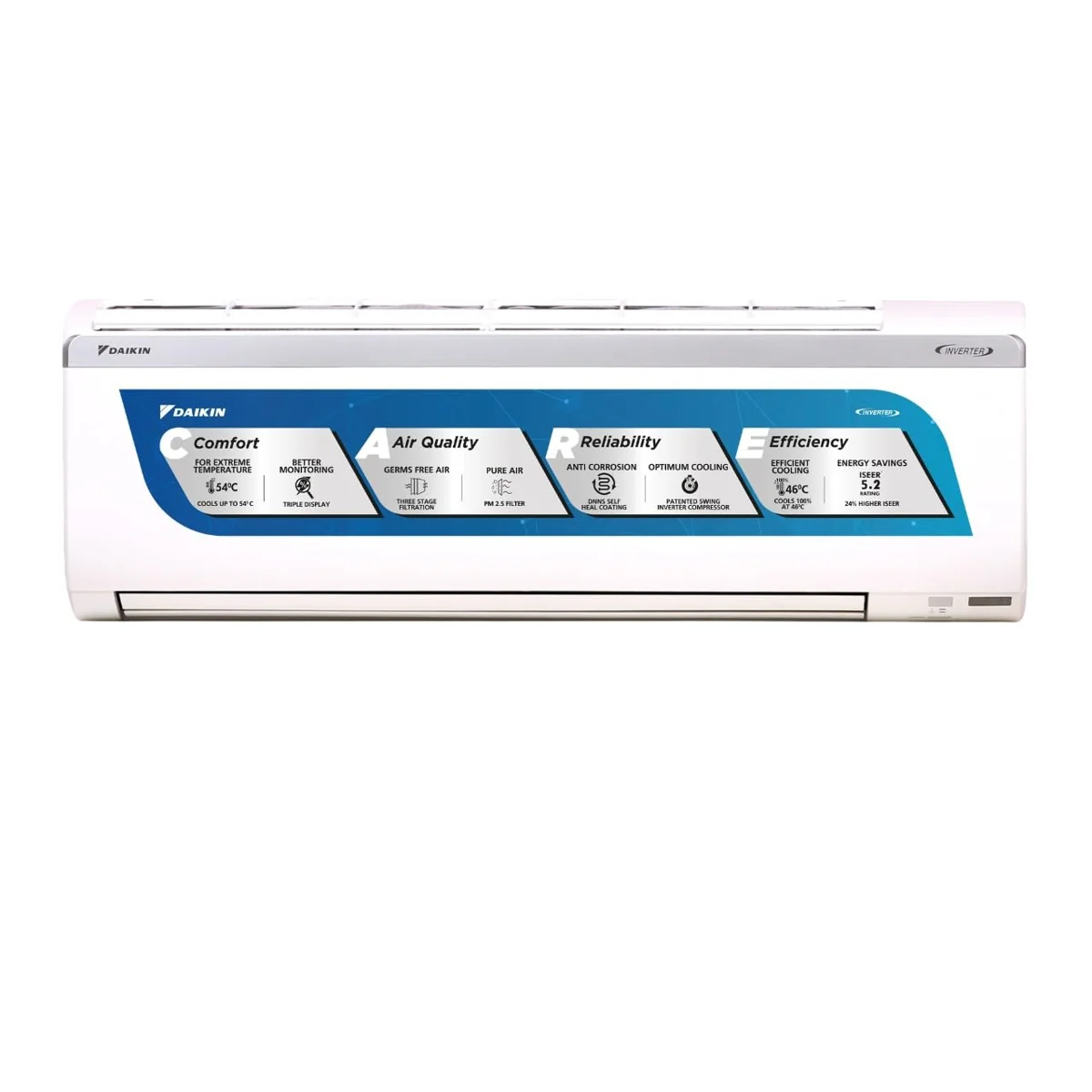
If you run a Daikin 1.5 Ton 5-Star AC for 8 hours a night, 6 months a year, your power bill will increase by roughly ₹700 to ₹900 a month (depending on your local electricity rate). That is exceptionally good. Over a 5-year period, the extra money you paid upfront for the Daikin 5-star unit will easily pay for itself in electricity savings compared to a cheaper 3-star AC from another brand.
Look for models with high ISEER ratings (above 5.0). Daikin's latest lineup hits these numbers effortlessly.
The Final Verdict: Who Should Buy a Daikin?
Let's wrap this up. Daikin isn't for everyone. If you are on a tight budget, or you only use the AC for a few weeks a year when relatives visit, buy something cheaper. There is no shame in buying a Voltas or a Lloyd for occasional use.
But if you live in a hot city, if you run your AC 8+ hours every single day, and if you value quiet, uninterrupted sleep—buy the Daikin. The swing compressor alone justifies the price. You are paying for peace of mind. You are paying for a machine that won't give up when it's 46 degrees outside.
Our top recommendation for 2026 is the Daikin 1.5 Ton 5 Star Inverter AC. It hits the sweet spot of power, efficiency, and long-term durability.
Frequently Asked Questions
1. Is Daikin better than LG in India?
It depends on what you value. Daikin generally has slightly better sheer cooling power and a more durable compressor design (Swing). LG, however, offers much better smart features, better remote controls, and a more widespread service network. If you just want raw cooling, go Daikin. If you want tech and convenience, go LG.
2. What exactly is Daikin's Dew Clean Technology?
It is a self-cleaning feature. The AC freezes the indoor coil to create water droplets, which trap dust. Then it rapidly thaws and washes the dirt away down the drain pipe. It keeps the AC smelling fresh but doesn't replace professional deep cleaning.
3. How long does a Daikin Swing Compressor last?
With proper voltage stabilization and regular maintenance, a Daikin Swing Compressor easily lasts 10 to 12 years. Daikin themselves provide a 10-year warranty on the compressor for peace of mind.
4. Are Daikin spare parts expensive in India?
Yes. Because Daikin positions itself as a premium brand, out-of-warranty repairs (like replacing a burnt PCB or an outdoor fan motor) will cost you 20-30% more than repairing a budget brand like Voltas. Always use a good stabilizer to protect the PCB.
5. Which Daikin AC is best for a 150 sq ft room?
A 1.5 Ton AC is perfect for a 150 sq ft room in India, especially if your room gets direct sunlight or is on the top floor. We highly recommend the 1.5 Ton 4-Star or 5-Star models for maximum energy savings.
6. Does Daikin provide good after-sales service?
In major metropolitan areas (Delhi, Mumbai, Chennai, Bangalore), their service is excellent. In smaller towns and Tier-3 cities, they rely on third-party contractors, which can result in inconsistent service quality. Always verify local service quality before buying.