The Legacy
How Panasonic Became a Titan
Pioneering Japanese innovation, combining the highest energy efficiencies with cutting-edge smart home IoT.
Matsushita Electric
Founded by the legendary Konosuke Matsushita in Japan. Built on a philosophy of contributing to society through technology.
First Room AC
Launched their first room air conditioner, focusing on compact design and quiet operation for Japanese homes.
Heat Pump Innovation
Introduced their first highly efficient heat pump AC, setting the stage for decades of energy-saving research.
The Panasonic Brand
Officially adopted the Panasonic brand name globally, unifying its massive portfolio of consumer electronics.
The MirAIe Revolution
Revolutionized smart cooling in India with the launch of the MirAIe IoT platform, setting the gold standard for AC mobile apps.
Efficiency Champions
Leads the Indian industry with the highest ISEER ratings (up to 5.80) and exclusive nanoe-X air purification technology.
Panasonic AC Review India: Is the Hype Real?
If you are shopping for a new air conditioner in India right now, Panasonic keeps popping up. You've probably seen the ads pushing their "smart" features and high energy ratings. Panasonic has long been a staple in Indian homes, offering reliable cooling since the early days of split ACs. As we noted in our historical 2022 buying guide, they remain one of the most prominent names competing alongside LG and Daikin. But here is the thing: reading a generic spec sheet doesn't tell you what it's actually like to live with one of these machines through a sweltering Delhi summer or a humid Mumbai monsoon. So, we're taking a closer look. Let's talk about the good, the bad, and the slightly annoying.
The MirAIe App: Why You Won't Touch the Remote Again
Let's just address the most talked-about feature first. Panasonic's big selling point is their MirAIe ecosystem. Most AC brands have a smart app these days. Usually, they are clunky, disconnect constantly, and feel like an afterthought. We noticed that Panasonic actually put some real thought into MirAIe.
The interface is surprisingly snappy. But what makes it a game-changer isn't just turning the AC on from your office (though that's nice). It's the sleep profiles. You can program the AC to start at 18 degrees when you first get into bed, raise to 25 degrees by 2 AM when you're freezing, and turn off at 6 AM. If you've ever woken up shivering in the middle of the night, fumbling for a remote in the dark, you know exactly why this matters.
Another big win for the app is the energy tracking. You can actually see how many units your AC is burning through. If you are terrified of your summer electricity bill, watching the real-time usage might ease your anxiety. Or increase it, depending on how low you set the temperature. To be honest, once you get used to controlling your AC from your phone with MirAIe, the physical remote just ends up gathering dust in a drawer. Which is fine, because the included remote looks like it was designed in 2012. It gets the job done, but it lacks the sleekness of the app.
Also, their newer models support "Matter," meaning they slot right into your Google Home or Alexa setup without weird workarounds. You can literally yell at your Echo dot to cool the room, and it happens.
Highest ISEER Ratings Explained (Yes, 5.80 is a Big Deal)
Let's talk numbers. When looking at a Panasonic AC review in India, you'll see a lot of chatter about ISEER. Indian Seasonal Energy Efficiency Ratio. It's how the Bureau of Energy Efficiency tells you if an AC is a power hog. Right now, Panasonic has 1.5-ton 5-star models boasting an ISEER of up to 5.80.
To put that in perspective, a standard 3-star AC usually hovers around 3.80 to 4.00. A 5.80 rating is massive. It means the compressor is incredibly efficient at varying its speed to maintain cooling without sucking up raw power. If you run your AC for 8 to 10 hours a day for most of the year, a 5.80 ISEER rating isn't just a marketing gimmick. It translates to thousands of rupees saved annually.
Panasonic achieves this through their Twin Cool Inverter technology. Instead of one rotor inside the compressor doing all the heavy lifting, there are two. This reduces vibration, lowers noise levels, and allows the compressor to spool up and down much faster. The result? Faster cooling when you turn it on, and less power used once the room hits the target temperature.
How Much Do You Actually Save?
We crunched some numbers. Assuming an electricity rate of ₹8 per unit, running a 3-star AC vs. a Panasonic 5-star (5.80 ISEER) for 1600 hours a year (about 8 hours a day for 200 days).
| AC Type (1.5 Ton) | Approx. Annual Units | Estimated Annual Cost (₹8/unit) | Savings vs 3-Star |
|---|---|---|---|
| Generic 3-Star (ISEER ~3.90) | 1050 Units | ₹8,400 | -- |
| Generic 5-Star (ISEER ~5.00) | 850 Units | ₹6,800 | ₹1,600 / yr |
| Panasonic 5-Star (ISEER 5.80) | 750 Units | ₹6,000 | ₹2,400 / yr |
*Note: Real-world usage varies based on room insulation, ambient temperature, and set temperature. But the relative savings ratio holds true.
Cooling Performance and Build Quality
So it's smart and it saves electricity. But does it actually cool the room? Yes. Panasonic ACs are rated to cool even when ambient temperatures hit 52°C to 55°C. In the scorching heat of North India, this is practically a requirement now. The Jetstream technology they use pushes air up to 45 feet. If you have a long, rectangular living room, this ensures the cold air reaches the far corners rather than just dumping it directly under the indoor unit.
On the durability side, Panasonic uses 100% copper tubing. That's standard for premium ACs today. What sets them apart slightly is their Shield Blu+ technology. It's an anti-corrosion coating applied to both the indoor and outdoor coils. If you live near the coast or in an area with open drains (where corrosive gases are a real problem), this coating is a lifesaver. It prevents microscopic gas leaks that usually plague ACs after two or three years of use.
The Elephant in the Room: Installation Costs and Service
We can't write a genuine Panasonic AC review in India without talking about the installation experience. This is where the shiny marketing hits the messy reality.
Let's be blunt. Panasonic's official installation charges often feel a bit steep compared to budget brands. The base installation might be quoted reasonably, but once the technicians arrive, the "extras" start adding up. Extra copper piping (if your outdoor unit is placed far away), outdoor unit brackets, electrical wiring, and drain pipes. Many users report the final installation bill landing anywhere between ₹2,500 and ₹4,000.
Our advice? Stand there while they measure. Know exactly what comes in the box (usually 3 meters of copper pipe). If they say you need an extra meter, ask them to show you the measurement. It's also worth noting that the quality of service varies wildly by city. In major metros like Bangalore, Mumbai, and Delhi, service is generally prompt. In tier-2 or tier-3 cities, you might be at the mercy of third-party contractors who handle multiple brands. Always demand that the vacuum pump is used during installation—skipping this step to save time will ruin the AC's cooling efficiency in the long run.
Top Panasonic AC Models in India Right Now
If you've decided the pros outweigh the cons, which model should you actually buy? Here are the ones that stand out from their current lineup.
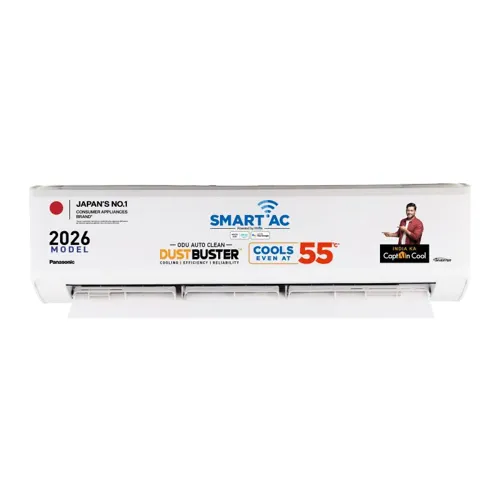
1. Panasonic 1.5 Ton 5 Star Wi-Fi Inverter Smart AC (The Top Pick)
This is the model that hits the sweet spot for most Indian homes. It packs the massive 5.80 ISEER rating, comes with the MirAIe app integration, and includes the PM0.1 air purification filter. If you live in a city with bad AQI, that filter is a nice bonus. It's not a replacement for a dedicated air purifier, but it helps.
- Capacity: 1.5 Ton (Ideal for 150-180 sq ft)
- Rating: 5 Star (ISEER 5.80)
- Key Feature: Custom Sleep Profiles via MirAIe
2. Panasonic 1.5 Ton 3 Star Wi-Fi Inverter Smart AC (The Value Option)
If the upfront cost of the 5-star model makes you wince, the 3-star variant is a solid fallback. You still get the 100% copper build, the smart app features, and fast cooling. The ISEER is lower (usually around 3.90), so your monthly bills will be slightly higher. Only buy this if you run your AC for fewer than 4-5 hours a day.
- Capacity: 1.5 Ton
- Rating: 3 Star
- Key Feature: Same smart features, lower upfront cost
3. Panasonic 1.0 Ton 5 Star Wi-Fi Inverter AC (For Small Bedrooms)
Have a tiny guest room or a small study? A 1.5-ton AC is overkill and will short-cycle (turn on and off too quickly), wasting power and failing to dehumidify the room properly. This 1-ton unit brings all the premium features in a smaller, highly efficient package.
- Capacity: 1.0 Ton (Ideal for up to 110 sq ft)
- Rating: 5 Star
- Key Feature: Whisper-quiet operation
Are They Really Worth It?
Buying an AC isn't just about blowing cold air anymore. It's about how much that cold air costs you over the next five years, and how easy the machine is to live with.
Panasonic nails the tech side. The MirAIe app is genuinely useful, not just a gimmick. The ISEER ratings are top-tier, meaning real savings on your electricity bill. The build quality, particularly the anti-corrosion coating on the coils, shows they understand Indian conditions.
The downsides? You have to navigate the installation process carefully to avoid getting overcharged, and the physical remote is ugly. If you can live with that, a Panasonic AC is one of the smartest buys you can make right now. You are paying a slight premium upfront, but the long-term energy savings and daily convenience of the app easily justify the price tag.
Frequently Asked Questions (FAQs)
1. Is the Panasonic MirAIe app easy to set up?
Yes, it's very straightforward. You download the app, connect to your home Wi-Fi (it requires a 2.4GHz network, which is standard), and follow the on-screen prompts to pair your AC. It usually takes less than five minutes.
2. Does a 5.80 ISEER rating really make a difference?
Absolutely. Compared to a standard 3-star AC, a 5.80 ISEER model uses significantly less electricity to produce the same amount of cooling. If you use your AC daily during the summer, it can save you thousands of rupees a year, paying back the price difference in a couple of seasons.
3. How much does Panasonic AC installation actually cost in India?
Standard installation usually costs around ₹1,199 to ₹1,500. However, most homes require extra copper piping, outdoor unit brackets, or complex wiring. Realistically, budget anywhere from ₹2,500 to ₹4,000 depending on the setup. Always check the final bill breakdown.
4. Are Panasonic ACs good for high heat (above 50°C)?
Yes. Panasonic's newer inverter models are rated to maintain cooling even when outdoor temperatures hit 52°C. Their compressors are designed to handle extreme Indian summers without tripping.
5. What is the warranty on Panasonic ACs?
Typically, they offer 1 year comprehensive warranty on the product, 5 years on the PCB (Printed Circuit Board), and 10 years on the compressor. Make sure you register your product on the app or website to activate these warranties.
6. Do Panasonic ACs have copper condensers?
Yes, all their current mainline residential ACs feature 100% copper condensers. They also add a 'Shield Blu' anti-corrosive coating to protect against rust and leaks, which is especially useful in humid or coastal areas.
7. Can I use Panasonic ACs without the internet or the app?
Of course. The AC comes with a standard physical remote control. The internet connection and app are purely for smart features like remote scheduling and energy tracking. If your Wi-Fi goes down, the AC works perfectly normally with the remote.