First published: 2018 | Last updated:
Window AC vs Split AC — Which is Better for India in 2026?
Every Indian summer reignites the same debate at kitchen tables and WhatsApp family groups: window AC or split AC? Both cool a room. Both run on electricity. But beyond that, they differ in almost every way that matters — how much they cost to install, how loudly they hum through the night, how much electricity they devour, and whether your landlord will even allow them.
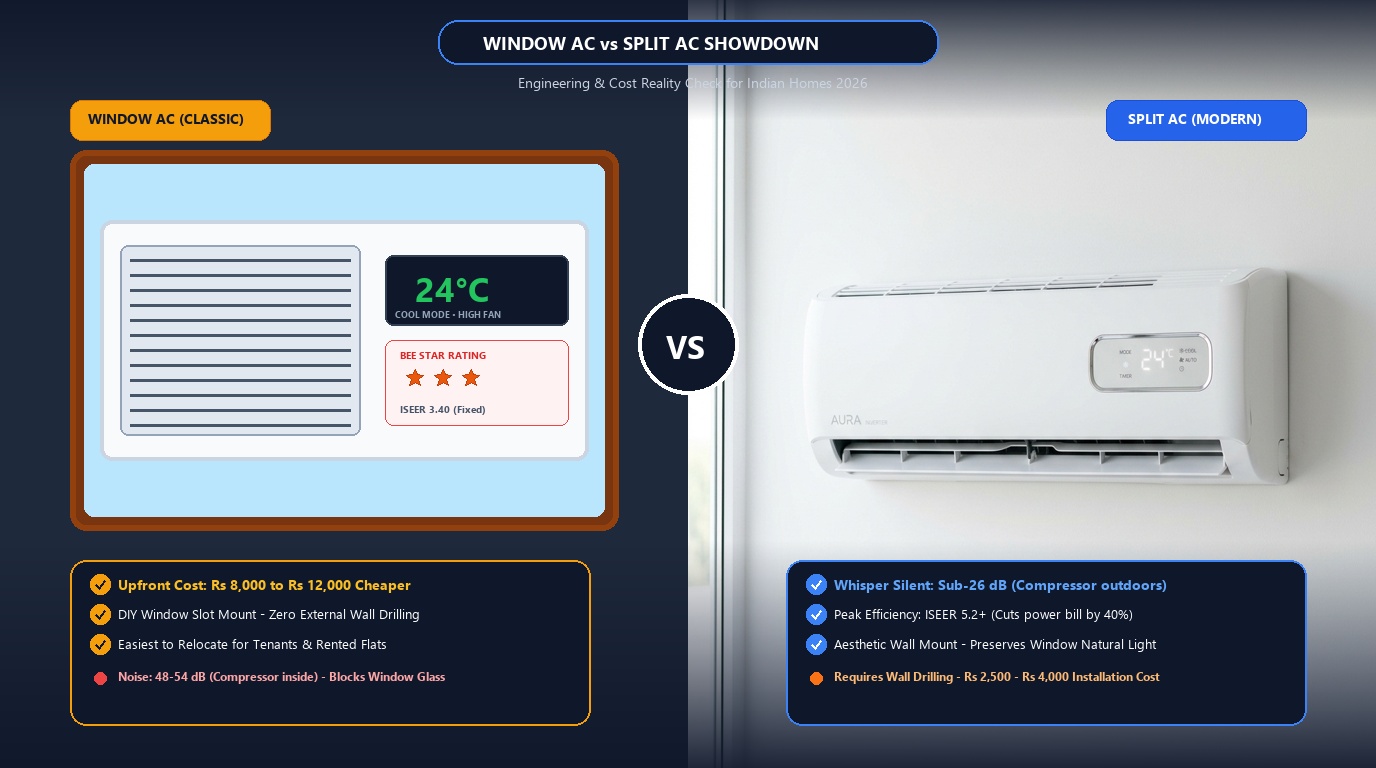
The Indian air-conditioner market has changed dramatically over the past decade. Inverter compressor technology, now standard in most split ACs, has pushed energy efficiency far ahead of conventional fixed-speed window units. BEE (Bureau of Energy Efficiency) 2023 star-rating data confirms that the best split inverter ACs now achieve an ISEER of 5.20, while the finest window ACs struggle past 3.70. That gap is not academic — it shows up on your electricity bill every single month.
At the same time, split ACs are not perfect for every situation. They require professional installation, two separate indoor and outdoor units, copper refrigerant piping, and a wall space that many rented Indian homes simply cannot spare. Window ACs, by contrast, drop into a single wall or window opening, cost a fraction to install, and can travel with you when you move.
This guide breaks down every major dimension — installation, noise, energy efficiency, price, maintenance, and total cost of ownership — so you can make the right call for your specific situation, whether that's a 120 sq ft rented PG room in Bengaluru or a 180 sq ft master bedroom in a new Mumbai flat.
Installation Comparison
Installation is one of the biggest practical differentiators between the two AC types, and it is often underweighted when people compare sticker prices.
Window AC installation is elegantly simple. The entire unit — compressor, condenser, evaporator, fan — lives in one chassis. All you need is an appropriately sized opening in an exterior wall or an existing window frame (typically around 600 mm × 450 mm for a 1-ton unit). A technician slides the AC into the opening, secures it with a support bracket, seals the gaps with foam or a weather-strip kit, and routes the power cable to a dedicated 15A socket. The whole job takes 1–2 hours. Installation typically costs ₹800–₹1,500 including the bracket — often included free in dealer promotions.
Split AC installation is more involved. You need two separate units — an indoor air-handler (typically wall-mounted) and an outdoor condenser — connected by a refrigerant copper pipe (usually ¼" liquid line + ⅜" suction line), an electrical cable, and a condensate drain pipe. A technician must drill through the exterior wall to route the piping, mount the indoor unit on a sturdy wall bracket, place the outdoor unit on a floor stand or wall bracket outside, and then vacuum and charge the refrigerant circuit. Professional installation costs ₹3,000–₹5,000 and can take 3–5 hours. Some brands charge extra for copper piping beyond 3 metres (typically ₹400–₹600 per extra metre).
🏠 For Rented Homes
Window ACs are almost always the better fit for rentals. Uninstallation is clean — remove the unit, patch the slot, done. Split AC installation leaves permanent bracket screw holes, wall penetrations for piping, and an outdoor unit that may violate building bylaws in older Indian apartment complexes. Many landlords explicitly prohibit split AC installation in lease agreements.
One overlooked factor is wall type. Modern flat construction increasingly uses RCC (reinforced concrete) walls, which require an SDS drill and significantly more time to penetrate — adding ₹500–₹1,000 to a split AC installation. Window ACs in older brick or AAC block walls are far easier to fit.
Noise Comparison
Noise is where split ACs pull decisively ahead, and it matters more than most buyers realise until they try to sleep next to a window unit on a hot May night.
Window ACs house the compressor inside the room-side chassis. Published acoustic specifications from major brands (Voltas, Blue Star, Lloyd) show indoor noise levels of 55–62 dB at normal operating speed. At 60 dB, a window AC is approximately as loud as a normal conversation or an office environment — acceptable during the day, disruptive for light sleepers or children at night. Vibration from the compressor can also transmit through the wall or window frame, adding a low-frequency rumble that is harder to mask than broadband noise.
Split ACs move the compressor entirely outside. The indoor air-handler contains only the evaporator coil and a centrifugal blower — quiet by design. Manufacturer specifications for the indoor unit of popular models like the Daikin FTKF, Voltas 185V Vectra, and LG RS-Q18YNZE show noise levels of 19–38 dB depending on fan speed. At the lowest fan setting, many split ACs are quieter than a whisper (30 dB), making them genuinely suitable for bedrooms and home-study rooms.
Rule of thumb: Every 10 dB increase roughly doubles the perceived loudness. A 60 dB window AC sounds about 4× louder than a 40 dB split AC at the same distance — a meaningful difference when you are trying to sleep in a 120 sq ft room.
For living rooms used during the day, the noise difference is less critical — TV audio and ambient sound mask much of a window AC's hum. But for bedrooms, nurseries, or home-office rooms, the 20–40 dB gap between the two types is a compelling reason to choose a split AC.
Energy Efficiency Comparison
The BEE (Bureau of Energy Efficiency) star-rating programme — updated in 2023 — uses ISEER (Indian Seasonal Energy Efficiency Ratio) as its benchmark metric. A higher ISEER means the AC delivers more cooling per watt of electricity consumed across a simulated Indian seasonal load profile.
Window ACs (2023 BEE bands): The 5-star band for 1-ton fixed-speed window ACs starts at ISEER ≥ 3.30. The best-in-class models (e.g., LG LWA5BP5FA, Voltas 125 LZH) achieve ISEER ≈ 3.50–3.70. Because window ACs almost universally use fixed-speed (non-inverter) compressors, they cannot modulate output — they cycle on and off, which is inherently less efficient.
Inverter Split ACs (2023 BEE bands): The 5-star band starts at ISEER ≥ 4.50. Premium inverter models — Daikin FTKF35, Hitachi RSB518HBEA, Voltas 185V Vectra — reach ISEER 5.00–5.20. Inverter compressors vary speed continuously, maintaining set temperature without cycling — which cuts energy waste dramatically, especially in the partial-load conditions that characterise real Indian usage (AC running in a room that is already somewhat cooled, doors opening, etc.).
Monthly Electricity Cost Comparison (1-Ton, 8 hr/day, 30 days, ₹8/kWh)
| AC Type | ISEER | Rated Power (W)* | Monthly kWh | Monthly Cost (₹8/kWh) |
|---|---|---|---|---|
| Window AC — 3-star | 2.90 | 1,205 | 289 | ₹2,312 |
| Window AC — 5-star | 3.60 | 972 | 233 | ₹1,864 |
| Split Inverter — 3-star | 3.99 | 877 | 211 | ₹1,688 |
| Split Inverter — 5-star | 5.00 | 700 | 168 | ₹1,344 |
* Rated power = 3,516 W (1 TR cooling output) ÷ ISEER. Monthly kWh = rated power × 8 hr × 30 days ÷ 1,000. Based on BEE 2023 ISEER methodology and ₹8/kWh average tariff.
The table above shows that switching from a 3-star window AC to a 5-star inverter split AC saves approximately ₹968 per month (₹2,312 − ₹1,344) at ₹8/kWh. Over a 5-month Indian summer, that is nearly ₹4,840 in annual savings — enough to offset the higher upfront cost of a split AC within 2–3 years.
Price Comparison & Total Cost of Ownership
Looking only at the purchase price gives a misleading picture. The real comparison is total cost of ownership (TCO) over 5 years — the period most Indian buyers keep an AC before the first major repair.
Window AC prices (1-ton, 2026 market): ₹20,000–₹35,000 for 3- to 5-star rated models. Entry-level 3-star units (Voltas 123 LZH, Blue Star 1W18LA) start around ₹20,000. The best 5-star window ACs (LG LWA5BP5FA, Carrier 12K Window) top out near ₹32,000–₹35,000. Add ₹800–₹1,500 for installation.
Split inverter AC prices (1-ton, 2026 market): ₹28,000–₹55,000 for 3- to 5-star inverter models. Budget 3-star inverters (Whirlpool 1.5T Magicool, Godrej 1T 3-Star) start around ₹28,000–₹32,000. Mid-range 5-star models (Voltas 185V Vectra, Panasonic CS/CU-SU12XKYW) fall in the ₹35,000–₹42,000 range. Premium brands (Daikin, Hitachi, LG Dual Inverter) reach ₹45,000–₹55,000. Add ₹3,000–₹5,000 for installation.
5-Year TCO Estimate (1-ton, 5 months/year AC season, 8 hr/day)
| Cost Head | 5-Star Window AC | 5-Star Split Inverter |
|---|---|---|
| Purchase price (mid-range) | ₹28,000 | ₹38,000 |
| Installation | ₹1,200 | ₹4,000 |
| Electricity (5 yr × 5 months × ₹/month) | ₹46,600 | ₹33,600 |
| Annual servicing (5 yr × ₹700 avg) | ₹3,500 | ₹4,500 |
| Total 5-Year TCO | ₹79,300 | ₹80,100 |
Electricity: Window AC 5-star @ ₹1,864/month; Split inverter 5-star @ ₹1,344/month. Figures are indicative; actual costs depend on local tariff, usage hours, and room heat load.
The 5-year TCO analysis reveals a near-parity situation. The split AC's higher upfront cost is almost entirely offset by lower electricity bills over 5 years. Beyond year 5, the split AC becomes the clear financial winner — electricity savings compound while the purchase cost stays fixed.
Maintenance Comparison
Both AC types need periodic maintenance to maintain cooling efficiency, but the nature of that maintenance differs in important ways.
Filter cleaning is the most frequent task — ideally monthly during active season. Window AC filters are typically accessible by opening a front grille panel — straightforward, no tools required. Split AC filters on the indoor unit are similarly accessible via a lift-up top panel on most models. DIY filter cleaning takes 10–15 minutes for either type.
Coil cleaning and gas refills are where differences emerge. Window ACs are a single self-contained unit — a technician can clean both the condenser and evaporator coils in one visit without complex disassembly. Gas refills (typically R-410A or R-32) require only one access point. For split ACs, the technician must clean both the indoor coil (evaporator) and the outdoor coil (condenser) separately — sometimes requiring an additional service charge for the outdoor unit if it is difficult to access. Gas refills for split ACs cost ₹1,500–₹2,500 for R-32 and require vacuuming the circuit first.
Service availability in smaller Indian towns and semi-urban areas still favours window ACs — mechanics are more familiar with the simpler single-unit design. Split AC servicing, particularly for less common brands, can require authorised service centres that may not be locally available. Major brands (Voltas, LG, Daikin, Carrier) have wide service networks in Tier-1 and Tier-2 cities, but coverage thins out in Tier-3 areas.
Compressor longevity: Fixed-speed window AC compressors cycle on/off repeatedly — typically 4–8 times per hour — creating mechanical stress at each startup. Inverter split AC compressors modulate speed continuously, reducing startup stress and often lasting longer. Many premium split ACs now carry 10-year compressor warranties (Daikin, LG, Hitachi), versus the 5-year norm for window AC compressors.
Window AC vs Split AC — Best For Whom?
| Criteria | Window AC | Split AC | Notes |
|---|---|---|---|
| Rented apartment | ✓ | ✗ | Window AC is fully portable; split AC leaves permanent holes |
| Bedroom / sleep comfort | ✗ | ✓ | Split AC indoor unit at 19–38 dB vs window AC at 55–62 dB |
| Low electricity bills | ✗ | ✓ | ISEER up to 5.20 vs 3.70 — ~28% less power consumption |
| Tight budget (upfront) | ✓ | ✗ | Window AC + install from ₹21,000; split AC from ₹32,000 |
| Large room (>150 sq ft) | ✗ | ✓ | Split ACs available in 1.5T & 2T; window ACs max 2T but rare |
| Small town service access | ✓ | ✗ | Window ACs simpler; any local mechanic can service them |
| Long-term ownership (5+ yr) | ✗ | ✓ | Lower TCO beyond year 3; better compressor longevity |
| Aesthetics / room look | ✗ | ✓ | Split indoor units are sleek; window boxes are bulky |
Verdict — Which Should You Buy?
There is no single universal answer — the right choice depends on your specific situation. But based on BEE efficiency data, installation cost analysis, and Indian market pricing, here is a clear framework:
Buy a Split Inverter AC if: You own your home or have a landlord who permits installation, you plan to stay in the property for 3+ years, you prioritise quiet sleep, you care about electricity bills over the long term, or your room is larger than 130 sq ft. A 5-star inverter split AC is the most economical choice over any multi-year horizon — BEE ISEER data makes this unambiguous. The ₹10,000–₹15,000 higher upfront cost versus a comparable window AC is recovered through electricity savings within 2–3 years of typical Indian summer usage.
Buy a Window AC if: You are in a rented property where wall drilling is not permitted, you move frequently and need a portable appliance, you have a strict upfront budget below ₹25,000, you are in a smaller city or town where split AC service is unreliable, or you need to cool a small room (under 110 sq ft) where the efficiency gap is less significant in absolute rupee terms.
A 5-star window AC remains a perfectly reasonable appliance in 2026 — it is not obsolete. But with each BEE rating revision, the efficiency bar for split inverter ACs rises while window ACs remain largely static due to their fixed-speed compressor architecture. Over the coming years, the cost-of-operation gap between the two types will only widen.
One final consideration for Indian buyers: voltage fluctuations. Most modern split inverter ACs include built-in voltage stabilisation (100V–290V auto-protection), making separate voltage stabilisers unnecessary. Many window ACs still require an external stabiliser (₹1,500–₹3,000), adding to the total cost — a factor that the headline price comparison often misses.
🪟 Best Window ACs
Top-rated 5-star window ACs for Indian homes — updated September 2026.
❄️ Best Split Inverter ACs
Top-rated 5-star inverter split ACs — with ISEER data and price comparison.
Frequently Asked Questions
Q1. Is split AC better than window AC for bedroom?
Yes, for bedrooms a split AC is significantly better. Split indoor units operate at 19–38 dB — barely audible — whereas window ACs produce 55–62 dB of noise because the compressor sits inside the same room as you. A difference of 20+ dB is perceived as roughly 4× louder. For quality sleep, especially for light sleepers or in homes with young children, the acoustic advantage of a split AC is decisive.
Q2. Can window AC cool as efficiently as split AC?
No. BEE 2023 star-rating data shows that window ACs top out at an ISEER of approximately 3.50–3.70 (5-star band), while modern inverter split ACs achieve ISEER values up to 5.20. This gap translates to 20–35% higher electricity consumption for a comparable window AC over the same operating hours. The fundamental reason is the fixed-speed compressor in window ACs, which cannot modulate output to match the actual cooling demand.
Q3. Which is cheaper to maintain — window or split AC?
Window ACs are marginally cheaper to maintain in absolute terms — there is one unit, one refrigerant circuit, and one service visit covers everything. Split AC servicing requires attention to both the indoor and outdoor unit, and gas refills (R-32) cost ₹1,500–₹2,500. However, neither type has dramatically high maintenance costs; expect ₹700–₹1,200 per annual service for window ACs and ₹900–₹1,500 for split ACs from branded service centres.
Q4. Is window AC good for Indian summers?
A window AC handles Indian summers adequately for small rooms up to ~130 sq ft. In most Indian climates — even hot cities like Nagpur, Jaipur, and Hyderabad — a properly sized 5-star window AC will maintain comfort. However, during extreme heat events above 45°C, fixed-speed window ACs are less adaptive than inverter split ACs, and their higher power draw means electricity bills spike more sharply during peak summer months.
Q5. Can I install window AC without a window?
Yes — a mason can cut a purpose-made opening (roughly 600 mm × 450 mm for a 1-ton unit) in an exterior brick or AAC block wall. This is common practice in older Indian apartments and independent houses. The additional cost for wall cutting, casing fabrication, and plastering is typically ₹1,500–₹3,000. Always confirm with a structural engineer that the wall is non-load-bearing before cutting any opening.
Q6. Does split AC cool faster than window AC?
Inverter split ACs generally cool a room faster in practice. When you first turn on the AC, an inverter compressor ramps up to full or above-rated speed to pull the room temperature down rapidly, then modulates. A fixed-speed window AC operates at one constant speed throughout. In typical 120 sq ft room tests reported by Indian consumer publications, inverter split ACs reach the set temperature 10–15% faster than fixed-speed window ACs of the same rated tonnage.
Q7. Which AC is better for a rented apartment in India?
For rentals, a window AC is almost always the practical choice. Installation is fully reversible — remove the unit, patch the slot with mortar, and the wall is restored. A split AC requires drilling 65–80 mm holes for copper piping, wall brackets that leave screw marks, and an outdoor unit that may violate building co-operative rules. Many Indian lease agreements explicitly prohibit permanent structural modifications, which split AC installation technically qualifies as. The ₹3,000–₹5,000 installation cost for a split AC is also largely unrecoverable when you vacate.
Conclusion
The window AC vs split AC debate does not have a single winner — it has context-dependent answers. For the majority of Indian homeowners who plan to live in their property for more than 3 years, the 5-star inverter split AC is the economically and practically superior choice. Its higher ISEER (up to 5.20 versus 3.70 for window ACs) translates to real monthly savings of ₹500–₹1,000 on electricity bills, its noise levels are genuinely bedroom-compatible, and its 10-year compressor warranties from brands like LG, Daikin, and Hitachi provide long-term peace of mind.
For renters, frequent movers, buyers in smaller towns with limited split AC servicing infrastructure, or anyone with a strict upfront budget below ₹25,000, the 5-star window AC remains a sensible, cost-effective purchase. Modern 5-star window ACs are far more efficient than the 3-star units of a decade ago, and for a small room used seasonally, the total operating cost difference versus a split AC is manageable.
Whatever you choose, always buy the highest BEE star rating your budget allows — the electricity savings over 5–10 years dwarf the price difference between a 3-star and 5-star model. Use our guides below to find the best-rated models in each category, verified against BEE 2023 ISEER data and current Indian market pricing.
📖 Continue Reading
Energy figures are calculated using BEE 2023 ISEER methodology: rated power = 3,516 W ÷ ISEER; monthly consumption = rated power × operating hours × 30 days. Prices are indicative based on Indian market data as of September 2026 and are subject to change. Amazon links are affiliate links (tag: gagdetwor08a0-21).