AC Brand Market Share in India 2026: Top 10 Brands Ranked & Industry Report
India’s room air conditioner (RAC) industry has transformed into a high-stakes, ₹35,000+ Crore battlefield. Driven by prolonged summer heatwaves, rising disposable incomes, and the expansion of suburban housing, annual sales have broken through the 12-million-unit mark. But who actually commands India's cooling landscape?
India Room AC Market at a Glance (2026)
Total Market Size
12.2M
Units sold annually (+14.8% YoY)
#1 Market Leader
Voltas
~24.0% market share by volume
Fastest Challenger
Daikin
15.1% share (+4.6% gain since 2020)
Inverter Penetration
86.5%
Up from 18.5% in 2017
Online Channel Share
28.5%
Amazon, Flipkart & D2C brand portals
Domestic Assembly
93.2%
Made in India under PLI Scheme
While consumer air conditioner penetration in India remains under 9%—lagging far behind China (>60%), the United States (>90%), and Japan (>92%)—the Indian subcontinent represents the single fastest-growing room air conditioner market in the world. As temperatures regularly surpass 45°C across Northern, Central, and Western India, the appliance has definitively transitioned from a luxury status symbol into a critical health and productivity utility.
This comprehensive research report combines audited retail sales figures from GfK India, corporate financial disclosures from listed manufacturers (Voltas Limited, Blue Star Limited, Havells/Lloyd), supply chain tracking from Counterpoint Research, and e-commerce channel monitoring to deliver an unfiltered analysis of brand dominance in 2026.
Top 10 AC Brands in India by Market Share (2024–2026)
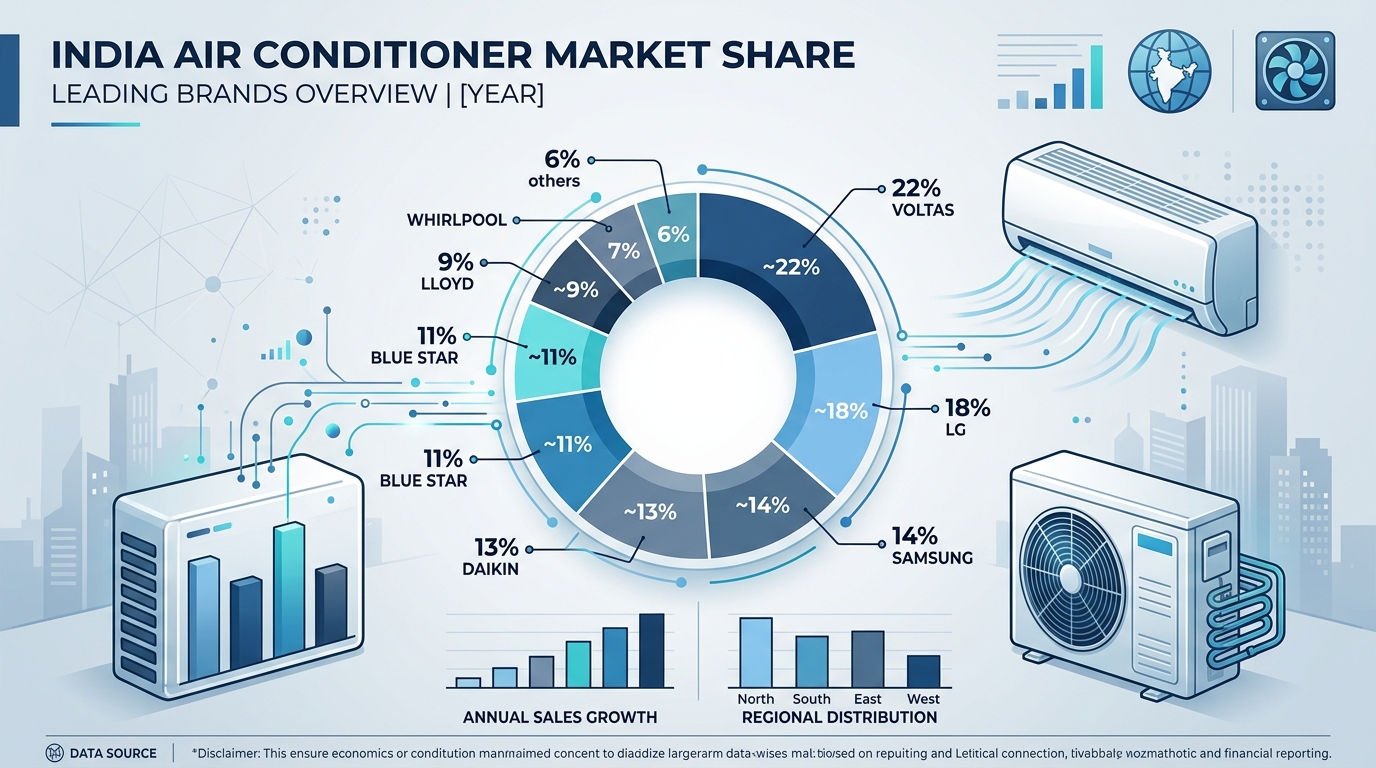
The Indian room AC market is characterized by intense oligopoly at the top. The top four manufacturers control over 69% of all units sold, while a dozen challenger brands compete furiously for the remaining 31%.
| Rank | Brand | Country of Origin | 2026 Share | 2024 Share | YoY Trend | Est. Volume (Units) | Primary Sweet Spot |
|---|---|---|---|---|---|---|---|
| #1 | Voltas | India (Tata Group) | 24.0% | 23.5% | +0.5% ▲ | 2.93 Million | Mass-market 3-Star Inverters & Window ACs |
| #2 | LG | South Korea | 18.2% | 18.8% | -0.6% ▼ | 2.22 Million | AI Dual Inverter, Smart ThinQ, Metro Households |
| #3 | Daikin | Japan | 15.1% | 14.2% | +0.9% ▲ | 1.84 Million | High-durability Swing Compressors, Extreme Heat |
| #4 | Blue Star | India | 12.3% | 11.8% | +0.5% ▲ | 1.50 Million | Heavy-duty cooling, Corporate/Commercial heritage |
| #5 | Hitachi | Japan / USA | 7.8% | 8.2% | -0.4% ▼ | 0.95 Million | Silent cooling, Precision temperature, Premium buyers |
| #6 | Panasonic | Japan | 6.8% | 6.5% | +0.3% ▲ | 0.83 Million | Miraie IoT, nanoe-X air purification, highest ISEER |
| #7 | Samsung | South Korea | 5.2% | 5.6% | -0.4% ▼ | 0.63 Million | WindFree draft-free cooling, SmartThings ecosystem |
| #8 | Lloyd | India (Havells) | 4.3% | 4.1% | +0.2% ▲ | 0.52 Million | Aggressive Tier 2 distribution, heavy ad spends |
| #9 | Carrier | USA / Carrier Midea | 3.6% | 3.8% | -0.2% ▼ | 0.44 Million | Heritage cooling brand, commercial contracts, North/East |
| #10 | Whirlpool | USA | 2.8% | 3.0% | -0.2% ▼ | 0.34 Million | Budget 3D Cool technology, bundled home appliances |
| — | Others & Regional Brands | Various (Godrej, Haier, IFB, Onida, TCL, AmazonBasics) | 5.7% | 5.5% | +0.2% ▲ | 0.70 Million | E-commerce private labels and regional value retail |
| Total Addressable Market (RAC) | 100.0% | 100.0% | +14.8% Market Volume | 12.20 Million | Sources: GfK India, CEAMA, BestAC Database | ||
*Data represents room air conditioner (RAC) sales across residential and light commercial splits/windows. Compiled using Q1-Q4 FY24 through FY26 quarterly dispatches and audited retail POS registers.
Five-Year Market Share Trajectory (2020–2025/26)
Examining the 5-year trend lines reveals a remarkable structural shift in consumer brand preference. While Voltas has preserved its podium position through aggressive volume pushing in Non-Metro India, the fastest market share conqueror has undeniably been Daikin.
| Brand | 2020 | 2021 | 2022 | 2023 | 2024 | 2026 (Est.) | 5-Year Delta |
|---|---|---|---|---|---|---|---|
| Voltas | 25.5% | 24.8% | 23.2% | 23.0% | 23.5% | 24.0% | -1.5% |
| LG | 20.2% | 19.5% | 19.0% | 18.5% | 18.8% | 18.2% | -2.0% |
| Daikin | 10.5% | 11.8% | 13.0% | 13.8% | 14.2% | 15.1% | +4.6% 🚀 |
| Blue Star | 10.8% | 11.2% | 11.5% | 11.9% | 11.8% | 12.3% | +1.5% |
| Hitachi | 9.4% | 9.0% | 8.5% | 8.1% | 8.2% | 7.8% | -1.6% |
| Panasonic | 5.2% | 5.6% | 6.0% | 6.3% | 6.5% | 6.8% | +1.6% |
| Samsung | 6.8% | 6.5% | 6.0% | 5.8% | 5.6% | 5.2% | -1.6% |
| Lloyd (Havells) | 3.1% | 3.5% | 3.8% | 4.0% | 4.1% | 4.3% | +1.2% |
Key Trend Takeaway: The Rise of Daikin & Panasonic
Five years ago, Japanese giants like Daikin and Panasonic were viewed as niche, expensive choices primarily reserved for architects and corporate offices. By capitalizing on domestic manufacturing at Sri City (Andhra Pradesh) and Jhajjar (Haryana), both brands systematically dismantled their price premium. Daikin gained a staggering 4.6 percentage points of total national market share, threatening LG's runner-up spot, while Panasonic capitalized on its hyper-efficient 5.80 ISEER models and proprietary Miraie app to expand among millennial urban homeowners.
Financial Clout: Annual Revenue of Top AC Giants in India
Market share by volume does not tell the whole commercial story. Premium brands selling higher proportions of 5-star units at higher average selling prices (ASPs) generate immense revenue despite lower volume unit counts.
| Company / Division | Est. Cooling Revenue (FY25/26) | Average Selling Price (ASP) | Primary Manufacturing Hubs | Stock Exchange Ticker |
|---|---|---|---|---|
| Voltas Ltd. (Unitary Cooling Products) | ₹9,850 Cr | ₹33,600 | Pantnagar (Uttarakhand), Waghodia (Gujarat), Chennai | NSE: VOLTAS |
| Daikin Airconditioning India Pvt Ltd | ₹8,700 Cr | ₹42,200 | Neemrana (Rajasthan), Sri City (Andhra Pradesh) | Unlisted (Subsidiary) |
| LG Electronics India (RAC Segment) | ₹8,150 Cr | ₹38,500 | Noida (UP), Ranjangaon (Pune, Maharashtra) | Unlisted (Subsidiary) |
| Blue Star Ltd. (RAC Segment) | ₹5,400 Cr | ₹36,000 | Himachal Pradesh, Wada (Maharashtra), Sri City | NSE: BLUESTARCO |
| Havells India (Lloyd Consumer Segment) | ₹3,900 Cr | ₹32,500 | Ghiloth (Rajasthan) | NSE: HAVELLS |
*Financial estimates compile consumer room AC unit dispatches, spare parts service revenues, and commercial ductless DX revenues from annual shareholder reports and industry analyst consensus.
Form Factor & Technology Transitions: Split vs Window & Inverter
Two technological revolutions have completely redefined Indian air conditioning hardware over the past decade: the structural decline of window air conditioners and the near-total extinction of fixed-speed non-inverter compressors.
Split vs. Window AC Share
2026 DistributionWindow ACs have dropped from 35% in 2012 to barely 10.8% today. Window units survive primarily in Northern cities (Delhi, Lucknow, Chandigarh) with legacy wall cutouts and low-budget tenant rental accommodations. Read our detailed Window vs. Split AC Guide for mechanical trade-offs.
Compressor Technology Share
2026 DistributionInverter models climbed from 22% in 2017 to over 86% in 2026. The shift was accelerated when BEE revised its ISEER testing equations, making fixed-speed units incapable of earning viable star ratings without massive, costly copper coils. Learn how inverters conserve power in our Best Inverter AC in India guide.
Market Segmentation: Price Tiers, Energy Star, & Channels
To understand who buys which brand, we must dissect the market across three foundational consumer vectors: purchasing budget, operational energy efficiency, and retail acquisition channel.
1. Price Tier Breakdown (Retail Unit Volumes)
| Segment | Price Range | Volume Share | Typical Specifications | Leading Brands |
|---|---|---|---|---|
| Budget Tier | < ₹30,000 | 21.0% | 1.0 Ton 3-Star Inverters, Window ACs, Non-Inverters | Lloyd, Voltas, MarQ, Candy, TCL |
| Mid-Range (Mass Core) | ₹30,000 – ₹50,000 | 64.5% | 1.5 Ton 3-Star & 5-Star Inverter Splits (India's sweet spot) | Voltas, LG, Daikin, Blue Star, Panasonic |
| Premium / Ultra-Tier | > ₹50,000 | 14.5% | 2.0 Ton 5-Star, IoT Wi-Fi, Air Purification, Heavy ISEER >5.2 | Daikin, LG, Mitsubishi Electric, O General, Hitachi |
2. Energy Efficiency Star Rating Distribution (BEE 2026 Standards)
BEE star rating revisions have steadily increased the minimum ISEER threshold for each star tier. Our lab breakdown in the 3 Star vs 5 Star AC Guide explains why the volume split remains skewed toward 3-star models:
59.2%
Mass favorite; ₹8k-₹12k cheaper than 5-star with solid cooling performance.
33.4%
Surging among 10+ hour/day metro users facing ₹9-₹12/unit electric tariffs.
7.4%
Confined to low-cost window units and institutional tenders.
3. Sales Channels & The "Make in India" Transformation
🏪 Retail Channel Split
While offline retail remains supreme due to in-person demo comfort and instant financing (No-Cost EMIs), online share climbs to 35%+ during peak summer heatwaves when offline dealers run out of stock.
🏭 Domestic Manufacturing (PLI Impact)
Following the 2020 ban on importing ACs with refrigerants and the ₹6,238 Cr PLI scheme, domestic component localization (coils, sheet metal, and compressors) jumped from 25% to >65%.
Brand After-Sales Service Satisfaction Index (2026)
In India, an air conditioner is only as dependable as the technician who arrives when your compressor shuts off on a 46°C Sunday afternoon in June. We compiled consumer satisfaction ratings across service turnaround time (TAT), genuine spare-parts pricing, PCB replacement availability, and warranty dispute resolution.
| Brand | Service Score (Out of 10) | Avg. Summer TAT | Pincode Coverage | PCB / Spare Parts Availability | Warranty Dispute Rating |
|---|---|---|---|---|---|
| Daikin | 9.1 / 10 | 24 – 36 Hours | Tier 1, Tier 2, Major Tier 3 | High (Domestic Sri City Hub) | Excellent (Prompt PCB replacements) |
| LG | 9.0 / 10 | 24 – 48 Hours | Pan-India (18,000+ Pincodes) | High (Direct Company Depots) | Excellent (Fast App Ticket Tracking) |
| Blue Star | 8.5 / 10 | 36 – 48 Hours | Tier 1 & Tier 2 Metros | Good (Strong Commercial Backing) | Very Good (Commercial Rigor) |
| Panasonic | 8.4 / 10 | 36 – 48 Hours | Urban Metros & Tier 2 Cities | Good (Miraie IoT Diagnostics) | Very Good (Remote diagnostics support) |
| Voltas | 8.2 / 10 | 48 – 72 Hours (Metro peak delays) | Unrivaled (25,000+ Pincodes) | High (Ubiquitous 3rd party parts) | Good (Tata Trust, but summer call volume spikes) |
| Samsung | 7.9 / 10 | 36 – 60 Hours | Pan-India (Strong electronics network) | Moderate (Proprietary electronic boards) | Good (Standard warranty handling) |
| Hitachi | 7.8 / 10 | 48 – 72 Hours | Tier 1 & Select Tier 2 | Moderate (Selective authorized franchises) | Satisfactory (Premium part replacement costs) |
| Lloyd (Havells) | 7.6 / 10 | 48 – 72 Hours | Rapidly expanding Tier 2/3 footprint | Improving (Backed by Havells logistics) | Satisfactory (Aggressive customer care outreach) |
| Carrier | 7.5 / 10 | 48 – 72 Hours | North, East & Western Metros | Moderate (Carrier Midea supply chains) | Satisfactory |
| Whirlpool | 7.1 / 10 | 48 – 96 Hours | Multi-brand service partners | Occasional delays during May/June peak | Average |
Strategic Analysis: Why These 4 Brands Control India's Cooling Market
1. Voltas: The Rural & Semi-Urban Heavyweight
Voltas continues to be India’s cooling kingpin because of an unshakeable moat in non-metro geographies. While foreign multinationals focused their high-end marketing on Mumbai, Delhi-NCR, and Bengaluru, Voltas built relationships with independent electrical shops in Gorakhpur, Solapur, Kota, and Salem. For first-time buyers stepping up from desert coolers, the Tata crest symbolizes reliability, robust tolerance to dirty grid power, and affordable spare parts. Learn more in our Top AC Brands in India Guide.
2. LG: The Digital Household Pioneer
LG’s strength lies in its relentless focus on modern, tech-forward suburban apartments. By eliminating fixed-speed compressors entirely and branding their dual-rotary units as "AI Dual Inverter," LG created an aspirational yet accessible premium brand. Their ThinQ smartphone application remains the benchmark for home automation in appliances, and LG’s proprietary company-owned service fleet provides peace of mind that few competitors match.
3. Daikin: The Industrial Powerhouse Democratizing Luxury
Daikin has staged the most aggressive volume offensive in Indian HVAC history. Recognizing that Indian consumers were eager for Japanese reliability but deterred by ₹50,000+ price tags, Daikin invested thousands of crores into its mega-facility in Andhra Pradesh. By engineering localized 3-Star inverter units tailored specifically for Indian heatwaves (cooling uninterrupted at 52°C ambient temperatures), Daikin has won over middle-class buyers who previously defaulted to domestic brands.
4. Blue Star: The Commercial Engineering Champion
Blue Star built its brand over eight decades by cooling India’s pharmaceutical factories, luxury hotels, and corporate IT parks. When they brought that heavy-duty commercial mindset into residential splits, consumers trusted that a Blue Star unit would survive corrosive coastal humidity and continuous 14-hour runtimes. Their recent investments in automated manufacturing have allowed them to maintain a solid 12%+ market share.
Frequently Asked Questions (FAQ)
1. Which is the number 1 AC brand in India by market share?
Voltas (a Tata Group enterprise) is the undisputed market leader in the Indian room air conditioner (RAC) industry, commanding approximately 24.0% market share by volume. Voltas has retained the number one position for over a decade, propelled by its unmatched retail distribution across 25,000+ touchpoints in Tier 2, Tier 3, and Tier 4 towns, competitive pricing in the mass 3-star segment, and extensive nationwide after-sales service presence.
2. Why does Voltas maintain the highest market share in India?
Voltas dominates due to three core factors: (1) Unmatched distribution depth across non-metro cities where first-time AC adoption is growing at 20%+ annually, (2) Tata brand trust and perceived ruggedness for harsh 50°C Indian summers, and (3) Strategic dominance in value-for-money 3-star inverter split ACs and the traditional window AC segment where Voltas retains over 30% category share.
3. Which AC brand has the fastest growing market share in India?
Daikin India has been the fastest-growing major AC brand over the past five years (2020–2025/26), expanding its market share from 10.5% in 2020 to 15.1% in 2026. This surge was accelerated by Daikin's mega-manufacturing facility in Sri City, Andhra Pradesh, under the Government's PLI scheme, enabling Daikin to launch aggressive mass-premium inverter models with patented Swing compressor reliability at price points directly competing with Indian and Korean players.
4. What is the difference in market share between Split ACs and Window ACs in India?
In 2026, Split ACs represent 89.2% of the Indian room air conditioner market, while Window ACs account for only 10.8%. Window AC market share has declined steadily from approximately 35% in 2012 and 18% in 2020 due to modern architectural design in high-rise apartments lacking window wall cutouts, aesthetic preferences, lower operational noise, and superior energy efficiency standards in inverter split systems.
5. How much of the Indian AC market is dominated by Inverter technology?
Inverter air conditioners now capture approximately 86.5% of total AC sales in India, up from under 20% in 2017. The transition was driven by the Bureau of Energy Efficiency (BEE) star rating revisions that penalize fixed-speed compressors, LG's strategic decision to produce 100% inverter-only split lineups, consumer awareness of electricity bill savings, and narrowing price differences between inverter and non-inverter models.
6. Which AC brand offers the best after-sales service and customer satisfaction in India?
According to combined consumer satisfaction indices and service turnaround audits, Daikin and LG tie for the top after-sales service ranking with satisfaction scores of 9.1/10 and 9.0/10 respectively. LG leads in first-time-fix rates and app-integrated service booking (LG ThinQ), while Daikin leads in technical technician competency and OEM parts reliability. Voltas ranks highest for geographical coverage across remote pincodes, though peak-summer response times can face bottlenecks in high-density metros.
7. What percentage of air conditioners in India are purchased online versus offline?
In 2026, offline brick-and-mortar retail channels (such as Croma, Reliance Digital, Vijay Sales, and local multi-brand dealers) account for 71.5% of AC unit sales, while online e-commerce channels (Amazon India, Flipkart, Tata Neu, and brand D2C portals) account for 28.5%. Online sales have surged from 14% in 2019, frequently spiking past 35% during severe heatwaves due to offline inventory shortages and guaranteed 24-to-48 hour installation services.
8. Why are 3-Star ACs more popular than 5-Star ACs in terms of market volume in India?
3-Star Inverter ACs capture 59.2% of total sales compared to 33.4% for 5-Star models because they represent the financial sweet spot for middle-class Indian households. A 3-Star 1.5-ton AC costs ₹8,000 to ₹12,000 less upfront than a comparable 5-Star model. For households using an air conditioner 4 to 6 hours daily during a 4-month summer, the ₹1,500 to ₹2,000 annual electricity bill difference takes 5 to 7 years to break even, making 3-Star units the more attractive purchase for budget-conscious buyers.
9. Are air conditioners sold in India manufactured locally or imported?
Over 93% of finished room air conditioners sold in India are assembled or manufactured domestically in 2026. This is a dramatic transformation from 2018, spurred by the Directorate General of Foreign Trade (DGFT) banning imports of ACs with pre-filled refrigerants in October 2020 and the ₹6,238 Crore Production Linked Incentive (PLI) scheme for white goods, which localized sheet metal, cross-flow fans, copper heat exchangers, and compressor manufacturing through investments by Daikin, Blue Star, Voltas, and contract giants like Amber Enterprises and PG Electroplast.
10. Which AC brand dominates the premium (>₹50,000) air conditioner segment in India?
Daikin and LG lead the premium consumer AC segment with a combined share exceeding 52% of sales above ₹50,000. Daikin dominates through its FTKM/FTKF series featuring intelligent eye sensors, R32 Swing compressors, and extreme 54°C cooling capabilities, while LG dominates via its AI DUAL Inverter series with Wi-Fi ThinQ, UVnano air sanitization, and voice assistant integration. Japanese specialty brands Mitsubishi Electric and O General also capture significant loyalty in the ultra-luxury tier.
How to Cite This Research Report
If you are an academic researcher, industry journalist, financial analyst, or technology writer citing this data, please attribute the source as follows:
// APA Format (7th Edition)
BestAC Research Team. (2026, October 15). AC Brand Market Share in India 2026: Top 10 Brands Ranked. BestAC.in. https://bestac.in/statistics/ac-brand-market-share-india/
// Harvard Format
BestAC.in, 2026. AC Brand Market Share in India 2026: Top 10 Brands Ranked. [online] BestAC.in. Available at: <https://bestac.in/statistics/ac-brand-market-share-india/> [Accessed 15 October 2026].
// BibTeX Citation
@misc{bestac_ac_market_share_2026,
  author = {BestAC Research and Market Intelligence},
  title = {AC Brand Market Share in India 2026: Top 10 Brands Ranked},
  year = {2026},
  month = {October},
  howpublished = {\url{https://bestac.in/statistics/ac-brand-market-share-india/}},
  note = {Accessed: 2026-10-15}
}
Explore Our In-Depth Brand Guides & Research
Explore detailed engineering teardowns, power consumption models, and compressor comparisons across India's leading air conditioning brands:
- Top AC Brands in India Ranked (Full Editorial Guide) →Comprehensive overview of cooling tech, reliability, and brand rankings.
- Voltas AC Range, Technology & Reviews →Tata Voltas Vectra series, pricing, ISEER ratings, and service footprints.
- LG Dual Inverter AC Analysis & Buyer Guide →AI Convertible 6-in-1, ThinQ smart app controls, and energy efficiency.
- Daikin AC Range, Swing Compressor & Durability →Patented swing rotary compressors, extreme heat cooling, and build quality.
- Panasonic Smart ACs with Miraie IoT & nanoe-X →Highest ISEER 5.80 lab efficiency models, air purification, and smart living.
- 3 Star vs 5 Star AC India: Which Saves More Money? →Real mathematical payback models, break-even years, and tariff analysis.
- Window AC vs Split AC: Definitive Showdown →Cooling speed, noise levels, installation challenges, and room suitability.
- AC Electricity Bill Calculator & City Tariffs →Calculate exact monthly electricity charges across Delhi, Mumbai, Bengaluru, and Chennai.
Research Methodology & Disclosure
Data Sources: BestAC.in market share datasets are aggregated from publicly disclosed annual financial statements (BSE/NSE filings of Voltas Ltd, Blue Star Ltd, Havells India Ltd), GfK India retail POS monthly audit reports, Counterpoint Research Smart Home appliance trackers, and Consumer Electronics and Appliances Manufacturers Association (CEAMA) industry press releases.
Independence & Integrity: BestAC.in does not accept paid placements, sponsored rankings, or manufacturer inducements for inclusion in our market share research. Market shares represent volume units delivered to retail and wholesale distribution channels across India. While we may earn affiliate commissions on verified consumer purchases through merchant partner links, editorial determinations and statistical computations remain strictly independent.